

The North Berwick Golf Club (West Links)
East Lothian, Scotland
United Kingdom
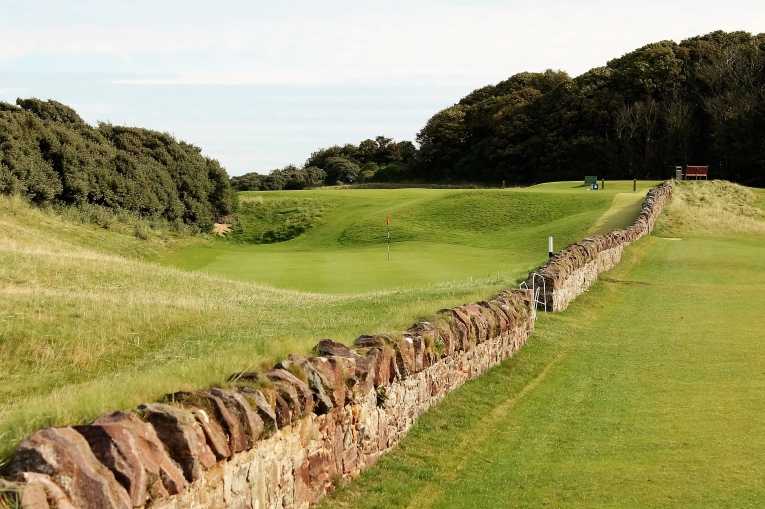
Some of the game’s finest, most singular holes populate the West Links at North Berwick. Put a different way, North Berwick possesses as many shots as any course in the world whereby the golfer would like to take a small bucket of balls and keep experimenting until he gets the shots just right.
Of all the joys derived from playing over ancient links, what’s most appreciated by this writer are those obstacles and conundrums that don’t exist elsewhere. Therefore, rather than feeling old and musty, a course like North Berwick, where golf has been played for several hundred years, feels fresh and invigorating. Indeed, North Berwick is a stark and timeless reminder that the attributes that are most important to golf course design are ones that stimulate creativity rather than stifle it. After the dark period that covered the second half of the last century when golf course architecture veered down a soulless path of examination rather than enjoyment, North Berwick happily stands at the other end of the spectrum reminding the player that golf is a game to be enjoyed by as many people as possible.
Numerous factors go into making a course satisfying to play but getting that elusive balance between enjoyment and challenge is the trick. Time has shown that the most telling factors in determining a course’s worth are its setting, climate/soil conditions and collection of holes. North Berwick scores so uncommonly high on all counts that for many well-traveled golfers, it stands as one of their handful of favorites anywhere in world golf.
North Berwick is an exhilarating place to find oneself with or without clubs; the links setting is sublime and runs predominately west-east along the Forth coastline. An out and back routing with the ninth green at the far end of the property might sound a bit pedestrian but North Berwick enjoys the twist of being a loose figure 8 routing. The first three holes hug the coast before the golf darts inland at the short fourth. It returns to the shoreline at the eleventh green and the fourteenth green is as close to the beach as any hole in the United Kingdom. While the final four holes meander inland, none are the worse for it.
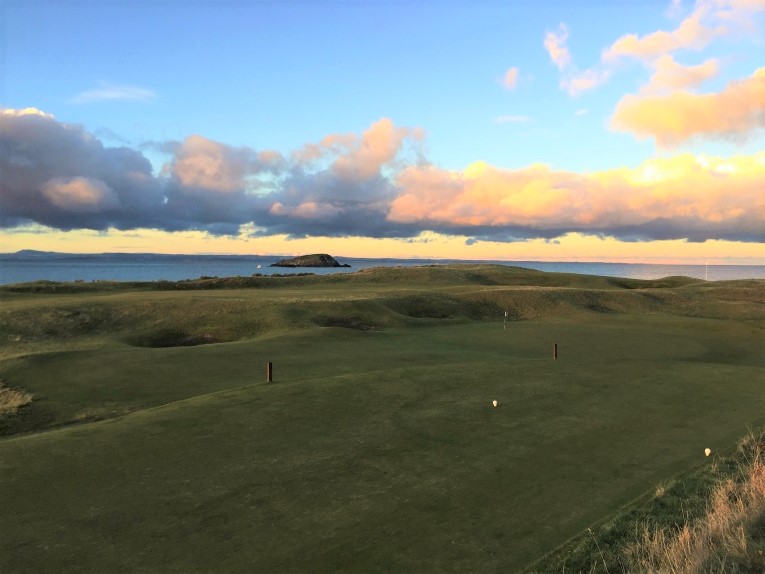
The irregular coastline jogs inland 1,300 yards from the first tee. Though the ribbon of property here measures less than 90 yards wide, mighty fine golf abounds. Seen above is the fifth tee, fourth green nestled low in the dunes and the humpy bumpy fourteenth fairway.
Eight holes are strung along the coast and on several of them (e.g. the 1st, 2nd, 14th) it is all too easy to deposit one’s ball onto the beach, so interwoven is the golf with the shoreline. Enchanting coastal views over the Firth of Forth to the lighthouse on Fidra and Bass Rock are afforded and the golfer is also frequently treated to the sight of numerous vessels, ranging from small fishing boats to clipper ships and massive frigates. Interior scenery is mesmerizing in its own right as it includes the massive ‘summer homes’ (a.k.a. mansions) which are part of the town that borders the southern perimeter of the course.
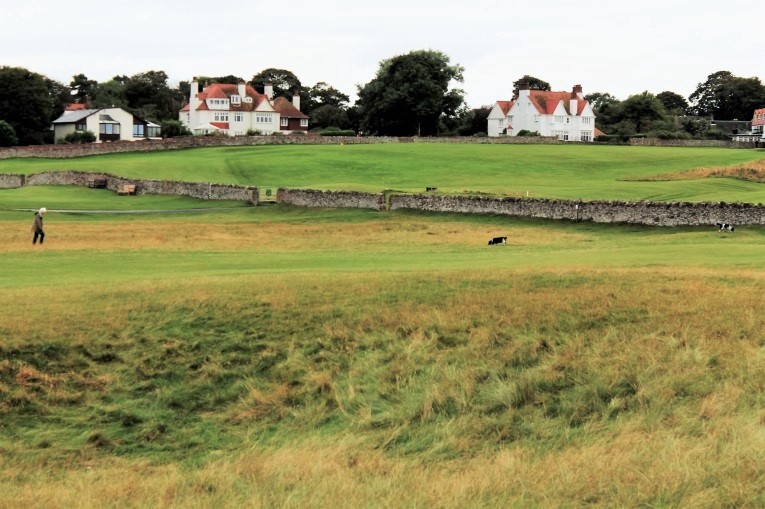
A lady walks her dogs along the common ground near the wall at the third.
Even if the Old Grump is solely focused on the golf, the crumpled landscape and sandy soils are bound to bring a glimmer of a smile. After all, these are optimal conditions for golf and the cagey veteran has every option at his disposal over these fast-playing surfaces, from low bullets along the ground to high soft shots bristling with spin nipped from the tight fescue.
As for the holes themselves, the game’s most copied hole – The Redan – originated here but it is just one of many holes of abundant merit. The variety of holes is inexorably linked to the variety of obstacles: the beach, stonewalls, dunes, scandalously contoured greens, burns, bunkers more properly called pits, holidayers heading across the course to the beach, a parking lot – you name it, they are found at North Berwick and the golfer has to deal with them all.
Well, almost all, what is missing for the most part is deep, choking rough. There are no long, forced carries over thick sea grasses nor is the golfer likely to waste much time with his head down, hacking through tall grass in search of his ball. What a blessing, the pace of play is maintained. The starter’s hut proclaims, ‘A round of golf should not take more than 3 hours.’ Thus, the enjoyment of the game soars.
How does Berwick challenge the better golfer? Wind and the elements are always a factor in this coastal setting and the linksland guarantees few level stances. More particularly, like Pinehurst No.2 and St. Andrews, the principal answer is found around Berwick’s green complexes, which fit their holes perfectly. For instance, the short par four first hole’s green appears to be sliding off a cliff top. Respecting the par four third’s length, its open green is more approachable in a field. The medium length seventh green is over a burn. Trouble is proportional to the hole’s length. In addition to their positioning, the greens feature some of the boldest contours in the British Isles and treacherous hole locations like those close to the wall on thirteen, front left on fourteen, or front right on fifteen ramp up the challenge even for the very best.
According to the club’s informative web site, www.northberwickgolfclub.com, golf has been played here since the 1700s, beginning with people batting balls about the dunescape. The club was formed in 1832 and opened with six holes, all to the east of the March Dyke, the burn that crosses today’s third and sixteenth fairways. A seventh hole was soon jammed into that small parcel but proved to be of no lasting merit. In 1868, the club’s first expansion westward occurred and that marked the birth of the Redan green complex. In 1877, the course was again stretched west and became 18 holes, albeit less than 4,900 yards because the club’s property ended east of the burn that fronts today’s seventh green. Seven of the eighteen holes were under 200 yards and no one confused the course with one of the greats. Finally, Ben Sayer was given the go ahead in 1895 to build today’s eighth through eleventh holes over an expansive tract of land. Three of those holes are proper par 5s and the course was stretched to over 6,000 yards. Today’s 6,505 yard course enjoys the same configuration, so a version of all of today’s holes has been in play for approximately 120 years.
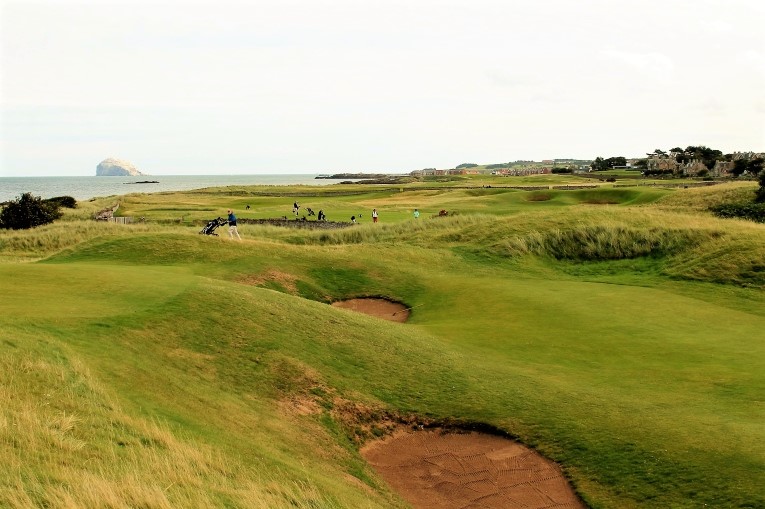
Invariably, the more ‘unique’ challenges are found on the more convoluted land, which is to say the eastern half, closer to the clubhouse.
There was nothing static about the course’s evolution. Greens and tees have been moved as the club regularly adapted to changes in technology. Even the famous Redan began life as a two shotter (!) and the infamous second hump to the sixteenth green was makes the hole flourish wasn’t added until 1895. Whatever missteps were made along the way were invariably corrected and the course today is the best it has ever been. A slew of thought-producing holes greet the golfer, as we see below. For many, the collection of holes strikes the perfect equilibrium between being thoroughly engaging without ever bludgeoning the golfer into submission.
Holes to Note
First hole, 320 yards, Point Garry (out); The game gets underway quickly. The first and second holes are a microcosm of the challenges of North Berwick, alternating between quirk and convention. The first is eccentric, requiring as little as a mid-iron tee shot to lay up short of a public foot path that cuts across the fairway heading toward the beach. The approach is a blind short iron to a cliff top green that slopes savagely away from high left to low right. Perhaps, one could quibble that it would be better if this half-par hole fell later in the round? Given that there isn’t a practice area, it is too daunting for the tiger to attempt to drive the green with the first swing of the day. Later in the round after loosening up, the author reckons more heroic deeds – and disasters – would occur.
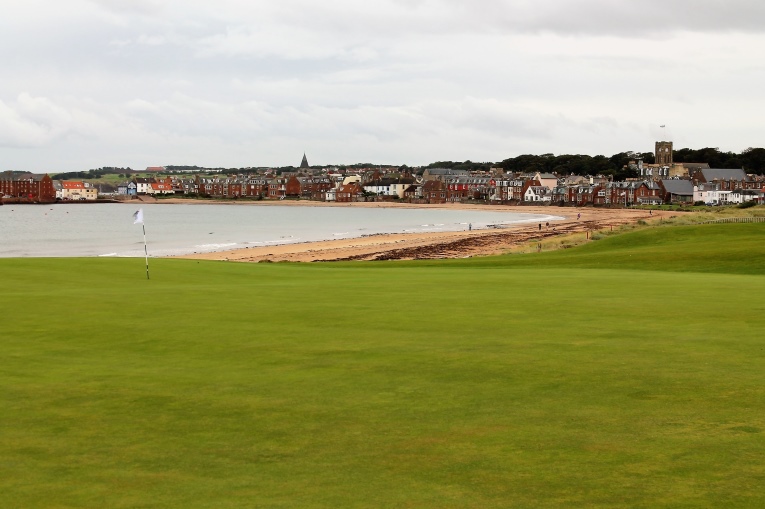
The bewitching town of North Berwick is appreciated in this view back across the elevated massive 1st green which stretches out of view on each side of the photograph. Similar to the predicaments posed by the greens at The Old Course and Yale, getting one’s approach close to the hole on a prodigiously large 11,650 square foot green is curiously difficult.
Second hole, 430 yards, Sea; As one of the more underrated holes in world golf, this classic dogleg deserves more recognition. Its tee is set high above the beach and the fairway follows the curve of the shore. Slicing one’s tee ball onto the beach is all too easy and the beach is treated as a lateral water hazard rather than out of bounds. Recovery from the beach is often possible making the hole even more engaging. If the golfer takes on the challenge of the dogleg, he is rewarded with a shorter and simpler approach. For those less daring (especially on a windy day from such an exposed tee), the approach might be a blind 3 wood from the adjacent seventeenth fairway. Golf architect Benjamin Warren, who grew up playing North Berwick, relates this story: ‘As I travel the world studying classic golf design, strands of North Berwick’s D.N.A. turn up in remarkable places. My most memorable discovery was in Japan. As my playing partners and I traversed the broad up-and-over landform to the first green at Tokyo Golf Club I sensed a familiar quality. Setting eyes on the Cape hole 2nd it became clear that I was playing a one-two combo straight out of the West Links playbook. My playing partner, noted Japanese golf historian Kazunori Ōtsuka, turned with a glint in his eye and said simply, “Kōmyo Ōtani was fond of North Berwick.” It was clear he’d waited a long time to share this nugget with a native of the venerable links. Never one to learn from my mistakes, I proceeded to bite off too much with my tee shot and came a cropper on Tokyo’s version of West Sands Beach.’ Yes, indeed, North Berwick is not only a blast to play today but it has shaped the direction of golf course design around the world.
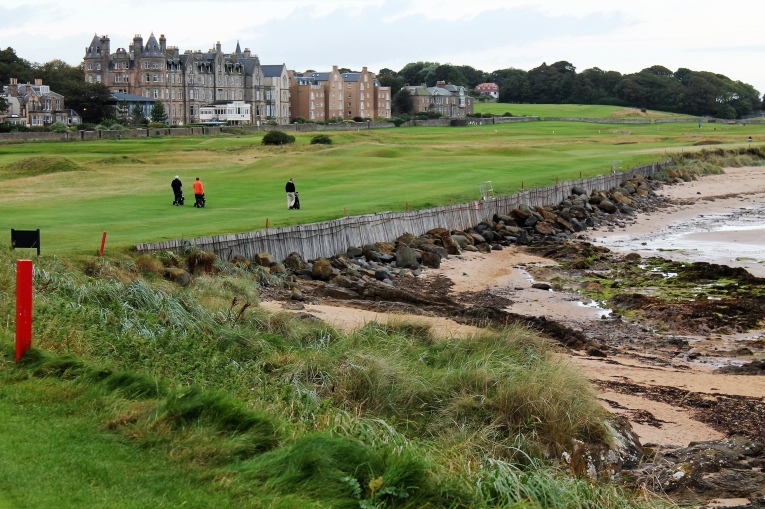
North Berwick is far from a one trick pony – the 2nd is the first of eight holes that could rightly be deemed world class.
Third hole, 475 yards, Trap; Visitors might be dazzled by the stonewall that crosses the fairway 100 yards shy of the green but members treasure this hole for its putting surface. Indeed, many contend it’s the finest on the course, which is just another example of why the Scots are universally acknowledged as having the world’s highest golf I.Q. An open approach to the front of the green gives way to a rumpled putting surface that is nothing more than an extension of the fairway. Random puffs, dips, and bowls make up the green and impart countless interesting hole locations like the particularly vexing one on the back high left plateau pictured below.
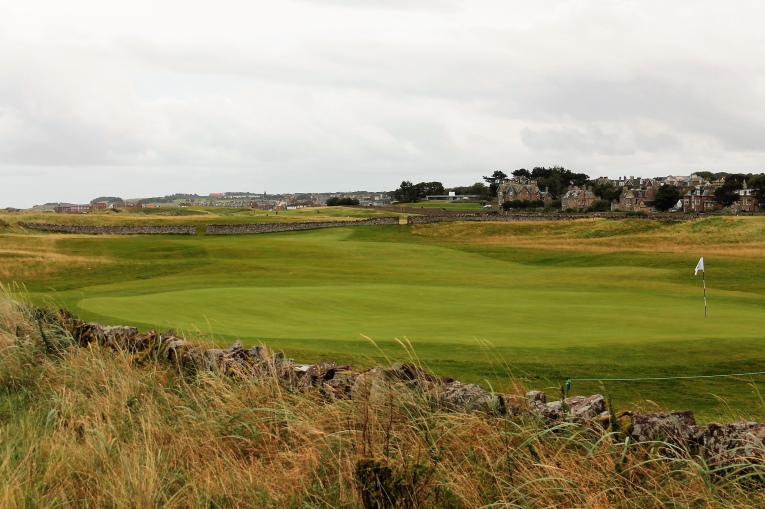
As seen from behind, the much beloved putting surface of the 3rd.
Fourth hole, 180 yards, Carlekemp; The Redan gobbles up all the attention as the one shotter, robbing any hope that the quartet of par 3s at North Berwick will ever get their just due. One knock on them is that they all fall into the relatively tight window of between 160 to 190 yards in length but they head in different directions so the statistically inclined need to bear that in mind before they sniff too loudly. Aside from length, they are remarkably diverse. For instance, the long, skinny, sunken fourth green is a wildly different target to the tenth, which sits on a plateau and falls away on all sides.

Snuggled low between two dune lines, the 4th green is much longer (38 paces) than it is wide (17 paces). Hole locations can impact club selection on the tee by up to four clubs.
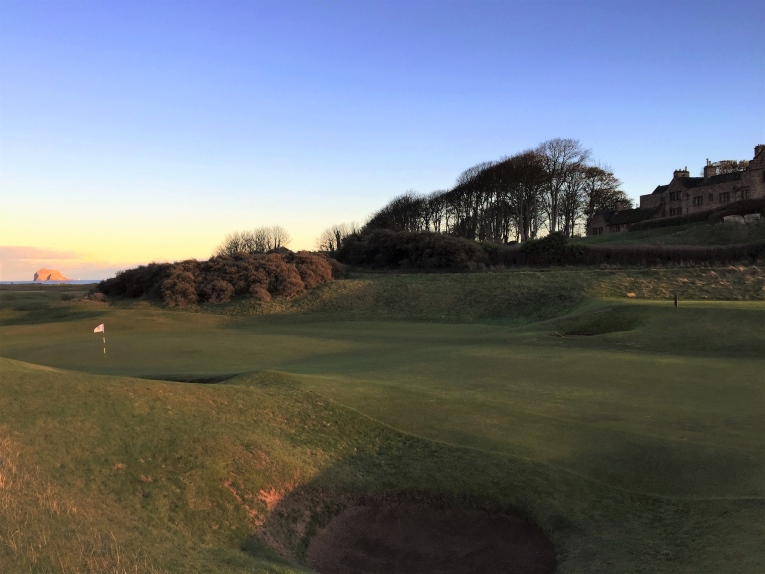
As the course pivots inland, century old summer homes lord over play.
Sixth hole, 160 yards, Quarry; Though shorter at the time, what a beast this hole must have been at its birth in 1877. Armed with a gutta percha and hickory, woe befell the golfer who didn’t clear the pit that walls off the front of the green. A successful recovery from the abyss by splaying open the face of the equivalent of today’s nine iron would have been remote.

Imagine trying to recover from this twelve foot deep hazard with a niblick!
Seventh hole, 365 yards, Eil Burn; The original incarnation of this hole (the tenth at one point) had the green before the burn and indicates just how short some of the holes were. Ben Sayer moved it across the Eil Burn in 1895. Presumably, he also deserves congratulations for the green’s interior contours, which are some of the best on the course.

Located across a burn, the large and rolling 7th green elicits many three putts. The open expanse seen beyond the green is where the last four holes were added, three of which are par 5’s. Give Ben Sayer credit for shrewdly chewing up the less interesting land with longer holes.
Ninth hole, 520 yards, Mizzentop; The course’s evolution over nearly two centuries was based on extending the course westward. Similar to Prestwick, it shouldn’t come as a surprise that the most recently added ground isn’t as rumpled as what was originally identified as being ideal for golf. Here is where the hand of man is most welcomed and indeed required. In the case of the ninth, two central bunkers dug out and created by man ‘make’ the hole. A golfer eager to reach the green in two attempts skirting them left to shorten his approach to the green, neatly tucked into a dune ahead. Alas, similar to the beloved ninth at Muirfield, just up the road, out of bounds lurks left and creates playing tension.
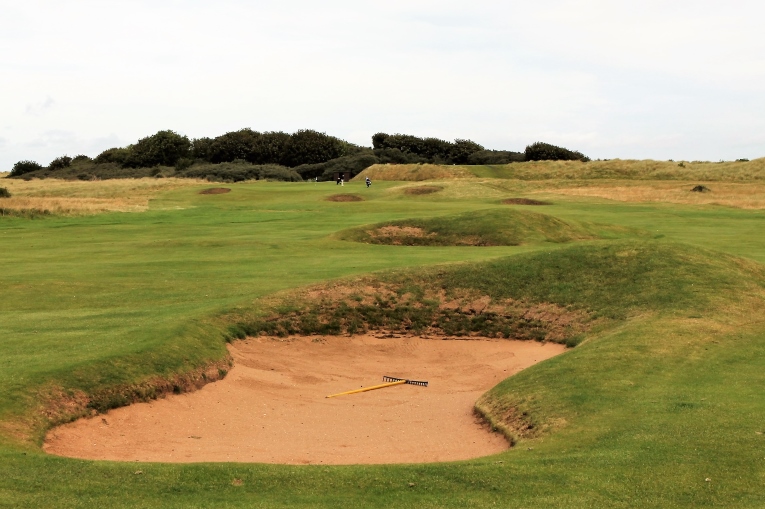
With out of bounds thirty paces to the left, brave is the man who aims his tee ball between the boundary and this pair of central hazards.
Eleventh hole, 545 yards, Bos’ns Locker; Some courses of this lineage suffer from playing corridors that are a bit too straightforward. Not here, where the playing angles are first rate, including the subtle ones found at this hole where a pair of right fairway bunkers guard the ideal angle into the long narrow green that best accepts shots from the right side of the fairway. The last sixty yards of the hole house three well-positioned bunkers whose effects are amplified by the short, tight running conditions. According to Warren, ‘The approach to the par 5 eleventh in an exacting challenge for the scratch golfer. With a following wind and firm ’n fast conditions, the key feature the golfer must utilise is a diagonal kick board ridge running eighty yards into the fairway from the green. Its re-directional properties must be employed if the golfer is to have any chance of holding the green surface with a long iron or fairway wood. The margin for error is tiny. Before the ridge lies a broad swale that is blind to the golfer and strewn with hummocks and bunkers that wait to deflect/consume the deficient stroke. Watching your approach careen out of the swale, skip left on the kick board and work slowly left-to-right towards the flag is cause for celebration. The seasoned West Links golfer knows the alternate outcomes only too well: overcook the right-to-left shape and a vertiginous pot bunker awaits short left; hit the ridge on the fly and you’re back in the swale; carry it too far or hit the dreaded straight ball and the flank bunker is your destination. North Berwick’s stretch features many more storied holes, but locals know that great matches and low rounds catch fire after a heroic approach at the eleventh.’

Short left, this ridge works in perfect concert with the pot bunker to penalize slightly pulled shots.
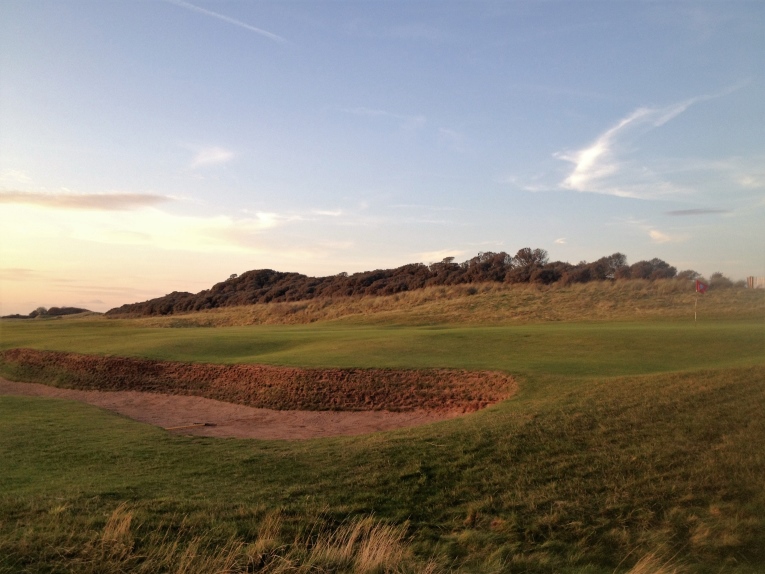
Working in tandem with those features short left of the green is this 28 yard serpentine bunker cut hard beneath the right of the green. Hidden from view, this bunker is one of the most visited hazards at North Berwick.
Twelfth hole, 400 yards, Bass; Architect and course critic, Tom Doak, has long heralded the merits of North Berwick. In 1990, he wrote this regarding the classic dogleg, ‘ The 374 yard 12th is one of the world’s best examples of just how simple golf design can be: a generic dogleg left with a critically placed pot bunker in the nook of the dogleg and another just to the right of the green, which falls away to the left, giving every advantage to the player who hugs the corner closest. It would be very interesting to watch players attack this hole on several consecutive days, steering away from the bunker at first and then gradually starting to hug the corner more and more closely, until one day they make a fatal pull into the bunker itself and begin the process all over again.’ At the time, Doak rated the course an ‘8’ on the Doak scale but having studied it more during construction of his own Renaissance course nearby, he raised the grade to a ‘9’ in Volume 1 of The Confidential Guide, which was released in 2014. To put that in perspective only two Open courses score as high or higher. Indeed, across the United Kingdom and Ireland, less than ten courses received the same lofty grade from Doak.

The twelfth epitomizes how the 6,506 yard North Berwick remain relevant despite the onslaught of technology. A new tee lengthened it by 25 yards since Doak’s 1990 description and actually decreased the walk to the tee from the prior green. Additionally, a nest of bunkers was installed in the dogleg to accommodate the greater distances that players hit it. Finally, the green is surprisingly the second smallest target on the course (behind only the thirteenth’s). When you add these three factors together, the integrity of the hole has been preserved for well over a century.
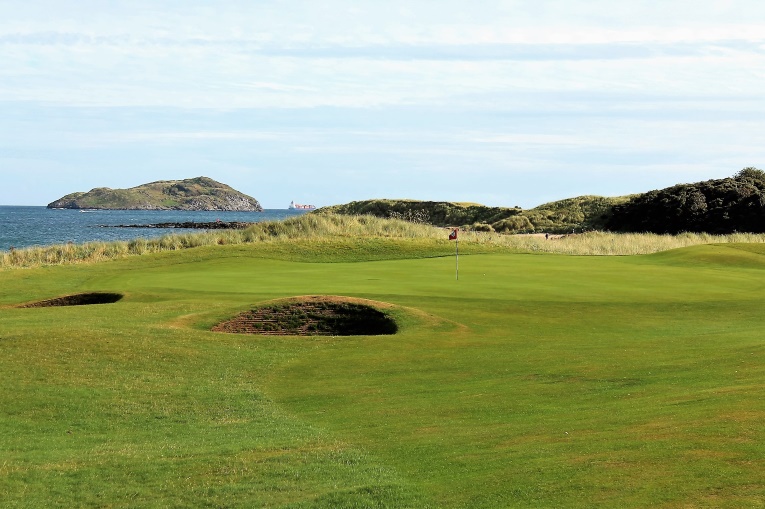
A diversity of backdrops adds to the enjoyment of a game at North Berwick. One of the prettiest is found at the twelfth.
Thirteenth hole, 385 yards, Pit; The drive is not dissimilar to that found on many links courses; the second shot is patently unique courtesy of the green’s tight placement on the other side of a three foot stonewall. Additionally, a sand dune pinches in the front left half of the green resulting in the course’s smallest target at 4,090 square foot. Getting close to hole positions near the wall is gallingly difficult, especially for the tiger who is unaccustomed to being so challenged with a short iron in hand. Those that come up short of the wall in two have a mess on their hands.
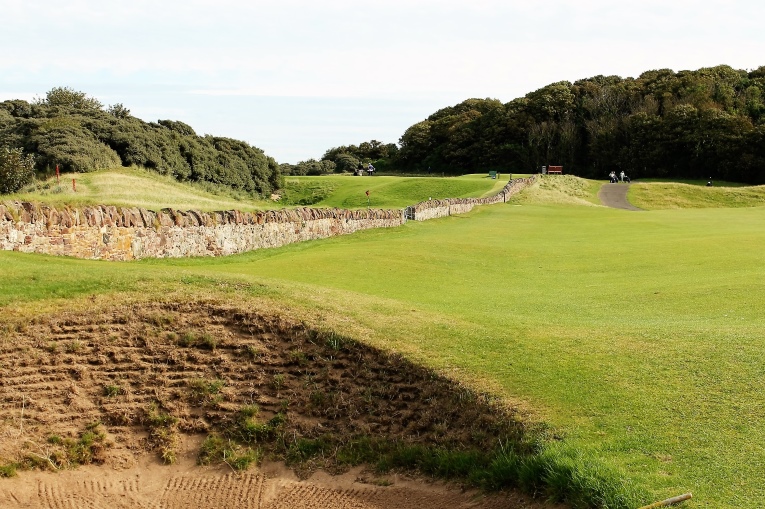
Fairway right, green left. For some this hole best highlights the joys of golf in Scotland.

Looking back down the narrow thirteenth green. Hitting the green is made all the harder by the frequent lack of visibility of the putting surface from the fairway.
Fourteenth hole, 375 yards, Perfection; The author knows of no course with three par 4s in the 375 to 400 yard range that match the quality of the thirteenth, fourteenth and sixteenth holes at North Berwick. Holes of this length are crucial to the fabric of all courses because they are within reach of all players. Yet, how can such holes be challenging for the tiger? Look no further than North Berwick for three superlative – and diverse – answers. A big moment in the course’s evolution occurred when a) this green was moved from short of today’s cross bunkers and placed out of view beyond the ridge hard along the shore and b) the next hole’s tee was brought off that same ridge and shortened to a par 3.
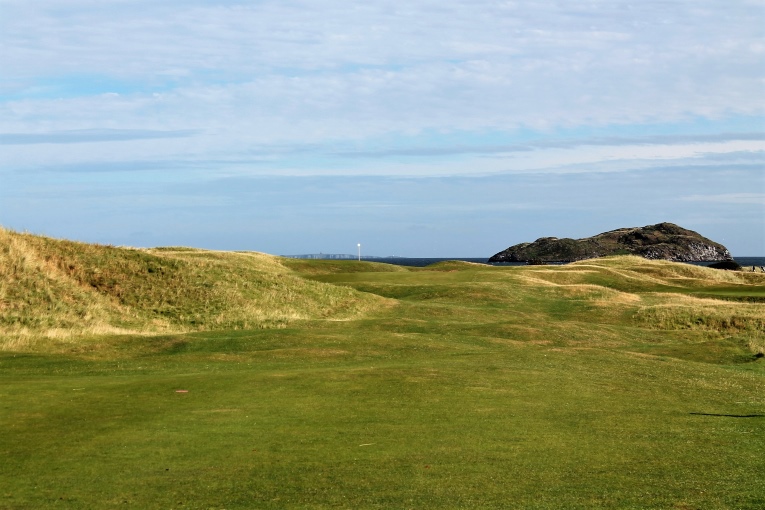
Perfection occupies the finest crumpled linksland of the club’s 180 acres.

A perfectly positioned drive nets this view of the directional marker and Bass Rock in the distance. Tours to the rock to study its world famous gannet population are available.
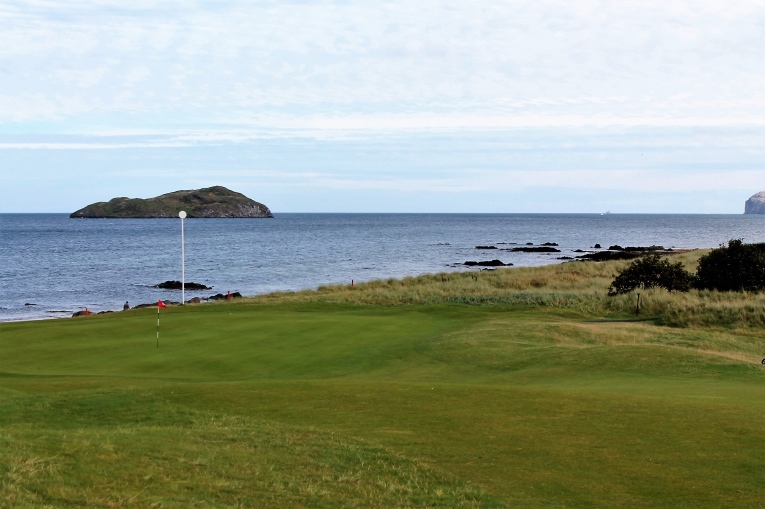
The view from a top the dune 50 yards shy of the green shows just how it races from front to back. Forward hole locations require both a deft touch and years of knowledge to work an approach close.
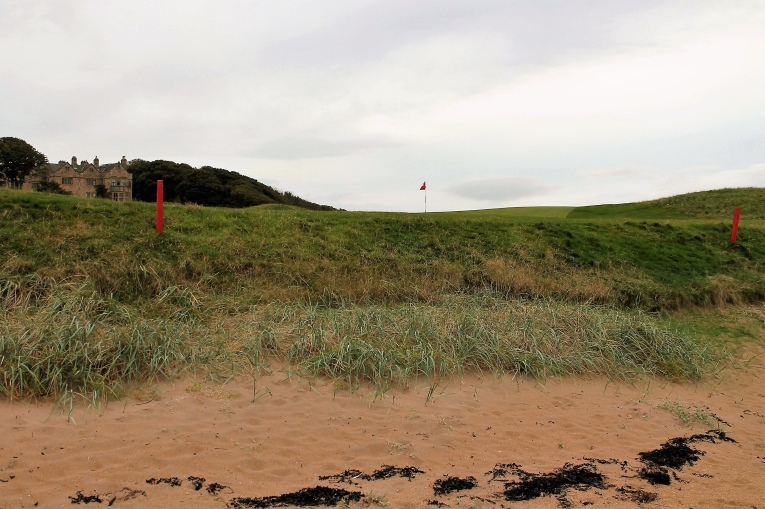
Plenty of approach shots land on the green only to be unceremoniously shunted off and over, leaving the golfer this recovery from the beach.
Fifteenth hole, 190 yards, Redan; The term Redan is borrowed from the military and means ‘guarding parapet.’ When playing this much-copied hole, the key is for the tee ball to clear the parapet and stop quickly on the green. Almost all subsequent versions provide more satisfying visuals that allow the golfer to enjoy the path of his ball as it lands and begins a tantalizingly slow sweep along the high right to back left canted putting surface. Superlative examples include the fourth at National Golf Links of America, second at Somerset Hills, and sixth at Yeamans Hall but there is no disputing the original’s place in history as well as the mystery created by the ridge thirty yards short of the green. Interestingly, when C.B. Macdonald first played here in 1872, he would have experienced the hole as a par 4 of some 265 yards. By the time he returned in the early 1900s to study holes for the construction of his National Golf Links, the Redan had morphed into a one shotter of today’s length and had become the fifteenth hole. The rest is history, literally!
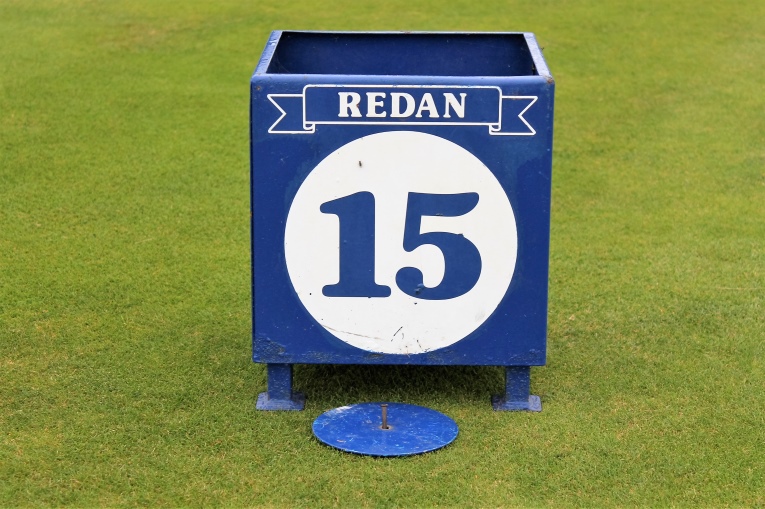
Any student’s education of architecture is incomplete prior to standing on this tee. Once here, he knows he has joined good company, given that all the titans of British architecture as well as the likes of C.B. Macdonald and A.W. Tillinghast had preceded him.
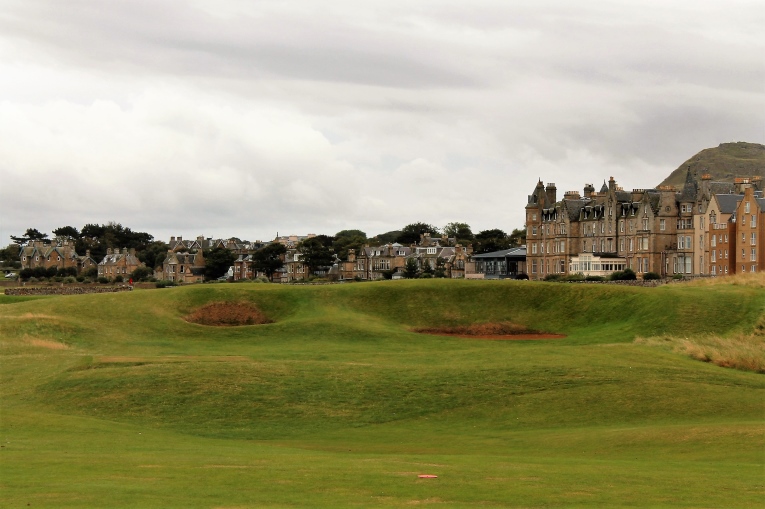
One of the most surprising first time views in golf occurs at the Redan. Few realize that the green is hidden from sight by a ridge thirty yards short of the green (the red flag can be seen just left of the forward left bunker).
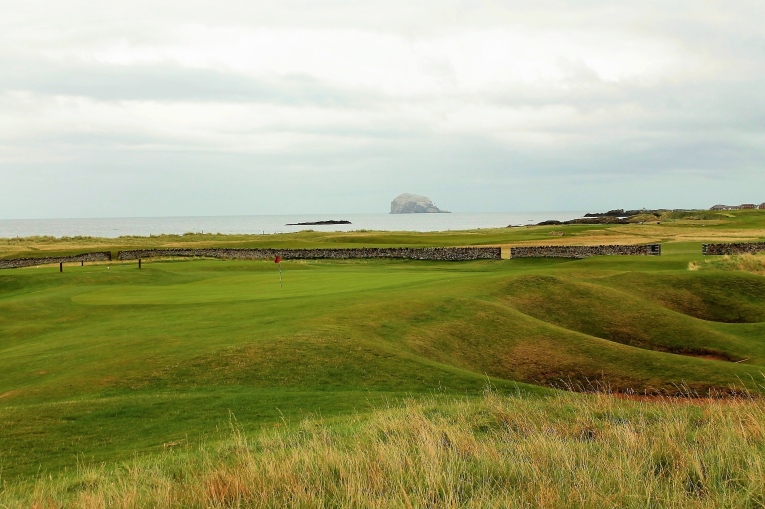
As seen from high right, the game’s most famous tilted putting surface sits majestically.
Sixteenth hole, 380 yards, Gate; A green that needs to be seen to be believed. After a drive over a stonewall (and a burn on certain days) the fun begins approaching the angled green – or greens – two upside down tea cups separated by a four foot valley. Trying to hit and hold it is one of the most fun shots in world golf. Recovery shots are equally vexing. Coming where it does near the end of the round when the nerves may be frayed, the hole is a real test of will. There are a lot of terrific sixteenth holes in the world over more dramatic land – Cypress Point, both at Cabot, Merion – but for pure entertainment, this one might be in a class by itself. Give Ben Sayer credit for boldly adding the wicked second hump. Even though the green is located in a field, the game becomes spectacular when played to such an intoxicating target.
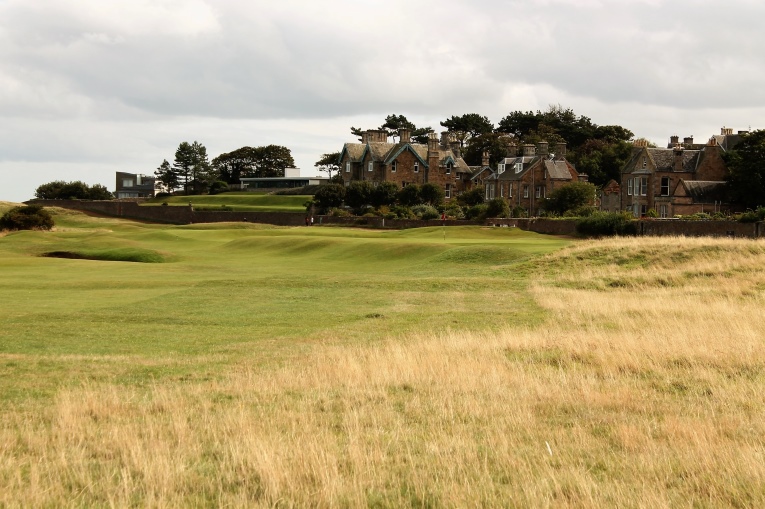
This photograph from 135 yards out only hints at the agitation posed by this one-of-a-kind green that …

… represents a shallow target from the fairway even though it is sixty paces wide! The hump in the near ground is criminally narrow at 11 paces across and the back hump that Sayer later added is a mere 14 paces.
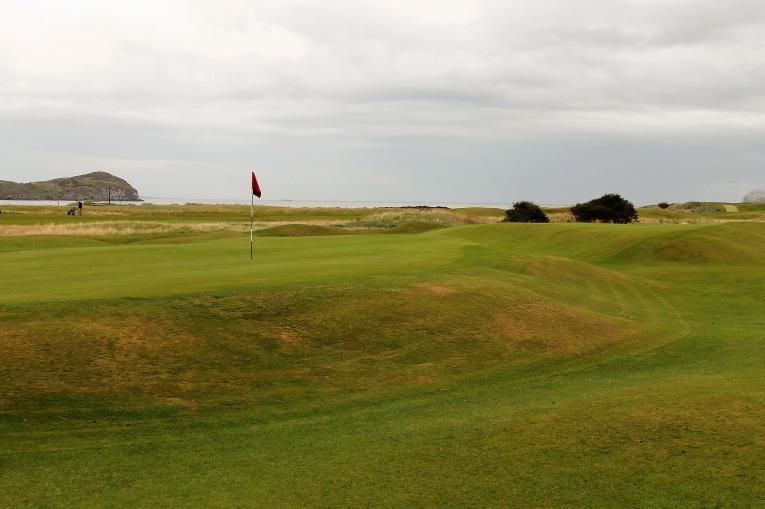
As seen from behind, only the most finely judged shots will find the ribbon of green. Otherwise, the tightly mown banks whisk balls away in all directions.
Seventeenth hole, 430 yards, Point Garry (in); The author’s favorite type of finish has the penultimate hole significantly harder than the Home hole. Warren states, ‘Seventeen is frequently overlooked in a back-nine that’s bursting with world heavyweight champion golf. A basic description such as ‘semi-blind punchbowl green on a rocky outcrop by the Firth of Forth’ would be enough to whet most taste buds, but Point Garry (In) has a layer of subtlety and strategy that merits further analysis. North Berwick’s penultimate tee shot confronts the golfer with a sea of short grass mounds punctuating a washboard fairway. The top-third of the flag is barely visible in the distance, a fluttering silhouette against the massiveness of Bass Rock. The gradual climb to Point Garry seems much farther than its scorecard entry of 428 yards. Indeed, with a sporty wind and the rock-hard midsummer conditions switching up your angle of attack can be the difference between reaching the sanctuary of the punchbowl green in regulation blows, disappearing into a cavernous sandy trench, or a 100-yard return putt from below the first green. Yet another diagonal ridge fronts a green that is marginally more receptive when approached from the left. When the course is browned out, these kind of margins turn matches. If the ridge dictates seventeen’s strategy, ‘The Horse’ enforces it. Play to its right and the golfer risks their second being stymied by an abrupt ripple in the fairway. Flatter ground and a shorter carry to the green awaits left of the horse, but if you overcook the right-to-left on that line the beach awaits!’

Benjamin Warren’s father prepares to play his tee ball at the 17th. The lumpy fairway and resulting uneven lies make the uphill approach all the more taxing.

Warren shares this photograph of the 35 yard long trench bunker that diagonally knives into the embankment upon which the saucer green sits.
Eighteenth hole, 275 yards, Home; Your heart would break if this course ended with a dull, conventional two shotter. Such is not the case and the opportunity exists for one more heroic deed on this half par hole. Played from an elevated tee, it is both short and bunkerless and can reward brute strength but if the ball fails to finish on the putting surface, a nervy chip or pitch of some sort awaits. The prying gazes in and around the clubhouse add to the drama. For the right handed player, finishing the swing strong and posting onto the left side is critical: hanging back and hitting a block won’t do as out-of-bounds looms right. As is generally true throughout the round, bold, attacking golf is encouraged. The author can’t help but dream of Seve Ballesteros playing here in his prime and what a treat it would have been to watch his brand of golf over these venerable links where imagination rules supreme.
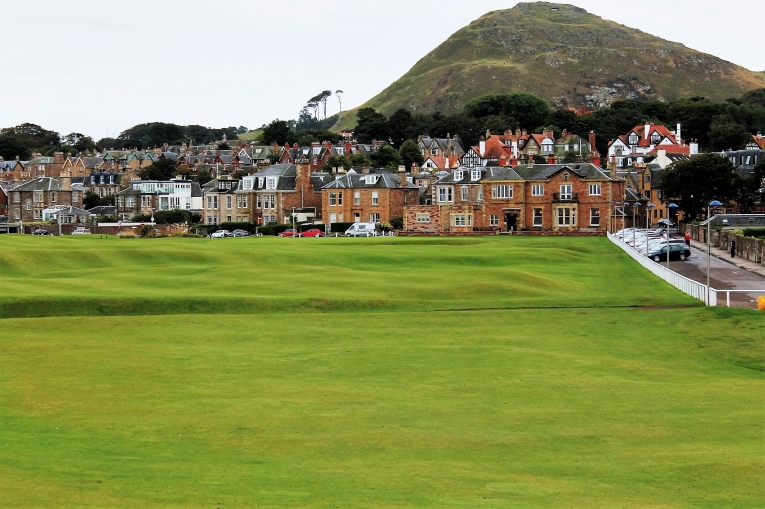
The Home hole at North Berwick is another reminder that the best undulations for golf are in the three to five foot range as opposed to massive dunes. The red flag is on the left side of the green between the two red cars behind the green. Of note is the imposing volcanic plug east of town – its presence is even sensed from the west end of the course!
Traveling golfers tend to worship courses of this ilk and a few like North Berwick, St. Enodoc and Machrihanish have crept onto GOLF Magazine’s World Top 100 rankings. That would place them in the top 25 in the United Kingdom. American GOLF Magazine panelist – and member – John Dempsey sums up his feelings this way,
What has always drawn me to North Berwick is that it represents exactly what I look for in a links. To begin with, it is near the sea, with the Firth of Forth and its various rocks and islands visible from nearly every point. The course is very pretty. Next is the variety and memorability of the holes. Even if you’ve only played the course once, you can’t help but remember the wedge up the hill on the short 1st, the magnificent view from the 11th tee, the stone wall protecting the 13th green, the wonderful Redan 15th, and the home hole that virtually begs you to birdie it on your way back to the course’s lovely little clubhouse. To me, a golf course is a special one if it makes me want to walk off the 18th green and go right back to the 1st tee looking for another game. North Berwick does exactly that. I don’t know of any course that combines great holes, great views, great times—and good old-fashioned Scottish quirkiness– as beautifully as the West Links at North Berwick. My membership there has been one of the highlights of my golfing life, and I return each summer to sample its joys.
What a great litmus test: the desire to go back for a second loop! Indeed, similar to The Old Course at St. Andrews, the Home green leaves the golfer staring at the starter’s hut and first tee wondering, ‘Should I?’ Comparison to The Old Course at St. Andrews is warranted on several other levels. First, they both begin and end in town, which is always pleasing. Second, the predominance of great holes falls on the returning nine. Indeed, for the author, the only stretch in world golf that can rival the run home from eleven on the Old Course is the final eight holes at North Berwick. Third, both front nines are full of underappreciated holes. Finally, both courses, as much as any in the world, require numerous rounds to gain even a faint idea of what is going on. North Berwick has not and will never hold The Open but on the plus side that will hopefully minimize tinkering. After all, its unique, infuriating features are what make North Berwick so compelling and most changes in modern times tend to be done with a view toward playability, a double edge sword. At over 6,500 yards, aside a windswept shore, the course is sufficiently long to be a serious challenge yet short enough to be walked comfortably in three hours. North Berwick is surely one of the most vibrant, telling museum pieces in the world and the perfect barometer for appreciating the game’s past and future. It is a living treasure to be cherished by golfers of all skill sets.
Ironically, the Brits tend to be harsher critics, sometimes dismissing North Berwick as a ‘holiday’ course. Evidently, some prefer the monotony of hay-lined fairways and brutishly long holes where only rifle straight shots suffice and power trumps finesse. Happily, such a view point is becoming less prevalent as more people cotton to the fact that golf is a game meant to stimulate the mind and improve one’s health. It is not meant to be an admonishment from a strict schoolmarm – life is too short!
Let’s leave the final words to Benjamin Warren who was so fortunate to grow up in North Berwick. He nicely summed up its allures when he writes: ‘Learning the game in North Berwick is a blessing and a curse. International golf teaches you that you live somewhere special but until you venture outside the town you expect all golf courses to have the beauty, shot values and community-integration you take for granted. You’ll quickly realise that your ground game is a potent weapon that will confound your partners and opponents. Even the least creatively minded golfer learns a trick or two lapping the West Links. The course frees up your mind to all the wonderful possibilities that exist in golf course design. I wouldn’t trade my time here for anywhere.’
Please note: the author wishes to thank David McIntosh for several of his insights and photographs in this profile.