Cabo del Sol (The Ocean Course)
Los Cabos, Mexico
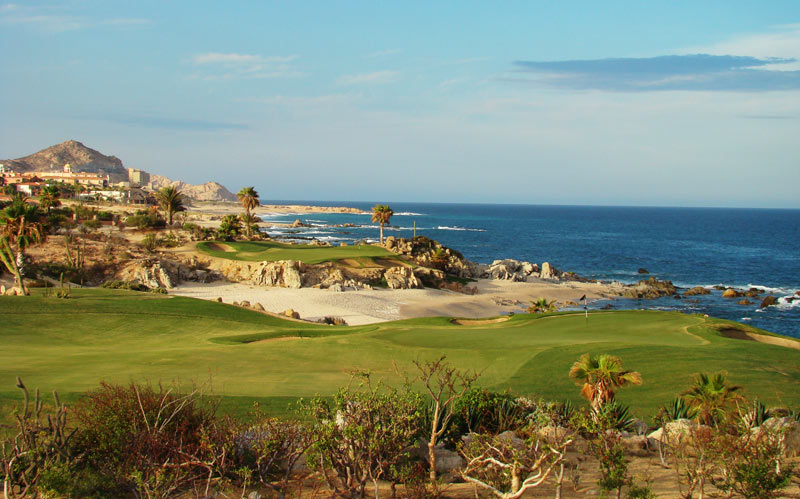
From the game’s inception along the North Sea, golf course architects have found ways to adapt to different environs. Few have done so as well as Jack Nicklaus did here along the Sea of Cortez.
Some of the key tenets of golf course design are in seeming conflict with one another. For example, holes of any great golf course have to feel that they belong together, that one leads into another as opposed to being in competition. That virtue though has to be balanced by the desire for diversity. The more varied the challenges, the more compelling the golf, provided that the course works well as a whole.
Essentially, this was the challenge that faced Jack Nicklaus and his design team led by Jim Lipe when they became involved in the Cabo del Sol project in 1990. On the one hand, Jack Nicklaus was given over 1,600 yards of sea frontage with which to work. On the other, the interior land was little more than decomposed granite with no soil or nutrients for growing grass. Various active arroyos fed down the mountain side across the resort’s 1,800 acres. In addition, the vegetation was thick and inhospitable, consisting of various cacti (including the cardon which is the largest in the world), palo blanco, palo verde, ciruela, tabachin and mequite.
How to make these seemingly incongruent elements come together was the task. If successful, Nicklaus Design would blend the appeal of several different types of golf (mountain, desert, and sea) into one eighteen hole course, a unique opportunity. Certainly, the underpinning for the course’s immediate success was the 1,600 yards of coastal frontage. Consisting of jagged granite rock formations, the coastline wasn’t linear and provided the opportunity for several tees and greens to jut (seemingly at least) into the sea. Holes were routed in crescent shapes, meaning that tee balls could be played over the rocky coastline and even over a sandy cove at the seventeenth.
Upon its opening in 1994, photographs of these ocean side holes quickly captivated the public’s imagination and Cabo del Sol has enjoyed great fanfare ever since. The six holes that feature their greens along the coastline (the fifth, sixth, seventh, sixteenth, seventeenth, and eighteenth) compel golfers to get on a plane and come to the east tip of this cabo (or cape).
Though the greens of the final three holes are no more than twenty feet above sea level, the elevation changes coupled with the arroyos and desert setting of the interior holes provide their own playing excitement. Indeed, it’s the strength of the inland holes that make this Mexico’s only world-class course. In particular, the imaginative use of the arroyos lends the inland holes a similar intense playing interest as that found with the sea holes.
Some of this drama is created for the interior holes by the use of half par holes. Overall, five (!) of the twelve interior holes can be termed as half par holes, three in the form of reachable par fives and two as drivable par fours under certain wind conditions. Although, without a doubt, trying to reach any of these greens in one shot less than regulation calls for some form of gallantry.
The par five fourth and fifteenth holes descend toward the sea and provide enticing prospects for eagles of the sort that rarely exist. They also act as an important bridge in transitioning the golfer from the higher desert holes down to the coastline ones. Pete Dye wasn’t as fortunate at Casa de Campo’s Teeth of the Dog where the interior holes play across flatter ground that didn’t yield holes of the same golf quality as his famous coastline ones. Also, the transition from the par five fourteenth to the fifteenth par four along the cliff line at Casa de Campo is much more abrupt – one moment the golfer is playing an inland hole along a lagoon and the next (after a long cart ride), he is standing on a dramatic cliff top tee. Though the golfer delights in finding himself there, there is no sense of grace as to how it was accomplished.
Nicklaus Design pulls off the transition with greater aplomb. Similar to Casa de Campo, Jack Nicklaus designed two nine-hole loops, each with several holes touching the Sea of Cortez. A par five takes the golfer from the desert to the ocean on each nine. The beauty behind such a routing plan is that it leads to a well-balanced course with spectacular holes on each side. In any such case, credit has to go to the developer for allowing Jack Nicklaus to reach the sea on both nines. Unlike other developers in the Cabo San Lucas region where some sea holes are being sacrificed for the sake of residential lots, such is patently not the case here.
When all was said and done, some of the holes captured the flavor of mountain golf with their attractive backdrops of hills and the use of arroyos (the Baja California Sur answer to mountain streams). Other holes play off the delightful contrast of the scrubby desert floor against the green prepared playing surfaces for golf. Finally, the ocean holes themselves provide the matchless exhilaration that is experienced only when the game is played next to (and over!) a large body of water.
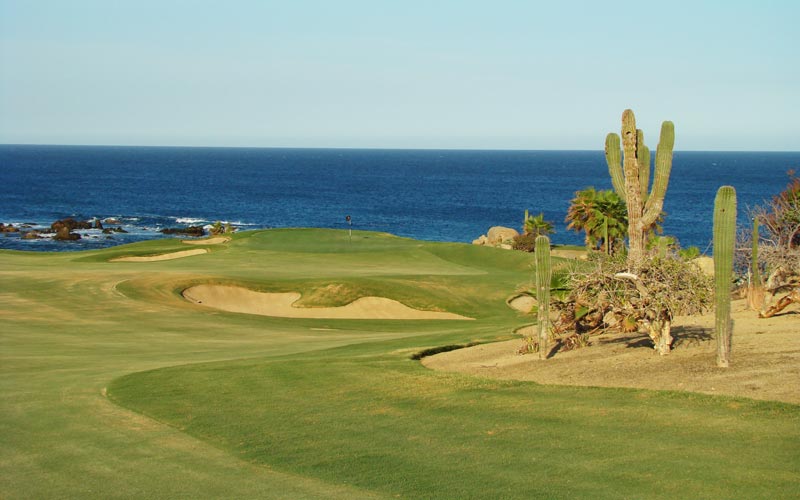
The sight of cacti framed against the vivid blue sea is unique to this part of the world. The photograph is taken 160 yards from the sixteenth green.
As seen below, Cabo del Sol and its holes are chock full of drama (!) from tee to green. The hazards, and the various manners in which they were incorporated into the holes, make Cabo del Sol visually arresting. Ultimately, though, the heart of any golf courselies its green and their surrounds. In the case of Cabo del Sol, plenty of recreational golfers leave the course thrilled by their round(s) as they are so wowed by the course’s tee to green aspect. However, specific credit is due to Jim Lipe and the rest of Nicklaus Design for the greens themselves. Take a look at the first five. The first one allows for approach shots to be kicked in from the left following the natural slope of the ground, and thus avoiding the deep right greenside bunker. The second green calls for a high pitch over a fronting center bunker to a shallow green. The third green is open in front to those that properly position their tee ball down the left side. The fourth and fifth are exact opposites with the fourth located dramatically beyond an arroyo while the fifth appears as an extension of the fairway. The greens proceed in this diverse manner, always posing a different question to the good golfer. Can he fade it into the eighth as the kidney green bends right around its greenside bunker and can he draw it around the left greenside bunker at the ninth?
Yes, the seaside holes and the interior ones with the arroyos highlight what a great opportunity/raw property Cabo del Sol represented. However, it’s the green complexes themselves that leave many critics confident in their assessment that this is Jack Nicklaus‘s best overall design. Judge for yourself as you read below.
Holes to Note
First hole, 435 yards; The first hole heads in a north-easterly direction which is to say that the mountains are on one’s left and the ocean is out of sight and to the right. That being the case, the natural slope of the first hole is from left to right. As we’ll see at the third too, this tilt was put to great use at the green. Unlike some holes built early in Jack Nicklaus‘s career that left you feeling that you needed to be Jack Nicklaus to play them properly, the first green is far more clever. Set on a forty-five degree angle to the fairway, it bends to the right around a deep front bunker. The fun is had in using the left to right tilt of the ground left of the green and all the short grass to kick approach shots onto the putting surface. Bearing in mind this is a resort course, this is but one example of how a hole was built to accommodate a wide range of playing talents.
Second hole, 575 yards; This is the only hole on Cabo del Sol that plays entirely within an arroyo. Its one hundred and ten yard wide corridor and natural bend to the right lent itself perfectly to good golf. Though the second is the longest hole on the course, the good golfer is still hoping for nothing more than a wedge approach shot.In order to obtain that, he needs to fit a 200-220 yard second shot into the elbow of the hole as it bends right 115 yards from the green. Safely onto the terrace, the golfer has a short iron in his hands and a good look at the green. However, if something has gone amiss on the first two shots, the shallow green at only twenty yards deep offers a poor target from well back in the fairway.
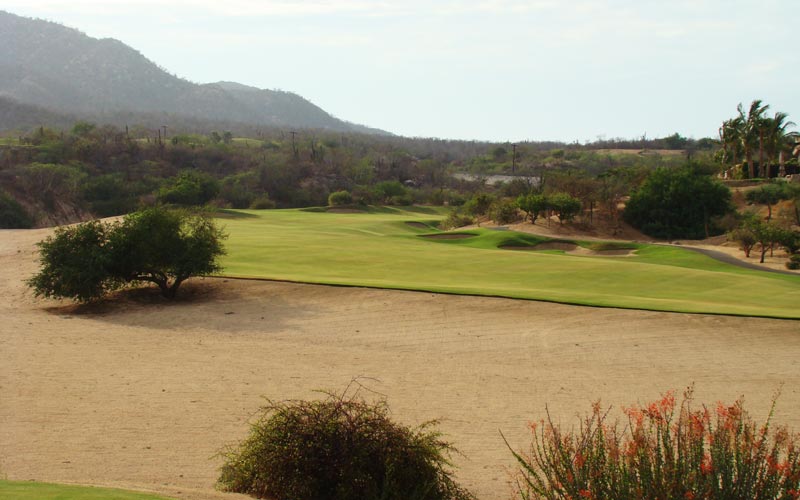
The second fairway plays within an arroyo that is thirty yards below its surrounds. As seen above, the arroyo bends to the right 460 yards from the tee. Director of Golf Greg Tallman makes the interesting observation that because the arroyo to the left of the fairway is active, the sand is quite soft and therefore penal. The golfer needs to avoid it off the tee, even if that means playing cautiously to the right.
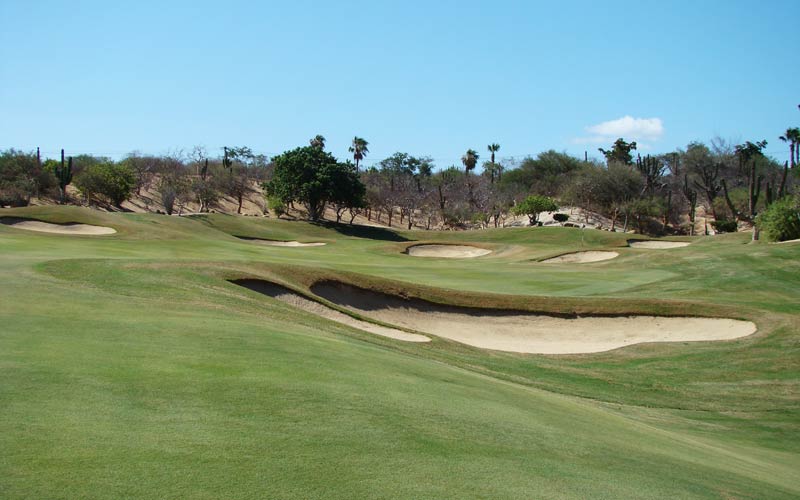
This well placed pair of bunkers divide the fairway into an upper left shelf and lower right one where the arroyo (and thus the fairway) bends to the right 115 yards from the green.
Third hole, 325 yards; Heavily influenced by the tenth at Riviera (and there is no greater compliment than that), the third has it all. Anything from a driver to a five iron has been used off the tee, depending on the day’s wind and the state of one’s game. The key playing features are the general left to right tilt of the ground, a large bunker in the left fairway 120 yards from the green, and the angled green itself which is wide but shallow and protected by a right front bunker. If anything, the burst in technology that has occurred since The Ocean Course opened has made this hole all the better/more tempting as more golfers go at the green from the tee.
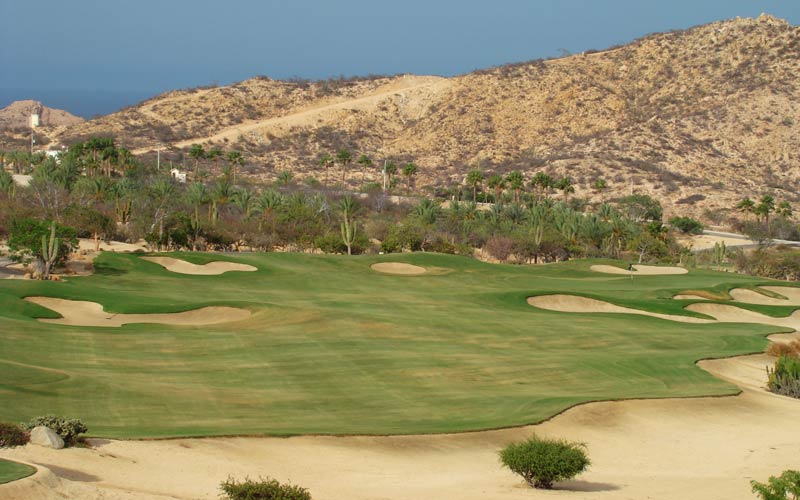
Great golf is all about options and the third has as many options as any short par four ever designed by Nicklaus. The smart play is often out to the left over the bunker, from where the golfer enjoys the ideal angle into an open green. Frequently though, the wind is strong enough from behind to goad the player into having a go at the green from the tee. Anything from a ‘2’ to a ‘7’ awaits in that case, making this a design standout.
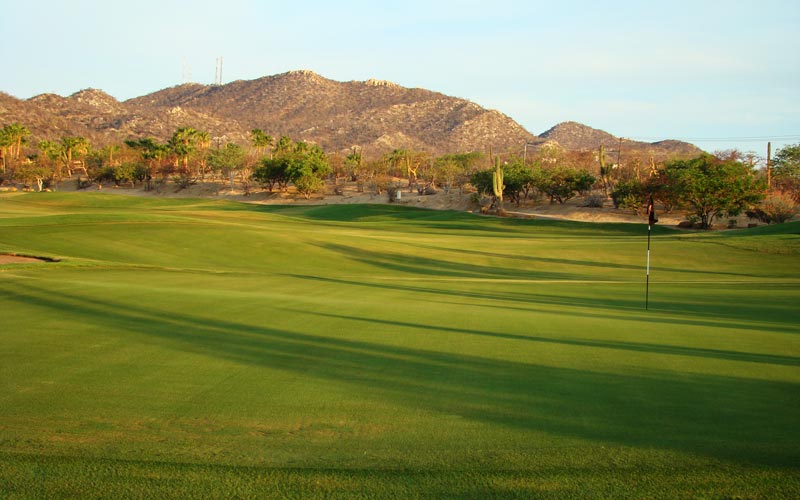
As seen from behind, the third green follows the natural slope of the terrain, which is to say that it slopes away and to the right from the player in the fairway. Thus, pitch shots played from fifteen to fifty-five yards from the green are done so from a real no man’s land area.
Fourth hole, 540 yards; A great drive here leaves the golfer in a conundrum: should I go for the green or not? Complicating matters is the invariably awkward stance that results in any fairway that drops eighty feet as this one does. Given the arroyo that fronts the green, the golfer is left with the need for a high approach from a hanging stance. Such a shot is never easy but the Sirens’ call of an eagle makes many a smart man try a less than smart (though intrepid!) shot.
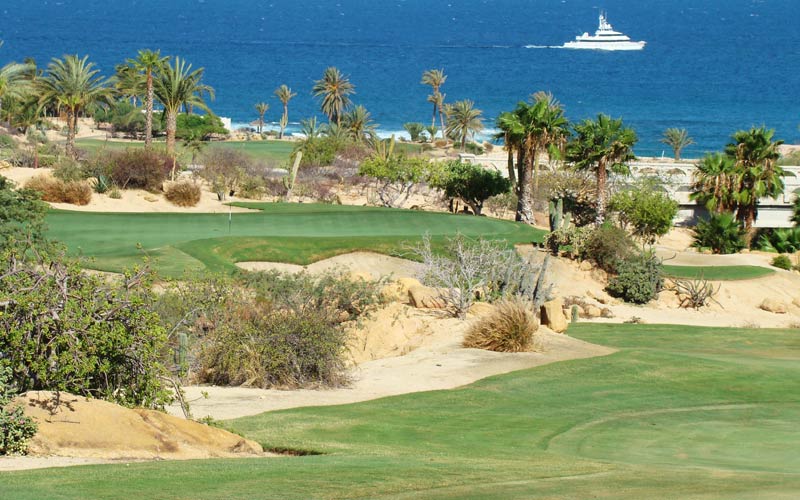
As photographed from 230 yards out, does the golfer dare have a go? Unseen from here, there is fairway short and left of the green on the other side of the arroyo.
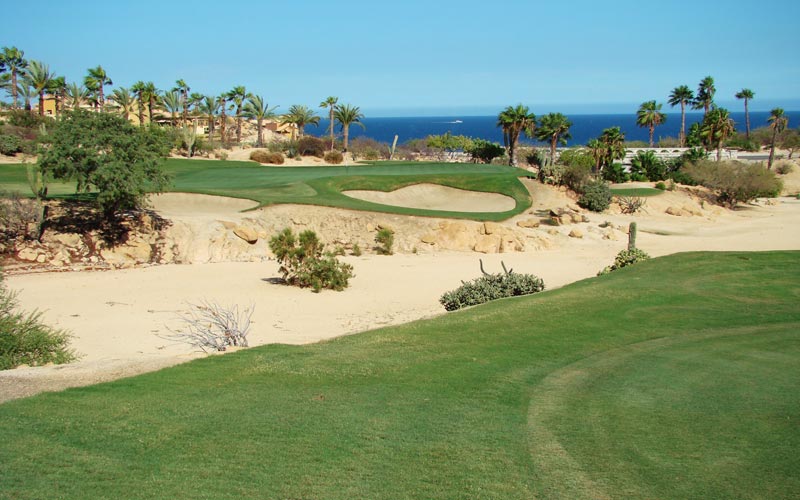
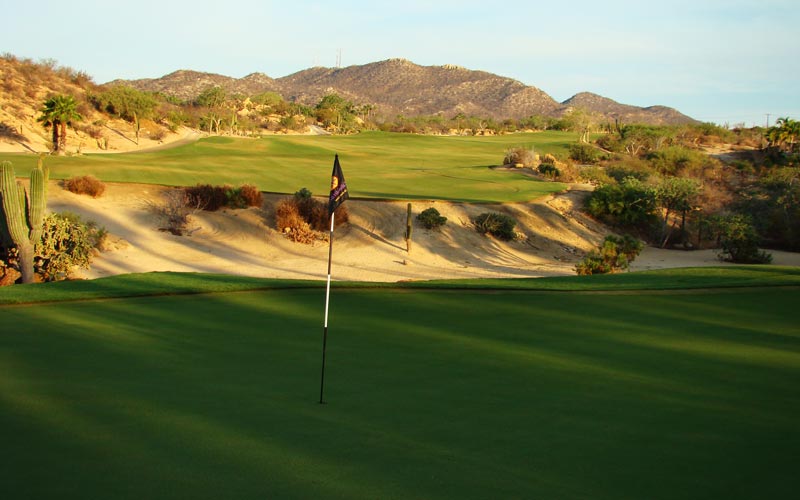
This early morning view back up the fourth highlights just how much the hole tumbles downhill. It also speaks as to the awkward fairway stance one is likely to have.
Fifth hole, 460 yards; A longer, Latin American version of the fifth at the Dunluce Course at Royal Portrush, the elevated tee provides a commanding view of the entire hole as its fairway swings right and heads to the sea. Though the fairway is miles wide, there is value in going down the right and challenging the trees and sand on the inside corner of the dogleg. More cautious tee balls left leave longer approach shots that may be blind. As dramatic as the hole is from tee to green, the best may be saved for last at the pushed-up, rolling green. Open in front, it accepts all sorts of well-played shots, something the Nicklaus Design team didn’t always offer.
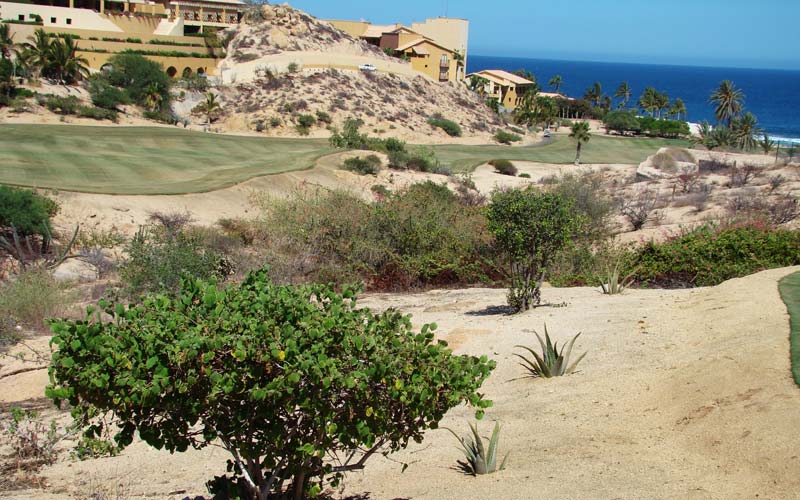
Beautifully routed, the fifth fairway swings right toward the ocean and picking the best angle off the tee is a task of which the golfer never tires. The structure in the background is an unrelated resort to Cabo del Sol.
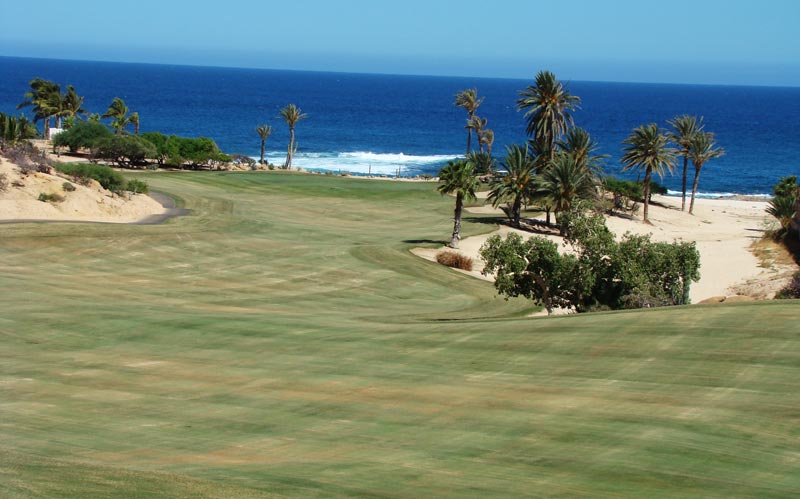
Ideally, the tee ball carries the clump of trees and shrub on the inside of the dogleg (as seen to the right in the photograph above) while avoiding the hillside on the left. Note the open green in the distance.
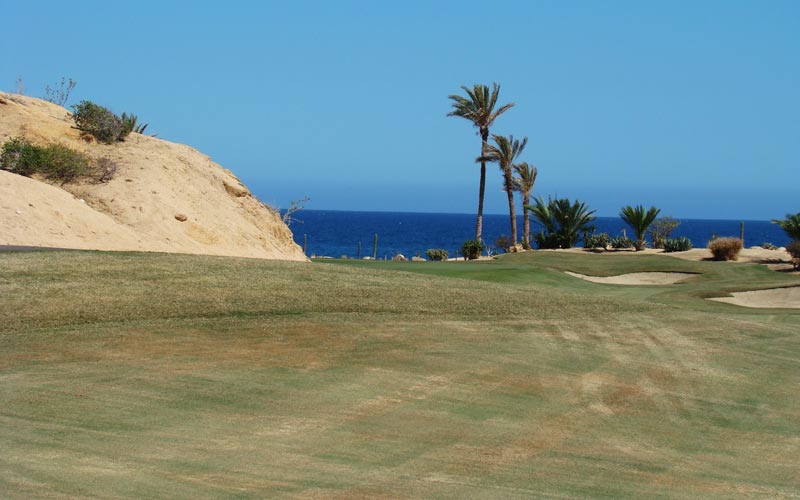
A slightly pulled drive leaves this view from 175 yards out, which shows only the right half of the green.
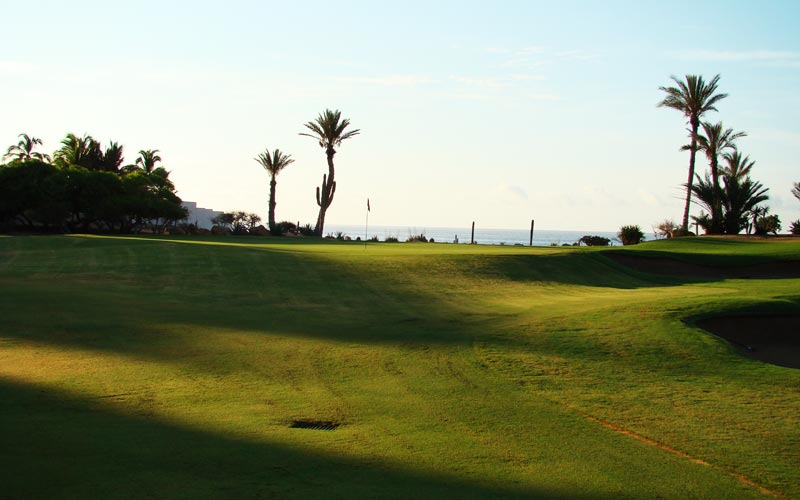
Open across its entire front, the fifth green features a slightly raised right shelf, a lower middle section and a higher left side. As the front of the right shelf runs away from the golfer, such hole locations are the toughest, though there is nothing but short grass around it.
Cabo del Sol (The Ocean Course)
Los Cabos, Mexico
Sixth hole, 190 yards; With a green complex that spectacularly seems to jut into the sea, Nicklaus Design wisely keep the other features low profile so as not to compete with nature. Though it does enjoy a classic Redan playing angle, the green is of the saddle variety and is a more receptive target than it first appears with its back a good two feet higher than the front, which helps keep balls on the green. The shoulder of the six foot deep bunker feeds well into the putting surface, meaning that the green slopes from left to right along that side.
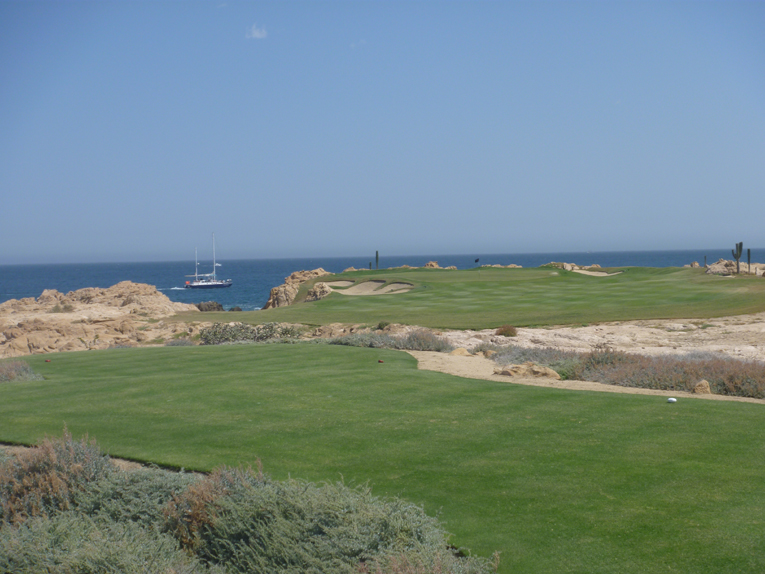
Constructed in 2011, Nicklaus Design pushed the sixth green complex even more onto a point, making the connection with the ocean even more intense than its predecessor. As seen above from the forward tee, Nicklaus Design employed short grass as a way to comfort the less accomplished player.
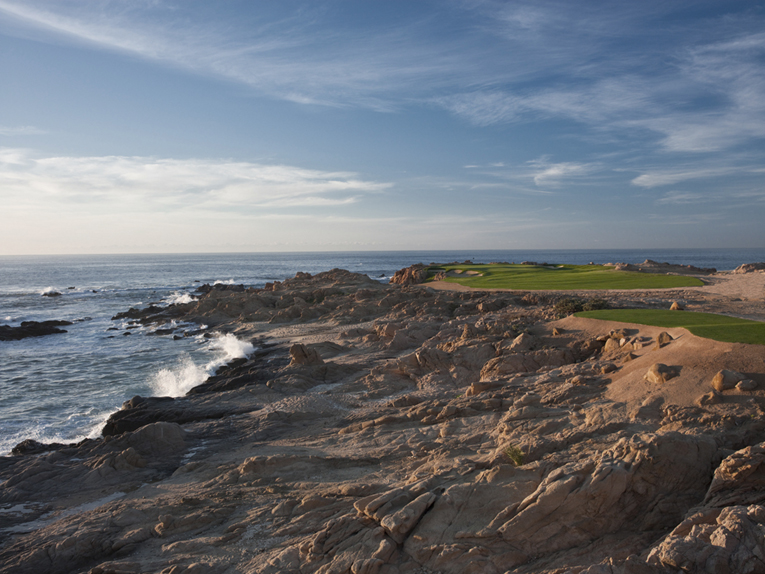
The back tees meanwhile present a far more fearsome prospect!
Seventh hole, 160 yards; Similar to how Alister MacKenzie must have felt at Cypress Point, Nicklaus had a strong desire to get the most out of the coastline and if that meant back to back par threes, then so be it. In the case of Cabo, the back to back par threes neatly accommodated the fact that under federal law, the Mexican people have a right to use the beaches and have unencumbered access. Most importantly from the golf design perspective, the seventh plays nothing at all like the sixth.
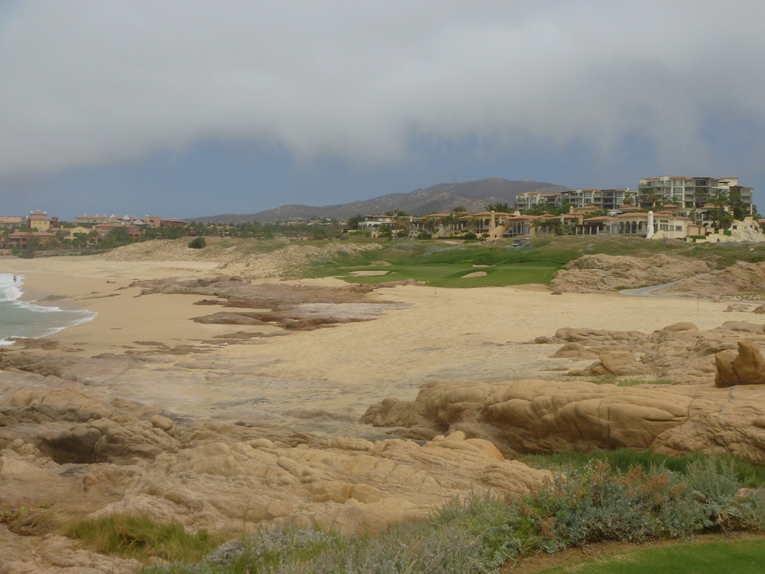
The prospect of playing over a beach is enough to overwhelm most fragile swings!
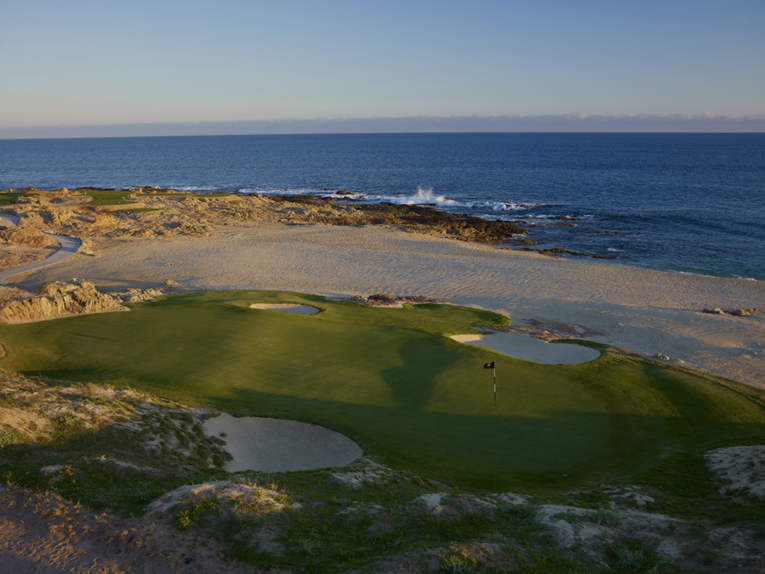
This aerial photo with low lighting shows the interior contours that confront all golfers. The tiger concentrates on finding the correct portion of the green.
Eighth hole, 430 yards; Unlike standing on the sixth tee at Spyglass Hill, there is no regret about turning inland as a) this is a wonderful hole and b) the golfer knows that he returns to the sea later in the round. A broad arroyo cuts across the fairway on a diagonal, from high right to lower left. Dry 99% of the time, this arroyo is an amazing sight during one of the infrequentsevere weather events when water comes racing down the mountain, pushing boulders along as if they were mere pebbles.
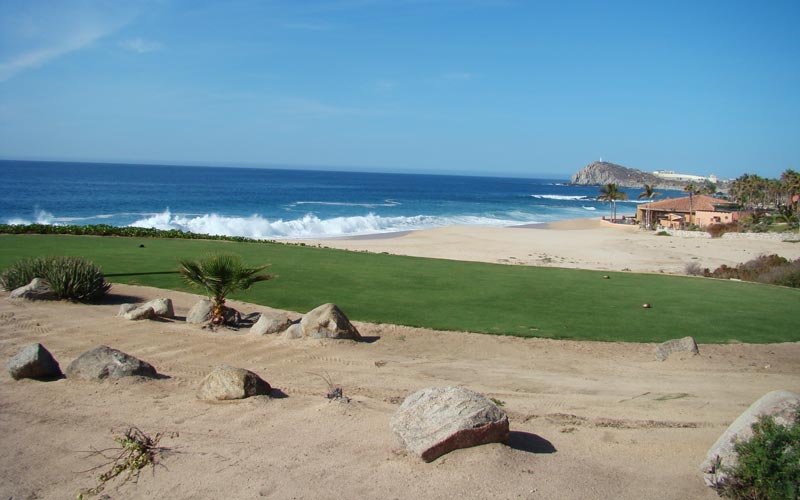
Just eleven paces off the back of the seventh green, the elevated eighth tee enjoys a commanding position above the resort’s beach and its pounding surf.
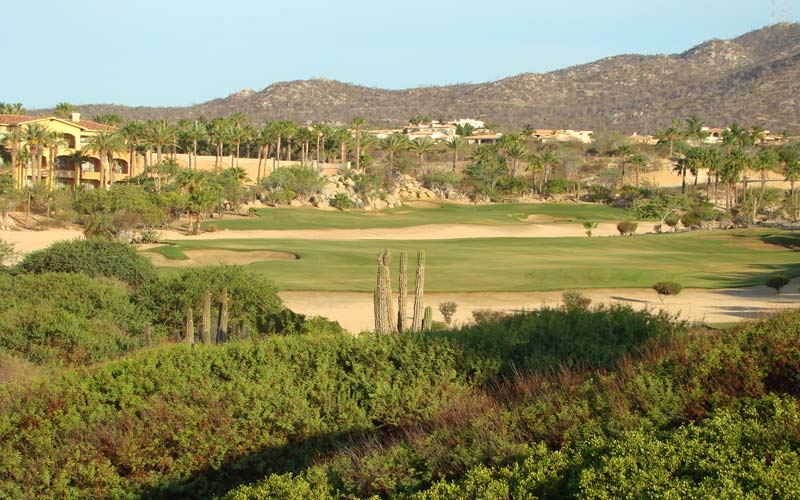
After soaking up the views, the golfer turns ninety degrees and plays the eighth as it heads inland. Though the playing corridor is straight, it’s best played as a switchback hole with a draw just past the left hand bunker ¦
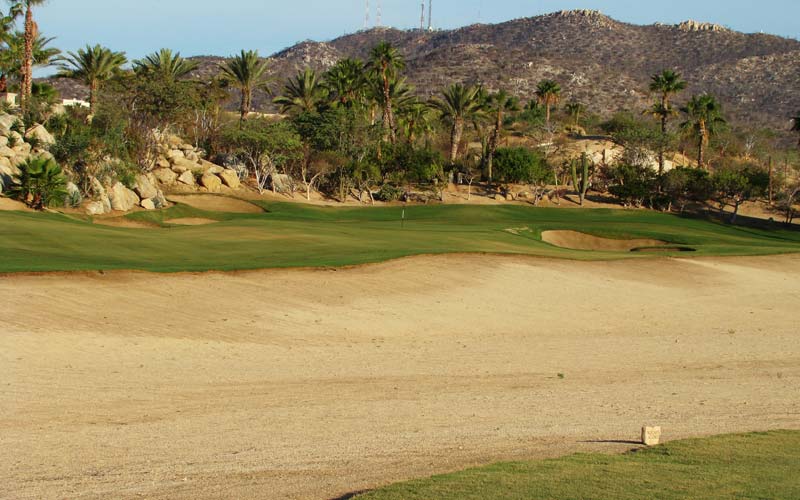
¦ leaving the optimal angle to play a fade into the kidney-shaped green.
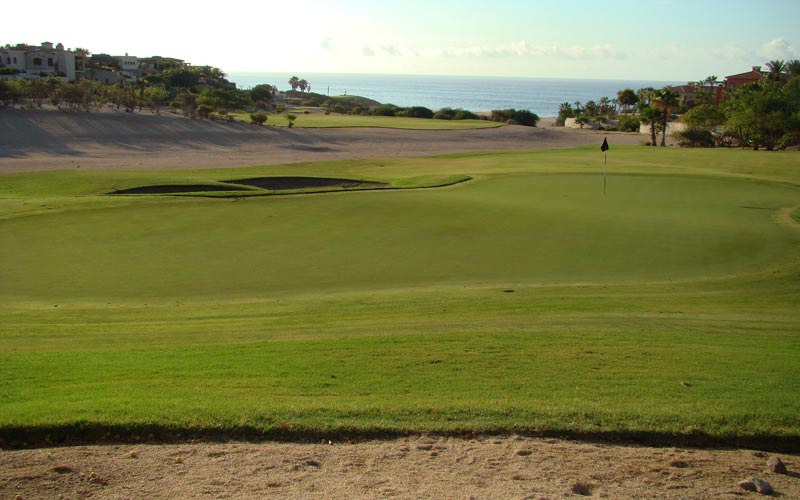
This view from behind shows how the shape of the green places a premium on playing from the left side of the fairway. The active arroyo that cuts through the fairway feeds into the Sea of Cortez in the background.
Tenth hole, 435 yards; Alister MacKenzie was a proponent of giving the player a fearsome hazard to overcome while at the same time providing plenty of room to do so. Such is the case here. At fifty-two yards, this is one of the widest fairways on the course (not a bad thing as the golfer has just played two tough par fours) but the approach is one of the most visually intimidating on the course.
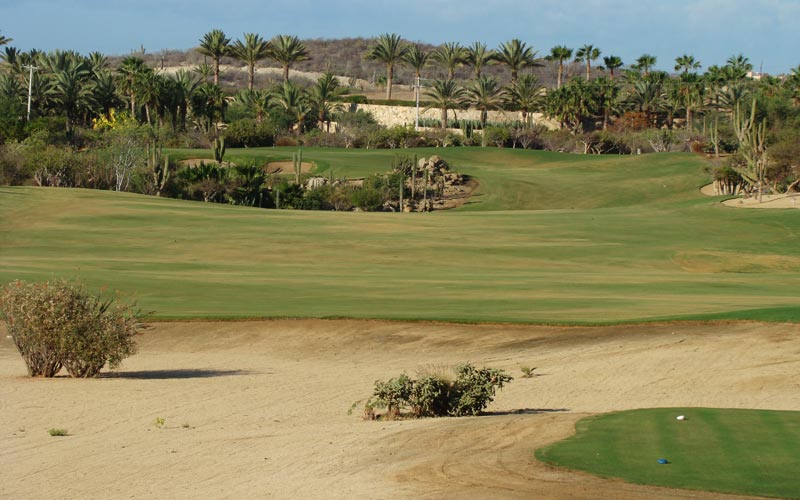
In a fine show of design restraint, Nicklaus Design left the tenth fairway wide and uncluttered.
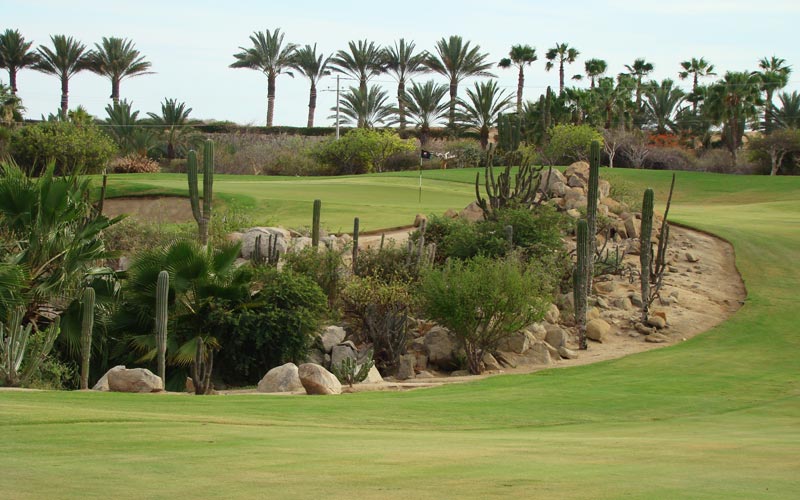
Though its twenty yards shy of the green, the desert vegetation consisting of cardon cacti, cholla cacti, organ pipe cacti, and octotillo dominates the eye on the approach. Play is certainly long as there is plenty of short grass beyond. However, the green slopes from back to front, so a reward is given to the golfer who drops his ball over the native desert while still staying beneath the day’s hole location.
Eleventh hole, 350 yards; Alternate fairways rarely work, but this one does 25% of the time. By that, what is meant is that when two of the eight hole locations are used in the back right of the green, the golfer is definitely rewarded by playing down the right fairway. Otherwise, for the other six hole locations, the golfer is free to play the hole in the more conventional manner down the left fairway. The average stay at the Cabo del Sol resort is nearly five days so the golfer is likely to catch one of the two back right hole locations during his stay. The flag is clearly visible from the tee – the golfer just needs to be cognizant what a back right hole location signals.
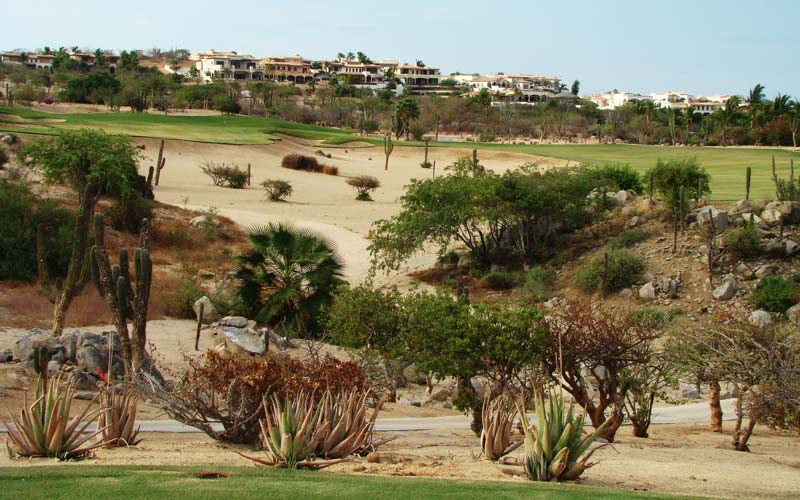
A forty yard wide patch of desert runs on a direct line from the tee to the green, effectively creating a left and right fairway.
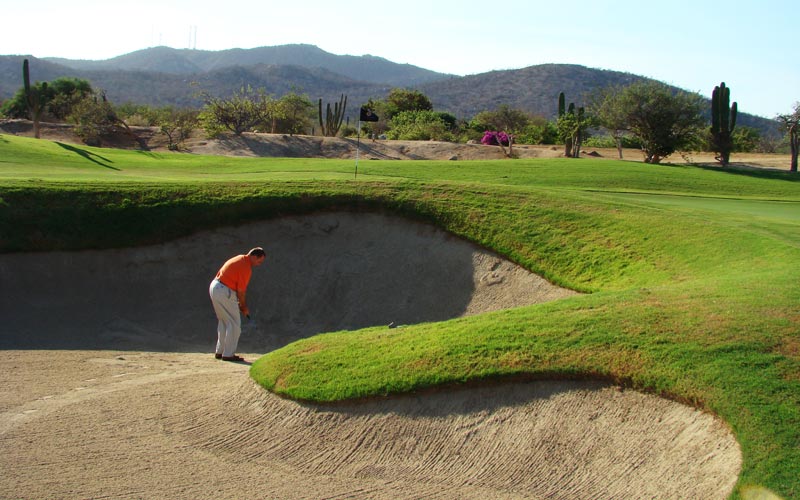
The deepest and steepest greenside bunker on the course eats into the right of the eleventh green. When back right hole locations are tucked behind it, golfers should play down the right fairway.
Twelfth hole, 515 yards; A maddening hole, golfers think they should be able to make something happen here at this modest length par five that plays straightaway.Unlike the other half par holes on the course, this one plays uphill and into the prevailing wind to an elevated green.
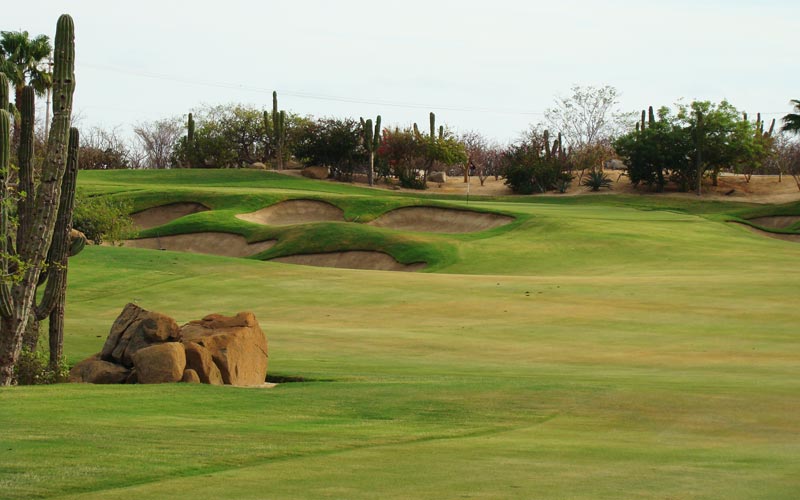
With eight bunkers left and right of the knob green, the golfer does well to conclude that the best way to play the twelfth is as a three shotter.
Thirteenth hole, 215 yards; Hopefully, good things have happened to the golfer at the eleventh and twelfth as he now faces the single most uncompromising shot on the course. On the far side of an arroyo lies the green and not much other good news other than a small bailout area to the right and a pair of mercy bunkers along the left of the green. High demand holes like this one played one after another can wear out/beat down any golfer. Such is not the case at Cabo as thisterror of a one shotter is sandwiched between two potentially reachable par fives and a medium length par four. Course critics whom first came here in 1994 were pleasantly surprised as they weren’t accustomed to seeing such give and take from Nicklaus Design. Indeed, history has now shown that The Ocean Course marked a significant turning point away from penal designs for Nicklaus.
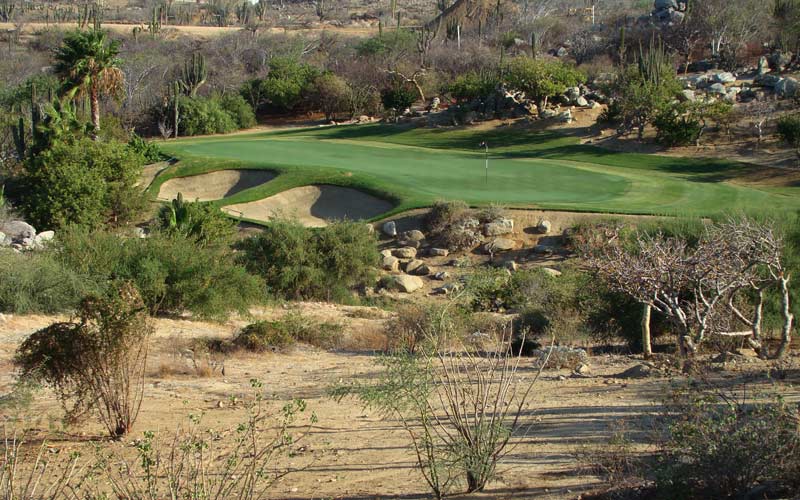
The long downhill thirteenth is a particularly fine time to put a great swing on the ball as…
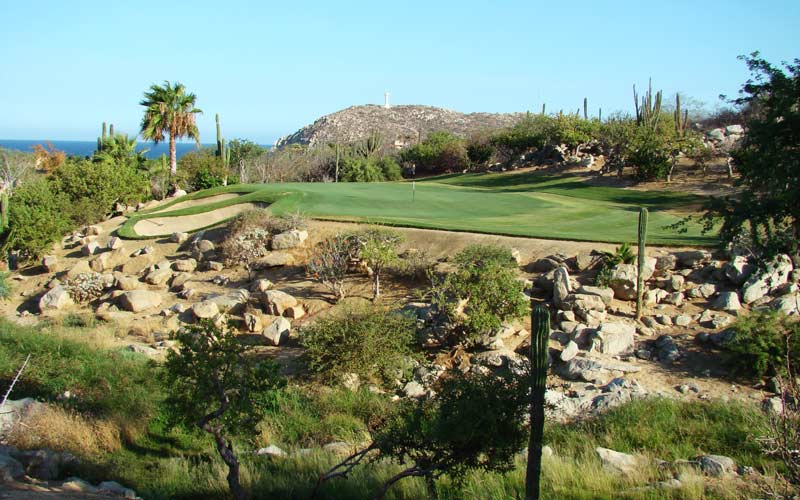
… the consequences for a miss are severe. The prevailing wind blows right to left and into the golfer, adding to the hole’s exacting challenge.
Cabo del Sol (The Ocean Course)
Los Cabos, Mexico
Fourteenth hole, 365 yards; The rugged features at Cabo, especially the arroyos, are such that a much harder and far less enjoyable course could have easily been built here. Nicklaus Design deserves credit for its routing whereby the number of intimidating forced carries is keep within reason. Having said that, the course’s most menacing forced carry comes here at this modest length hole. Given the apprehension created on the tee, the natural tendency is to aim well away from the arroyo as it snakes along the left of the fairway and up past the right of the green. Unfortunately, tentatively played tee balls out to the right leave the golfer with the ball well above his feet (i.e. a hook stance) to a green that angles from front left to back right (i.e. a fade green) beyond an arroyo. The golfer who accepts the challenge off the tee and plays a slight draw toward the inside of the dogleg is mightily rewarded with a potential easy pitch for birdie. Within Nicklaus Design, not only is the namesake a great (!!) golfer but so too is Jim Lipe. One can imagine how he relishes the opportunity to display his ball striking skills on this gem of a sub-400 yard hole.
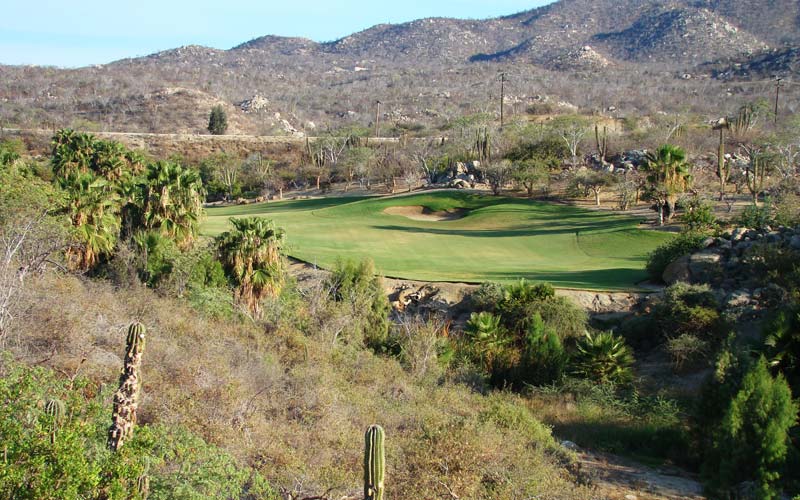
The arroyo was put to similar use as Rae’s Creek at the thirteenth at Augusta National: the more the golfer hugs it off the tee ¦
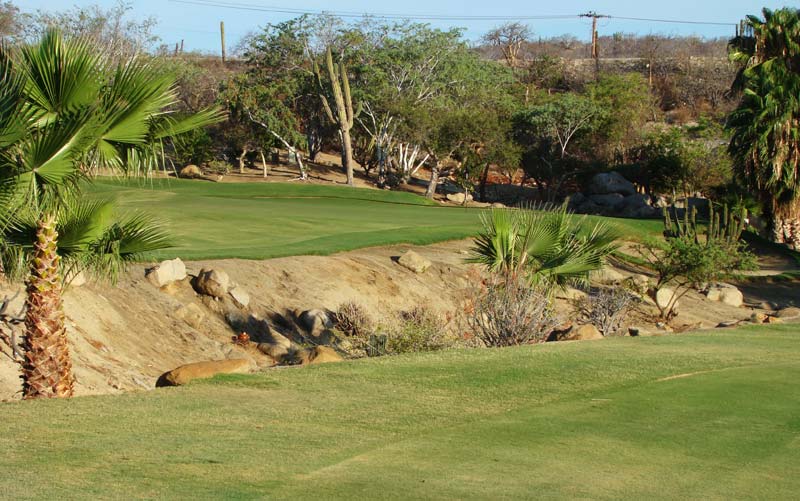
¦ the easier his approach shot becomes as he gains a level stance and the perfect angle down the length of the green which ¦
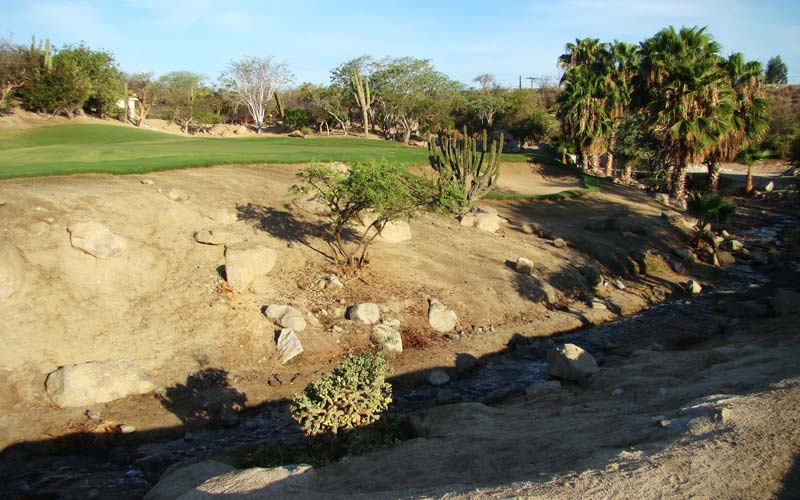
¦ was beautifully placed on the inside of the arroyo’s elbow as seen above. One of the single toughest hole locations on the course is found back right on a finger of green that protrudes perilously close to the arroyo.
Fifteenth hole, 530 yards; The previous six holes havestayed away from the sea and the fifteenth acts as a crucial transition holewhereby the golfer is slowly re-introduced to it. At 158 feet above sea level, the tee is the highest point on the course with the long views afforded to the Sea of Cortez providing the start for this seamless transition from desert to sea. In addition, the fact that it is a long hole means that the transition is allowed to play out gradually over the hole’s 500+ yards in length.
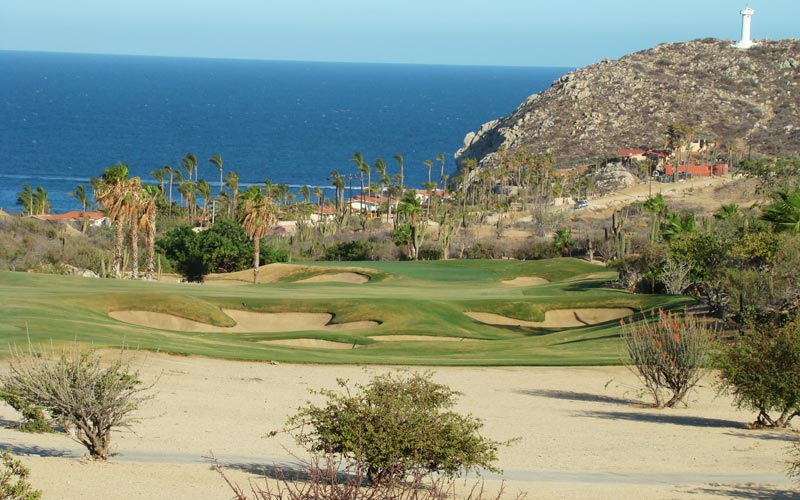
Though the golfer is one thousand yards away from the coastline, the view from the elevated fifteenth tee across the scrubby desert floor and out to the Sea of Cortez signals an important transition.
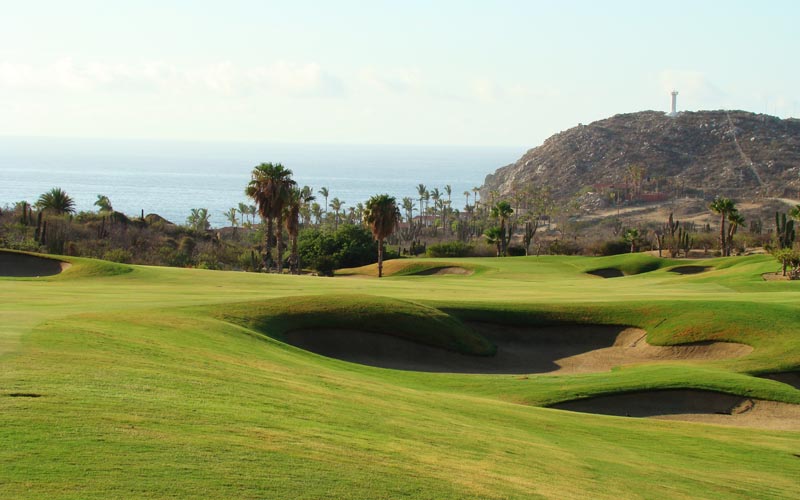
With the prevailing wind behind and from the right, the golfer is mightily repaid if he can get past this bunker complex with his tee ball as he might have as little as a mid iron into the green in two.
Sixteenth hole, 445 yards; Great courses evolve as no architect gets every feature right after spending a limited time on sitefor a few scant years. The more concentrated basis of power for decision making like at Pine Valley, Oakmont in the days of Fownes and Friar’s Head today, the course’s evolution is likely to occur in a quicker and more sophisticated manner. Why go into this here at the sixteenth you wonder? After all, the sixteenth couldn’t look more natural as its fairway meanders downhill toward the Sea of Cortez. In fact, more tweaking has occurred design-wise to this hole than any other since opening day. The fact that the hole has been allowed to be steadily improved upon is a great compliment to all parties concerned. The end result is what some consider to be the finest hole on the course.
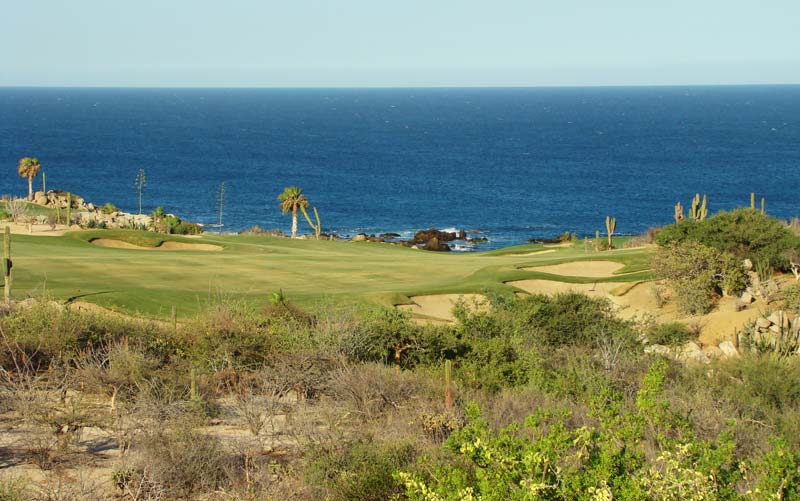
Though the sixteenth is now picture-perfect, such wasn’t always the case as the fairway, bunkering scheme and green location have been all tinkered with to yield today’s exceptional hole.
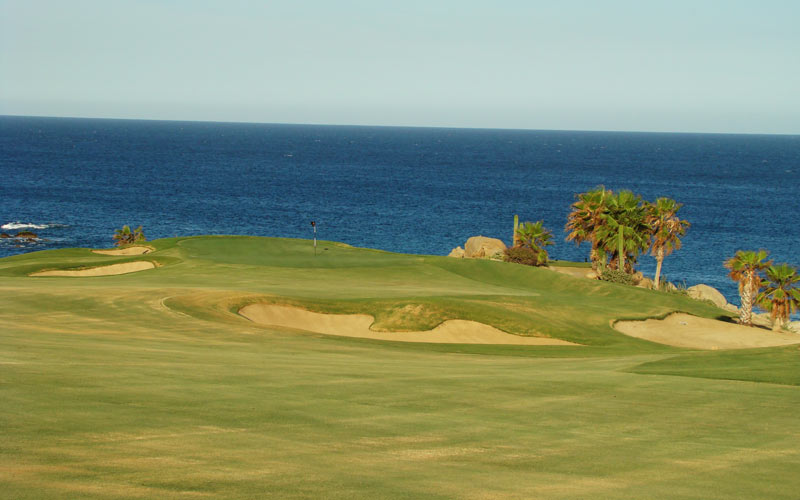
In the 1990s, the sixteenth green commenced just past the bunker in the foreground and stopped before the edge of today’s green. The removal of a back bunker and an extra set of tees meant that the green could be pushed back thirty-five yards to its present superior location. Today’s ground game options makes the approach the author’s single favorite shot on the course.
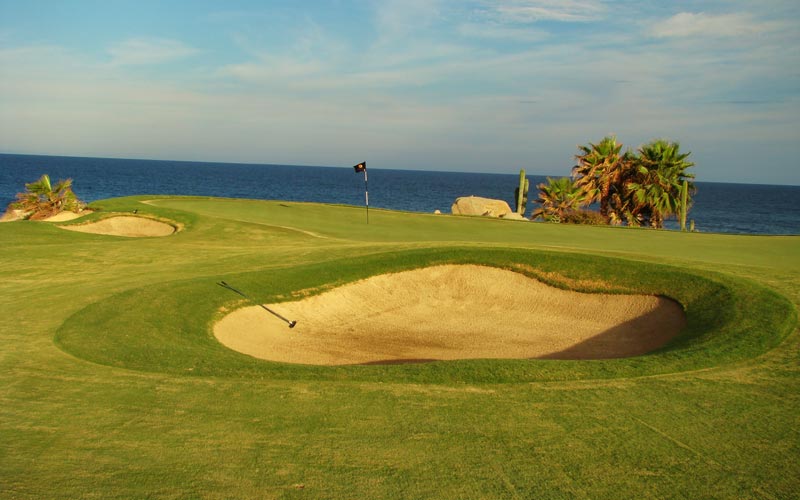
As seen from the left, the back third of the sixteenth green narrows to a scant ten paces wide, making the back hole locations among the most ticklish on the course to access.
Seventeenth hole, 180 yards; The tees were well thought-out on this postcard hole across the beach. From the back tee, even the Great man himself Jack Nicklaus feels a bit of perspiration, yet the mid-handicap player experiences the same feeling from his tee at 145 yards as does a lady or junior golfer from their 110 yard set. This attribute of well thought out tee boxes applies throughout this design. Thoughsuch teesare obviously a highly desirable attribute for any resort course as it seeks to accommodate a vast array of playing abilities, capturing the same spirit of the hole from different lengths and angles is a far more complicated task than most appreciate. Along with the fifth, this was included in George Peper’s book entitled The 500 World’s Greatest Golf Holes.
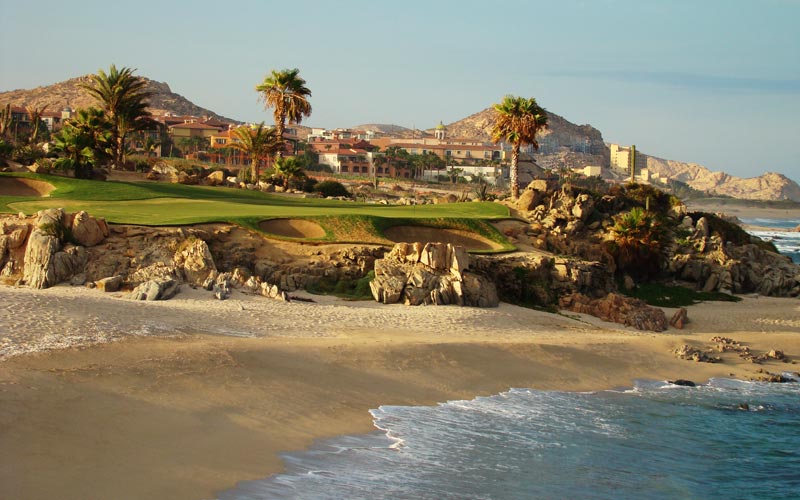
The adage ‘build it and they shall come’ only applies when the architect delivers world-class holes that draw people in. Nicklaus did just that at The Ocean Course with this view from the back markers at the seventeenth being a conspicuous example.
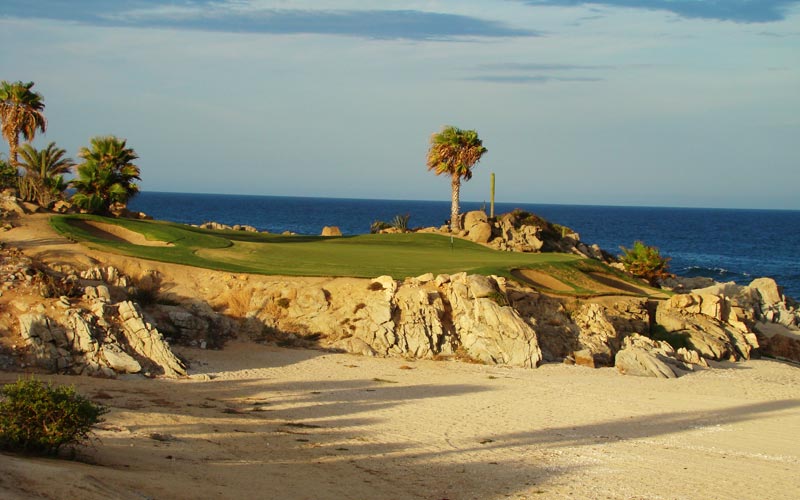
A mid-handicap golfer playing from the blue tees enjoys an equally thrilling shot from the 140 yard markers as …
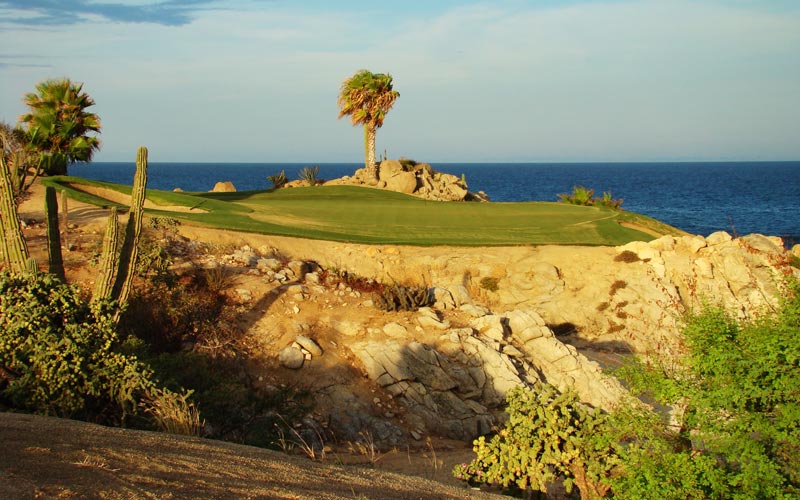
… does a lady or junior from farther forward.
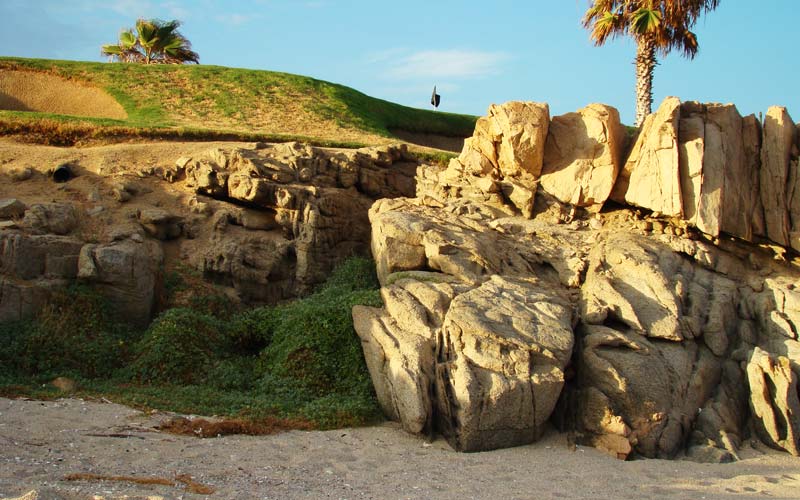
Though it was a disappointing swing that led to this photograph being taken on the beach below the green, there is a point to it and that is that a recovery shot was possible. Though the desert and sand provide numerous hazards around the course, the opportunity frequently exists to play a heroic recovery shot. This makes the hazards at Cabo del Sol among the best in the game from a quality of golf perspective as they entice you to think/play boldly.
Eighteenth hole, 430 yards; Within its first year of being open for play, this was heralded as Nicklaus’s finest finishing hole as well as one of the best anywhere. The only thing that has changed since then is that the hole has been improved by virtue of a small gathering bunkering that pinches in this kidney shaped green set atop the coastline’s granite boulders. Now, not only does playing down the right considerably shorten the hole, it also provides the best angle into the numerous back left hole locations.
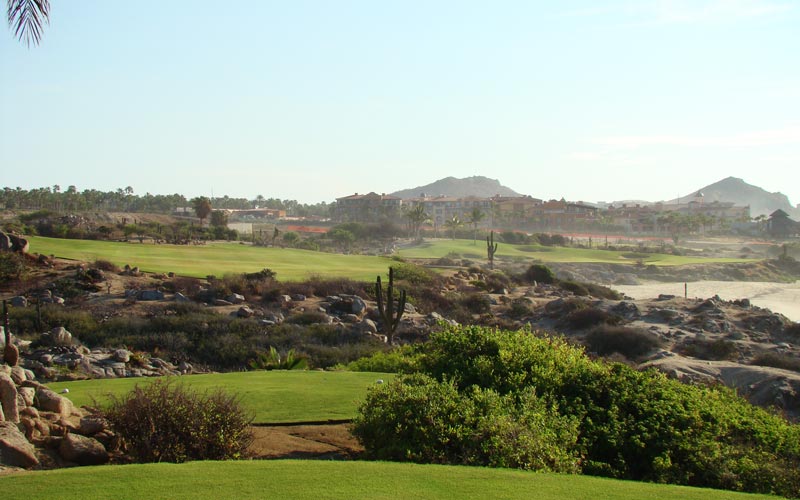
The graceful eighteenth fairway follows the natural left to right tilt of the land with nothing forced upon it.
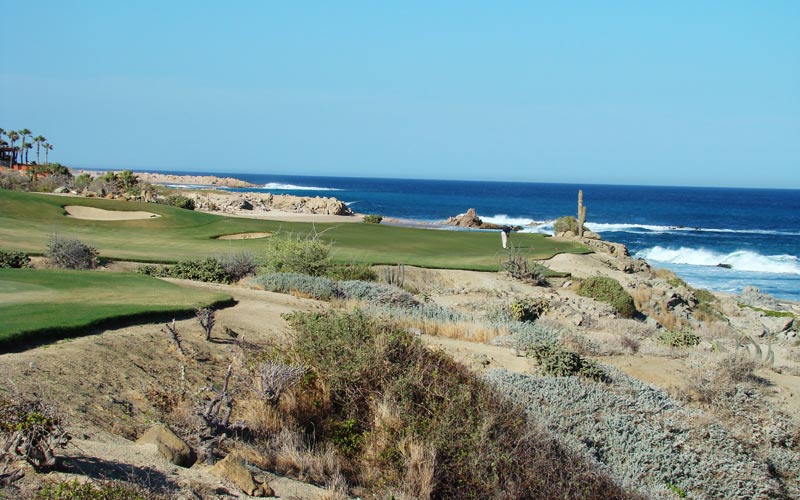
The eighteenth plays around its own bay with both its tee and green protruding into the sea, yielding this impressive (!) approach angle into the Home green.
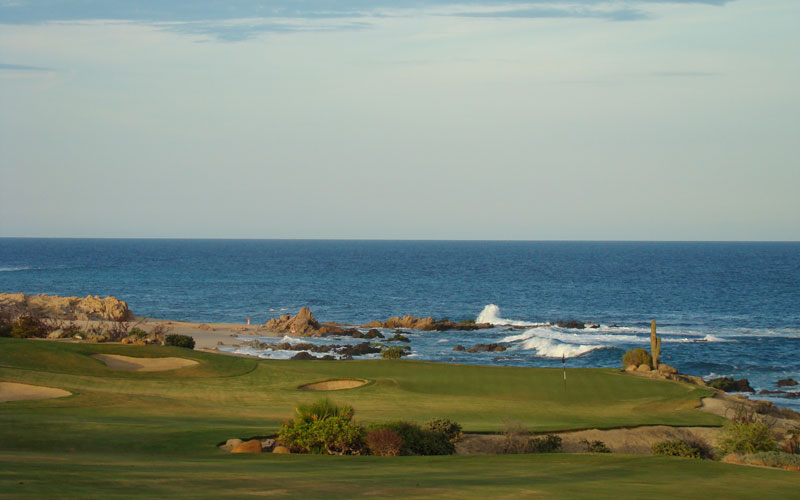
The small bunker left of the green that was added in 2002 makes the approach more confounding/interesting.
The Ocean Course’s famous four hole finish is both spectacular and fun, an irresistible combination. The whole gamut of emotions can be had from a potential eagle at the fifteenth to a ball that hangs in the air a fraction too longat theseventeenth. Regardless of the outcome, the strong connection that the golfer feels with nature during this stretchinsuresmany a return round.
Interestingly enough, the initial routing had these four holes as the fourteenth through seventeenth holes. The eighteenth was to be a hole that headed perpendicular to the coastline and back to the clubhouse, some four hundred yards inland. Mercifully, Nicklaus and Lipe (along with Lyle Anderson who happened to be down when the decision was made) agreed in unison that the course should finishalong the water. Time has proven them right that golfers don’t mind the short cart ride back to the clubhouse.
Golfers are interesting creatures in that they don’t require perfect weather to enjoy the game. Many head in droves to the United Kingdom and relish telling return stories of battling the wind and rain. Such won’t happen here as Cabo enjoys over 340 sunny days per year. Yes, you’ll get the wind but for miserable rain (and so-so food), you’ll have to go elsewhere as Cabo averages only seven inches per annum! Certainly, such playing conditions (and great fresh seafood) are part of the appeal that has made Cabo a top golf destination. The real reason though to cometo Cabo San Lucas is the high quality of the golf. In addition to The Ocean Course, Cabo del Sol Resort also offers the Weiskopf designed Desert Course. Opened in December 2001, several of its holes play 400 feet above sea level and feature sweeping views out to sea. Totally different from the Nicklaus course, it makes for a perfect complement.
New courses are being built each year here by the likes of Nicklaus, Fazio, Davis Love, and a Tom Doak up the coast. Whether the developers of these projects allow such courses to reach their full potential and whether the architects can deliver a world class design remains to be seen. What is for sure is that Jack Nicklaus has already set the design bar at a standard that will be hard to match and that all golfers who fly into Cabo San Lucas will relish a game at the peerless Ocean Course.Leaving the last word to Lipe, ‘the flow and variety of the course is what makes it successful. Since it was to be a high profile resort course, we worked very hard to achieve just that and hopefully its success has proven that we delivered what we sat out to do.’
The End