Art and Architecture
Paintings by Michael Miller
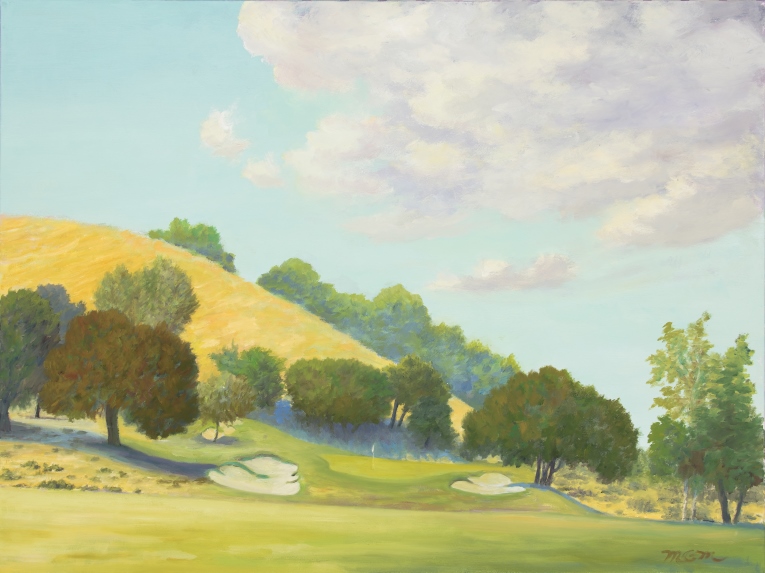
“The Valley Club of Montecito, 11th Hole”
This bucolic and historical view of the original Alistair Mackenzie design, reveals the natural simplicity of the architect’s genius. Looks simple, but it isn’t. And although this par 4 is quite short (particularly by today’s standards), the wedge shot must be precise and below the hole. Anything left runs quickly away and anything right finds trouble. 30″ x 40″ o/c at $8,400
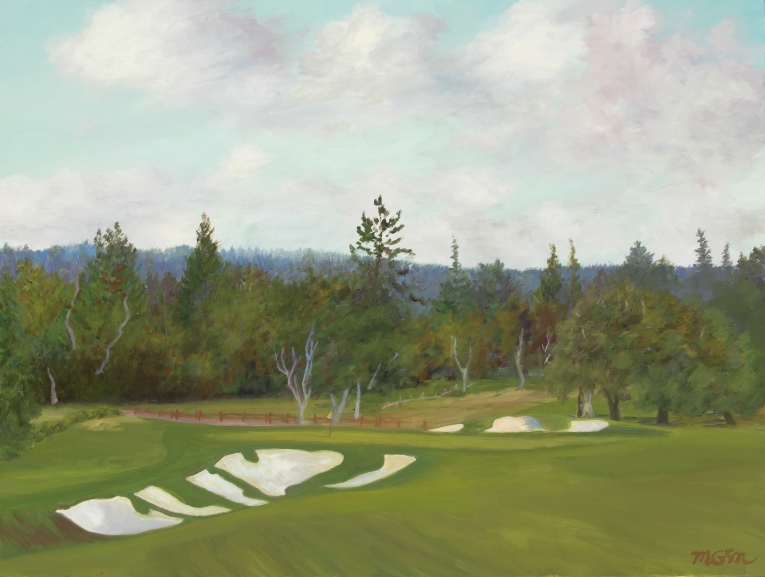
“Overcast Day at Pasatiempo’s 10th Hole”
This depiction of Alistair Mackenzie’s glorious bunkering at one of Pastirmpo’s more difficult par 4’s, attempts to reveal the commonly overcast mornings and “soft” conditions of one of America’s masterpiece golf designs and settings. While the hole can measure over 450 yards, it plays much, much longer. The tee shot, from the back tees, which will get virtually no roll, must carry an upward slope, and in doing so, then leave a difficult downhill lie to this intimidating approach. Achieving a par on this hole is very gratifying.
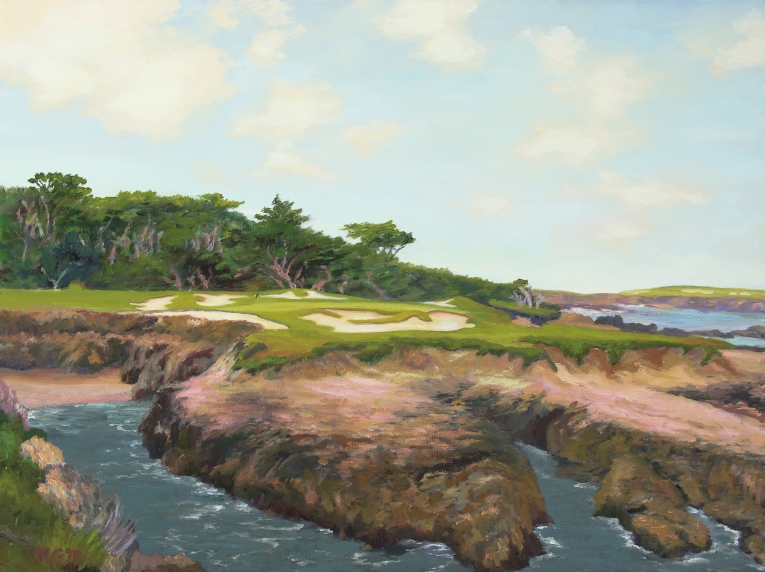
Cypress Point, the 15th
The iconic and dazzling 15th at Cypress Point has been photographed, painted and admired for many, many years. Nonetheless, it remains a golf setting that demands the attention of all those who acknowledge the architectural genius of Alister MacKenzie and marvel at the unparalleled beauty of the Monterey Peninsula. With these factors in mind, I have to attempted to bring this visage to canvas as a tribute to this rare combination and nothing more. No dynamic weather, spectacular sunset or identifiable season. Just MacKenzie and The Creation. A tough combination to beat.
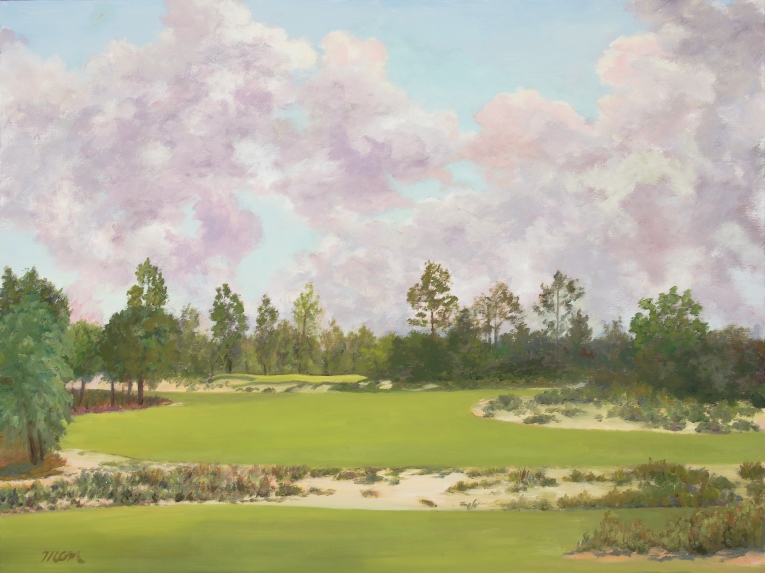
“The Naturalness of The Ohoopee Match Club, 17th Hole”
As the title states, Gil Hanse’s masterful Ohoopee Match Club is a testament to “Naturalness” in classic golf architecture. While the 17th is a great example of the “natural school”, the course is full of diversity, complexity and the unexpected. Whether natural terrain, or created, to the player it all comes together as golfer versus nature.
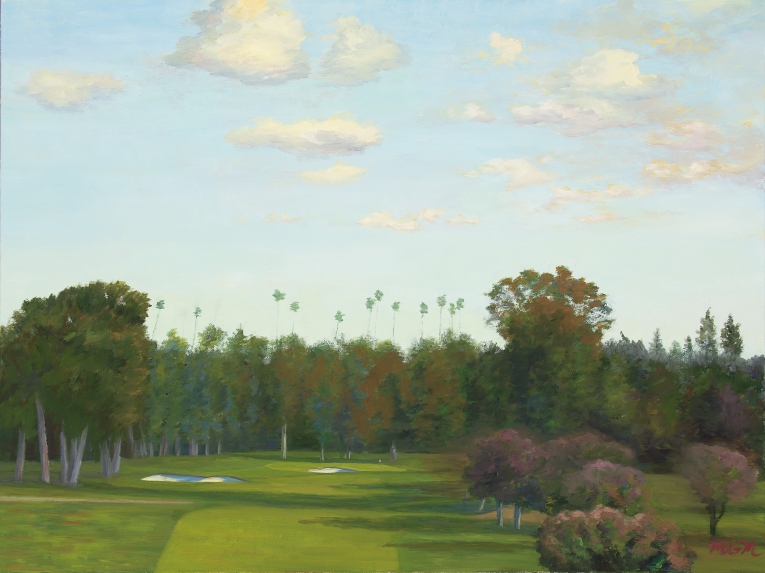
“View of Riviera’s First Hole From the Elevated Tee”
Riviera’s famous elevated tee at number one has inspired and intimidated golfers for decades. Some 75 feet above the fairway, tee shots are majestic or not so good. At 501 yards, it is now too short of a par 5 for the modern tournament player, and in fact, played as a par 4 in Riviera’s recent U. S. Amateur. Nonetheless, it is the view that is remembered and this painting attempts the capture that iconic scene. 30” x 40” o/c $8,400
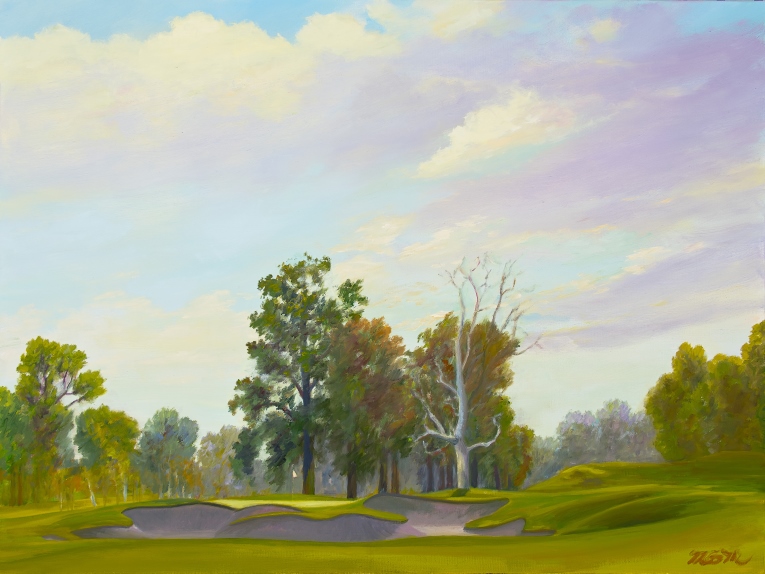
“The Daunting 4th at Riviera CC”
One of golf’s great bunkers, architect George Thomas place it in front of a sloping green some 230 yards from the tee. This hole plays into a prevailing ocean breeze and since the kikuya grass has pretty much negated the redan to the right of the green, full carry is pretty much required. With the pin on the right any shot that “short sides” will leave an impossible downhill chip unless it hits the pin. Left is no bargain either it is usually fairly deep kikuya rough on an uphill slope. 30″ x 40″ o/c $8400
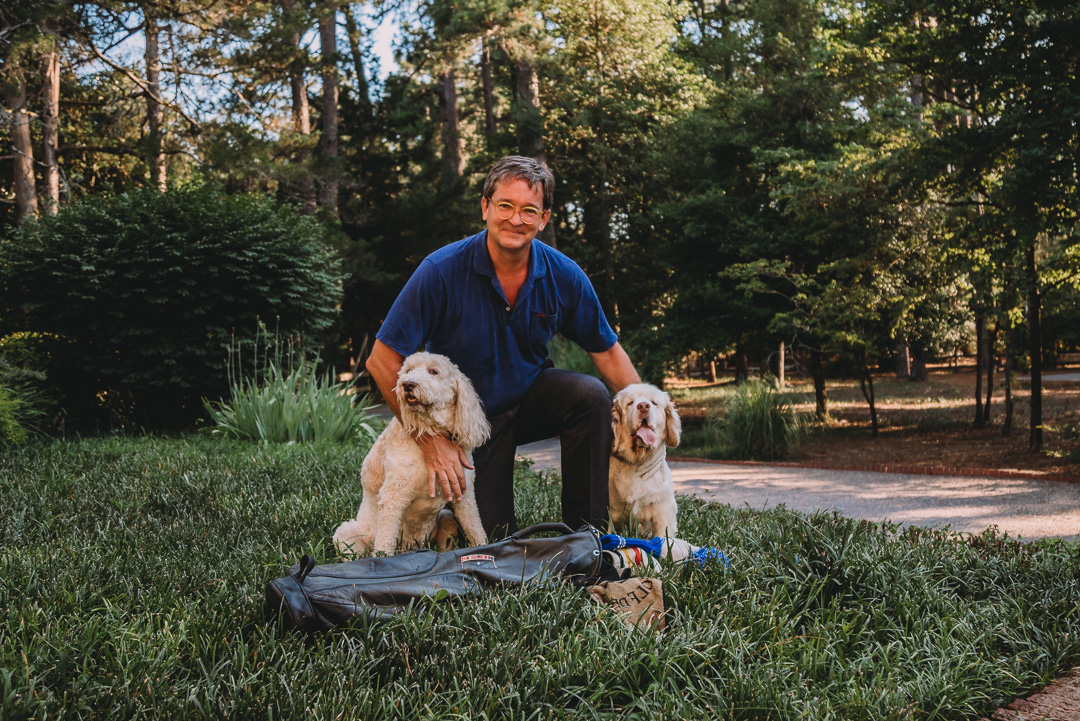
GolfClubAtlas.com is pleased to present the paintings of Michael G. Miller, who has painted in a 19th century style both still life and golf landscapes since 1985.
After receiving formal training at UCLA Extension and the Brentwood Art Center, Mike benefited from the ‘one on one’ mentoring of Mr. Gene Mako in Los Angeles. Through these latter teachings, Mike developed an appreciation for the work of 19th century masters such as Henri Fantin-Latour, Jean Baptiste Chardin, Eugene Boudin, Winslow Homer, W. M. Chase, J.A.M. Whistler, Robert Henri, Frank Benson, and John Singer Sargent.
At the same time, Mike worked as the Head Golf Professional at MountainGate CC and then as the Head Golf Professional at Riviera Country Club from 1993 to 1998. The dual career of painter and golf professional merged into one as Mike paints full time now. In doing so, he calls on his experience in golf and his keen interest in golf course design to produce noteworthy golf landscapes. His one-man exhibition in the main gallery of the World Golf Hall of Fame Museum in St. Augustine, Florida ran to great acclaim.
Golf architects Gil Hanse and Ben Crenshaw have acquired his paintings.
According to Hanse,
“The game of golf has been blessed with many talented artists focusing on the beautiful grounds upon which the game is played. In this era the work of Mike Miller is head and shoulders above the other artists focusing on golf. His paintings clearly evoke the feelings of the work of Harry Rountree, capturing tones and moods that pervade golf courses. As opposed to the mainly illustrative work of his contemporaries, Mike is able to put on canvas the subtle shades and nuances that add to the texture and feel of a real golf course. His focus on historic paintings has also resurrected many discussions about the true look and character of a golf course. I love old golf courses and new courses that feel old, Mike paints in a style that is able to capture that feeling perfectly.”
For information on commissioning Mike Miller to paint a specific hole for you or your club, please contact him directly on 765.621.5695. Limited edition prints are also available for the paintings featured below. Final edition prints are signed, numbered and titled, on Somerset Velvet paper, either cut or torn (deckled) edges, sprayed with UV protective coating, packed in clear sleeve with foamcore backing. Mike Miller can reached at mgmfineart@gmail.com or through his web site millerfineart.com.
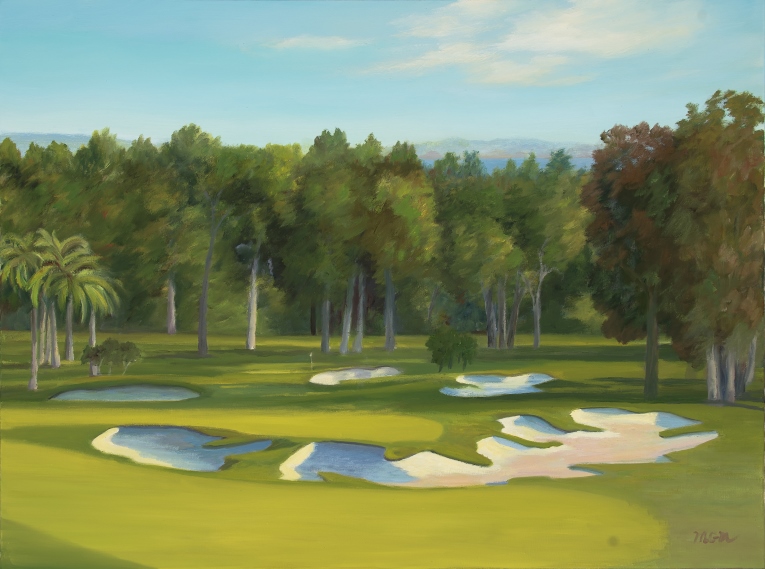 “The Magnificent Tenth at Riviera” |
One of the great short par 4’s in the world, the 10th offers a marvellously exquisite choice involving golf’s old conundrum of “risk reward.” Any tee shot right of the left side edge of the green side bunker is pretty much dead as the very narrow green slopes away from that angle and there is a bunker on the far side as well. A tee shot right on line may reach the green but usually kicks left and runs past. Anything short of the bunker on the far left side of the fairway leaves 80 to 100 yards but with the best angle to the green. Compound this with an ocean breeze from the right and anything off line usually gets worse. Putting that green is no bargain either. Even if the player puts his tee shot on the front of the green, the very large break from right to left can often allow the fringe to block the best line, thus encouraging anything putted too far left to easily roll off the green. 30″ x 40″ o/c $8500
Fourteen plays into the prevailing Pacific Ocean breeze which has the effect of keeping shots right to stay right and shots left to stay left. At the same time, fourteen is the largest and widest green on the course so merely hitting the green is not necessarily a routine 2 putt. The bunkers are typical George Thomas. Deep, each different from its neighbor and perfectly placed. – 30″ x 40″ o/c $8,400
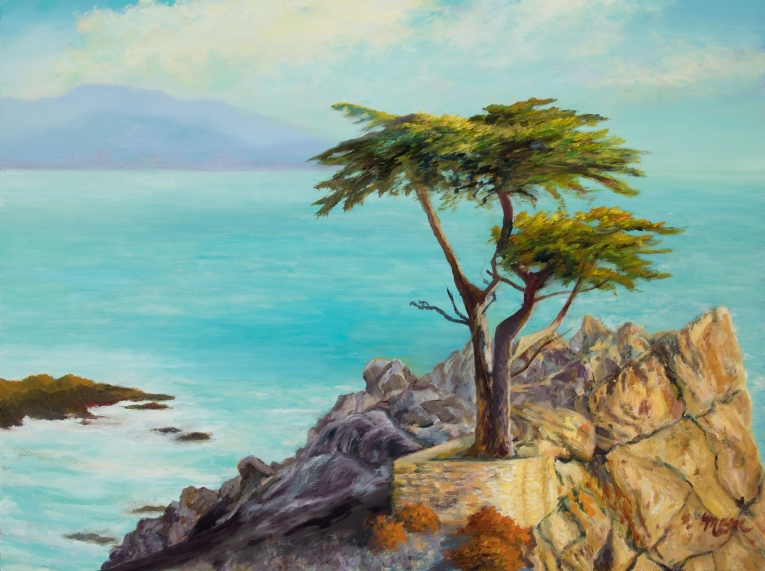 “The Lone Cypress, Pebble Beach” 30” x 40” o/c $8900 unframed $9800 framed |
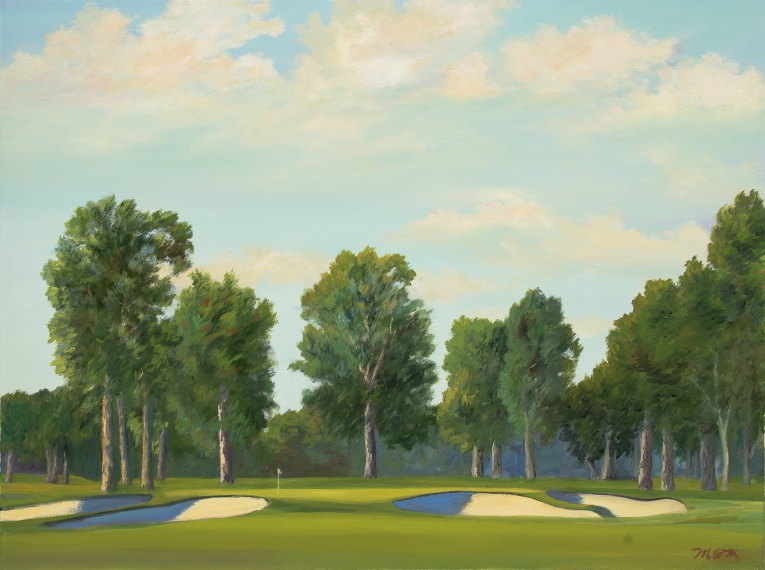
“Summer Afternoon at Rivera’s #14”
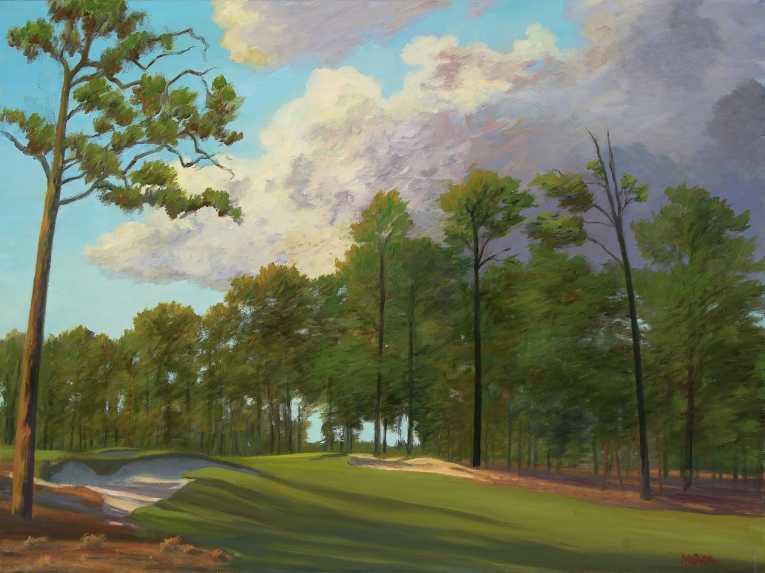
“Distant Weather Behind the First at Mid Pines” – 30″ x 40″ oil/canvas $8,400
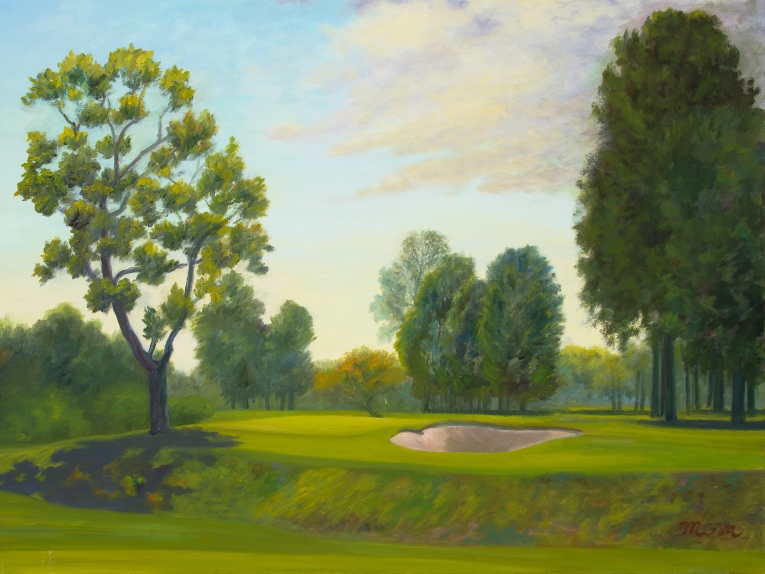
“The 12th at Riviera”
From the added back tees, the 12th can be a 490 yard par 4 into a prevailing ocean breeze, to a quite small and somewhat domed green. Of the 18 holes, It usually plays the most over par during tour events held at Riviera. The green was originally designed to receive short iron shots (the hole was around 390 yards), but even allowing for the prodigious length of the modern ball, long irons and even fairway woods are sometimes needed today. Anything right of the green, or even worse, in the bunker, will run away to the left. This green has to be missed left, but no too much because “Bogey’s Tree” and the fronting barranca can multiply your score very quickly. 30″ x 40″ o/c retail $8400
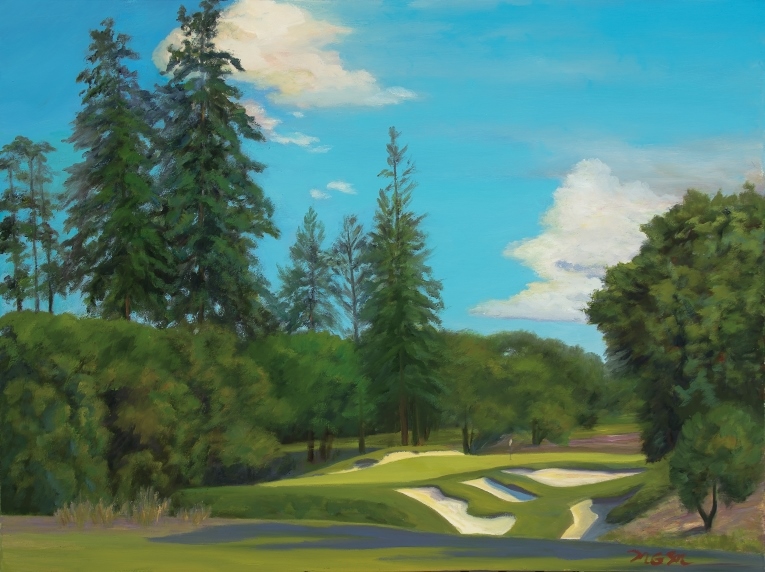
“Little Poison,’ the 15th at Pasatiempo”
I named this hole “Little Poison” because like many Mackenzie short par 3’s. it looks quite “getable.” A perfect wedge, on line and the correct distance will always leave a short putt. But get distracted by the setting and beauty of design, and an imperfect shot here leads to serious problems. A tee shot above the hole, get bunkered short right or leave a long putt and par becomes very tough indeed. 30″ x 40″ o/c $9,200
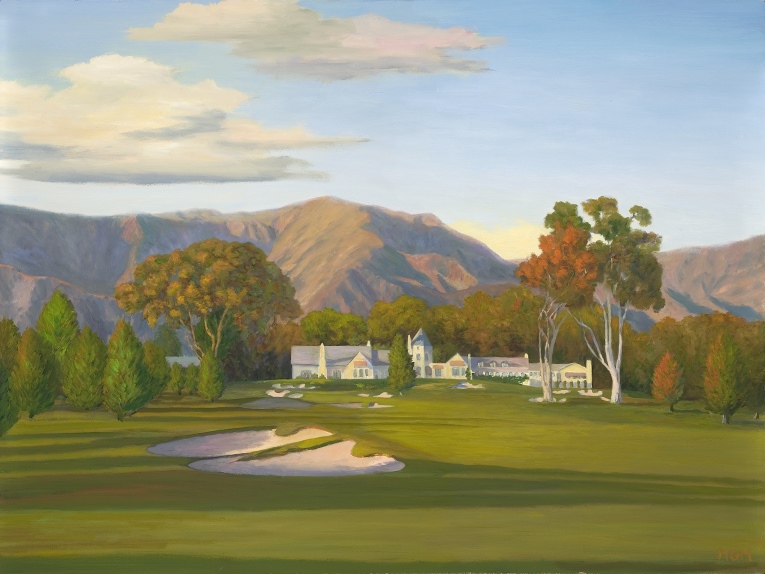
“The 18th Hole and Clubhouse at the Valley Club of Montecito”
It is the Alister MacKenzie design and the iconic clubhouse that taken together which make The Valley Club unique. Situated in Santa Barbara on the coast of California and up against the back drop of the nearby mountains, this painting depicts the elegance of a special golf setting. 36″ x 48″ o/panel $10,800
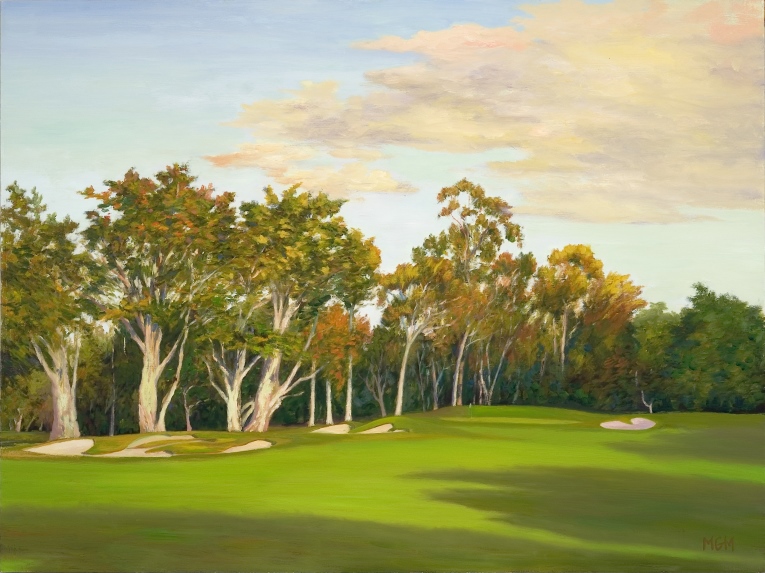
“The Sentinels to the Left of #16 at the Valley Club of Montecito”
While this par 4 bends to the left, the massive trees and fairway bunkers prevent “cutting off” the dogleg with out considerable risk. The safer tee shot to the right can leave a long second. Typical of MacKenzie, the player has to “pick his poison.” 36″ x 48″ o/panel $10,800
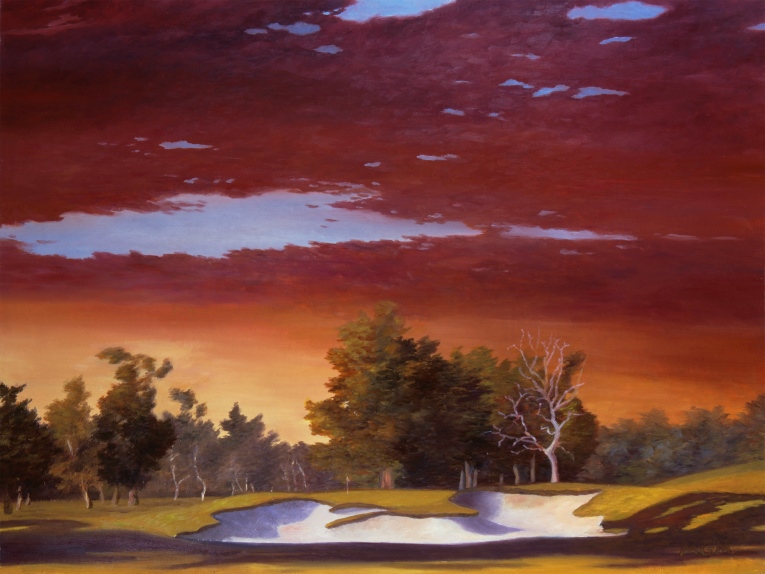
“Sunrise at Riviera’s 4th, c. 1995”
The famous fronting bunker at this magnificent George Thomas, redan, par 3 seems the major problem facing the player. Yet, the real danger is leaving the tee shot right of the green, From there, it is all down hill and all very fast. While that bunker is enormous and deep, most bogies are made while being careful to miss the bunker and ending up out of position. 30″ x 45″ o/panel $9450
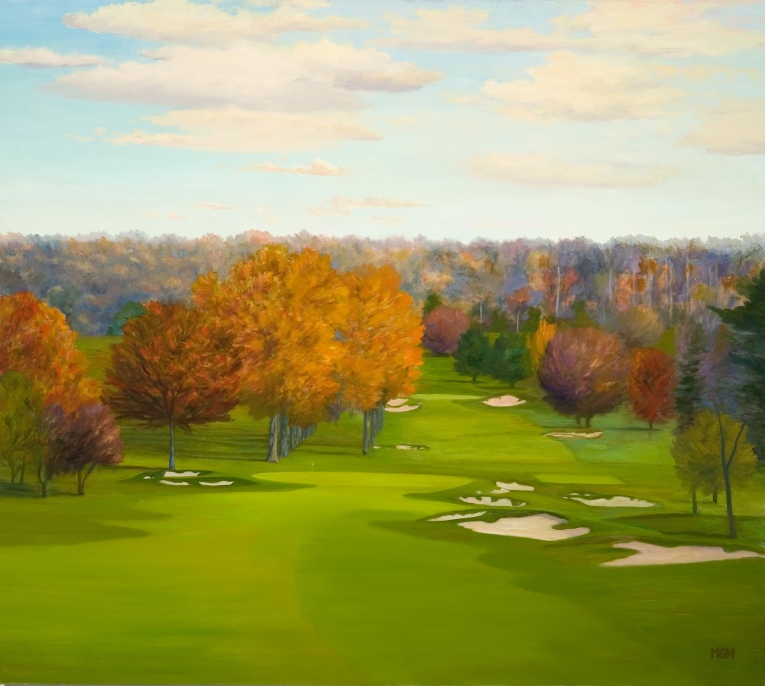
“Early Autumn at Whitemarsh Valley”
This overview from the clubhouse captures that time of year when the early autumn colors start to change but the late summer rains have still managed to keep the lush summer grasses in tact. 59″ x 56″ o/c $19,600
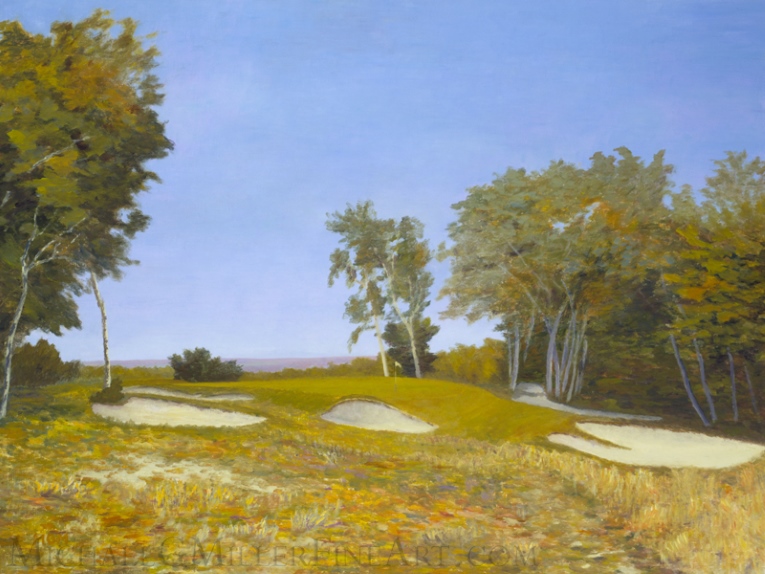
Fourteenth at Crystal Downs
The fourteenth ascends to point that overlooks the valley beyond. As is typical of MacKenzie. this is a short par three that has plenty of risk reward. Nonetheless, the painting is concerned more with the setting of Chrystal Downs and the “un-manicured” nature of certain parts of the course. The 14th is a god example of this “naturalness” and reminds the player what great architecture is all about. 36″ x 48″ oil/canvas $12,500
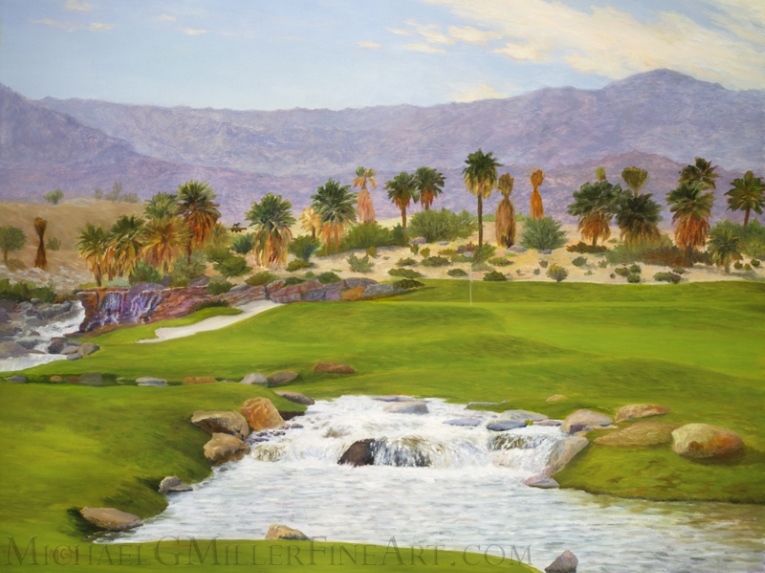
Big Horn #2, Canyon Course
A long par 4, this view is focused on the green and the dangerous water hazard left. While Fazio has a certain proclivity for water falls, even here in the desert, this one somehow seems to fit in to the general architecture. A lot of detail is evident in the background as the desert plays a large role in the navigation of the course. 36″ x 48″ o/p $12,500 framed $13,700
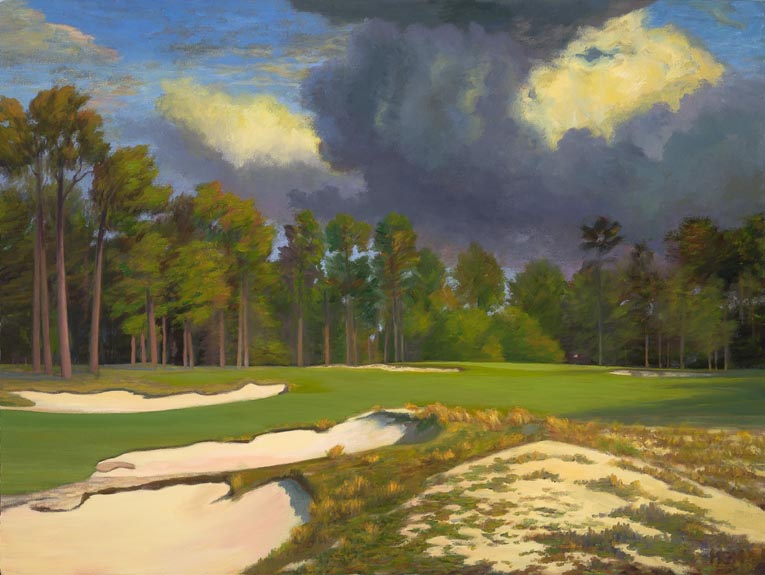
“Ominous, the 10th at Pinehurst #2”
This painting attempts to depict a sunny afternoon about to be transformed into a stormy day portended by the “ominous” sky looming over the horizon. The golfer has to either play fast or expect to get wet. 30″ x 40″ oil/canvas $12,600
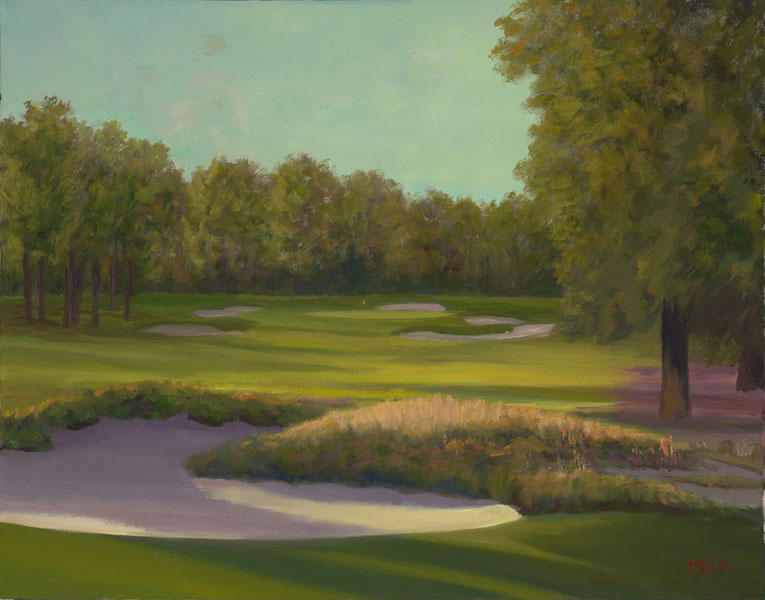
“The Deceptive Peacefulness of Pinehurst #2, 16th Hole”
This view from the fairway partially hides the serious danger that lurks in the fearsome bunkers short right of the green. While this is a very inviting and mild setting, a stray shot here can result in some following shots that are anything but peaceful. 22″ x 28″ oil/canvas $4,300
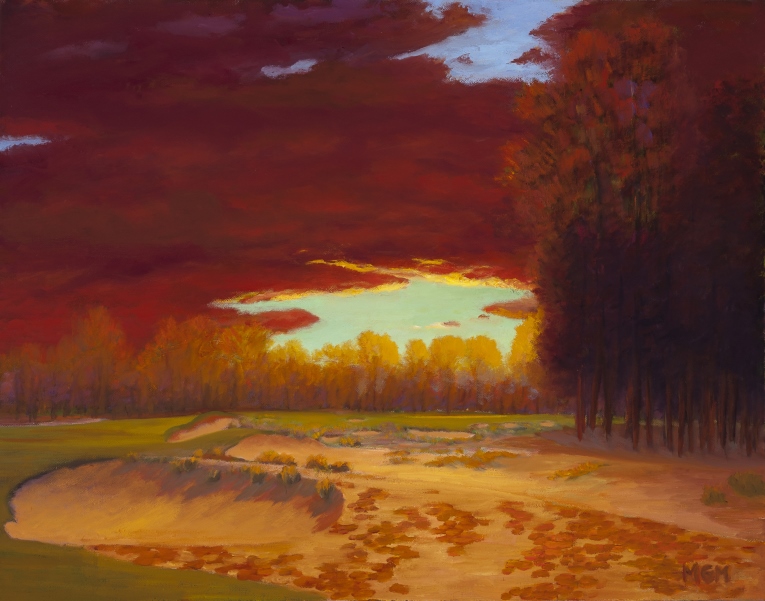
Nearing Sundown at Pinehurst #2, 7th Hole
This “luminist” depiction of #7 attempts to convey that time of day when one has to play fast in order to beat the setting sun. But in spite of the rather dramatic sky, the rustic bunkering and unmaintained areas found in this Coore/Crenshaw restoration are the real focus of the painting. The green and flag, though necessary in the painting, are but small and distant details. (22″ x 28″) oil/canvas $4,300
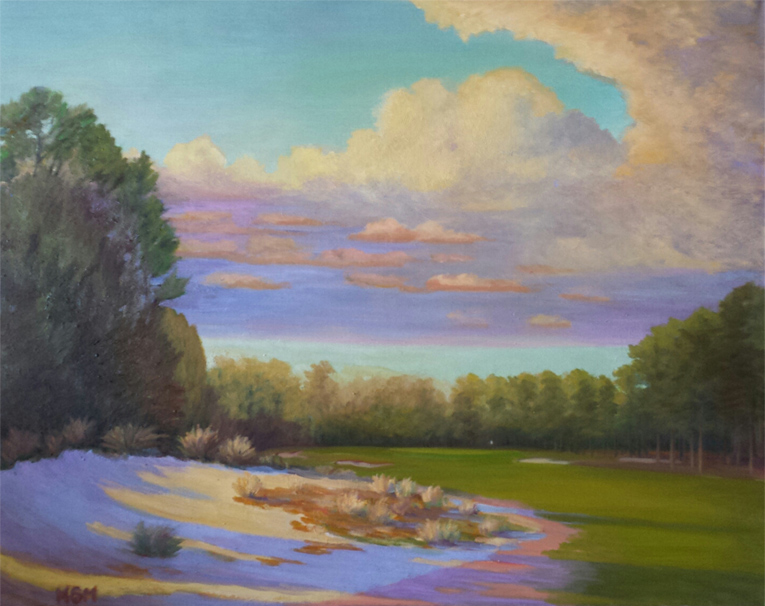
“Passing Cloud Bank, the Second Hole at Pinehurst #2”
This “atmospheric” treatment of Pinehurst #2 is in the hope of conveying the low light of late afternoon with the possibility of a change in the weather for the next day. 22″ x 28″ oil/canvas $4,300
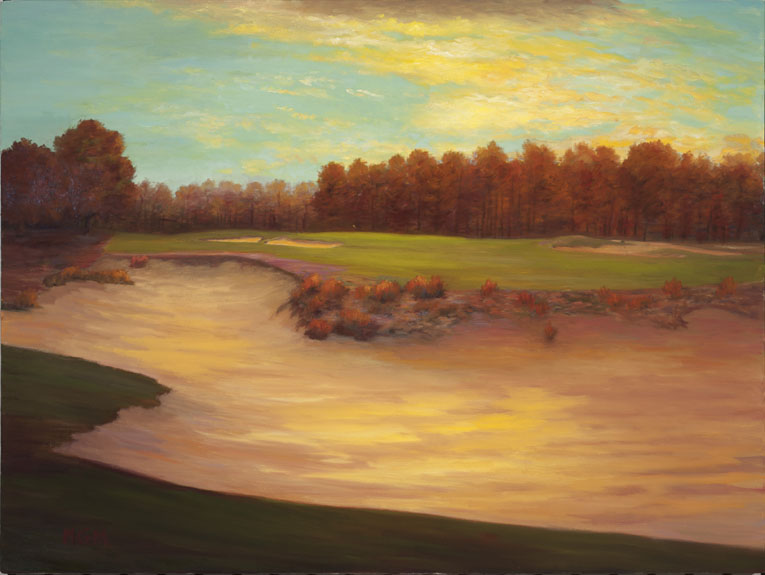
“After Dawn, the Fourteenth at Pinehurst #2”
This painting attempts to capture that feeling shared by golfers of an early morning round with dew on the grass and no players in front of you. While the sky may very well be the main focus of the painting, it is from that “illumination” that all else receives its color. And, insofar that Pinehurst #2’s “naturalness” has been restored, colors have returned to the course. 30″ x 40″ oil/canvas $8,900
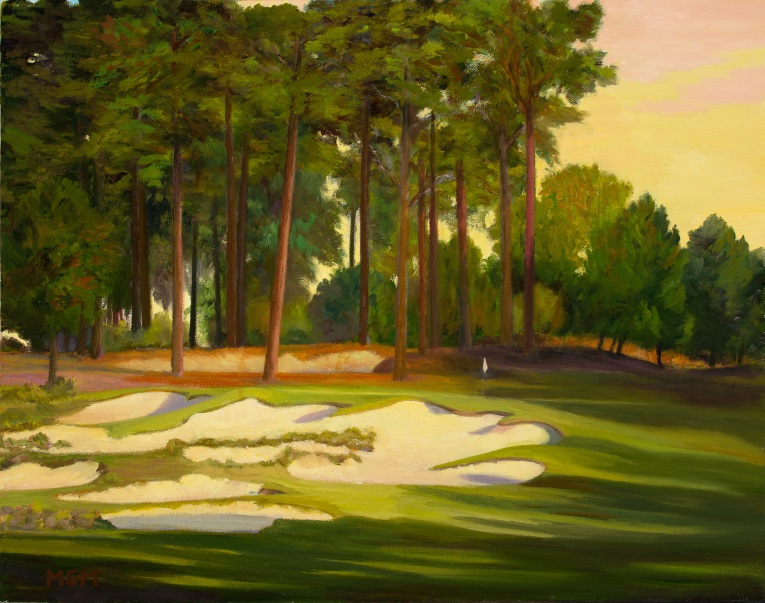
“The Perilous Approach to #12 at Forest Creek, North Course”
Perilous Approach – This view was selected as it highlights the very intricate and visually imposing bunker complex situated between the player and the narrow green beyond. Fazio did a great job of creating a bunker that gives the impression that it is separate bunkers. And with the inclusion of the separate bunkers in front, the illusion is complete. All this not withstanding the “perilous approach” shot itself, as going long to avoid the bunkers leaves a very difficult recovery to a green that slopes away. I endeavored to use the low sunlight from the right side to emphasize the shadows and “light up” the bunkers and the depth of the forest behind. 22″ x 28″ oil/canvas $4,300
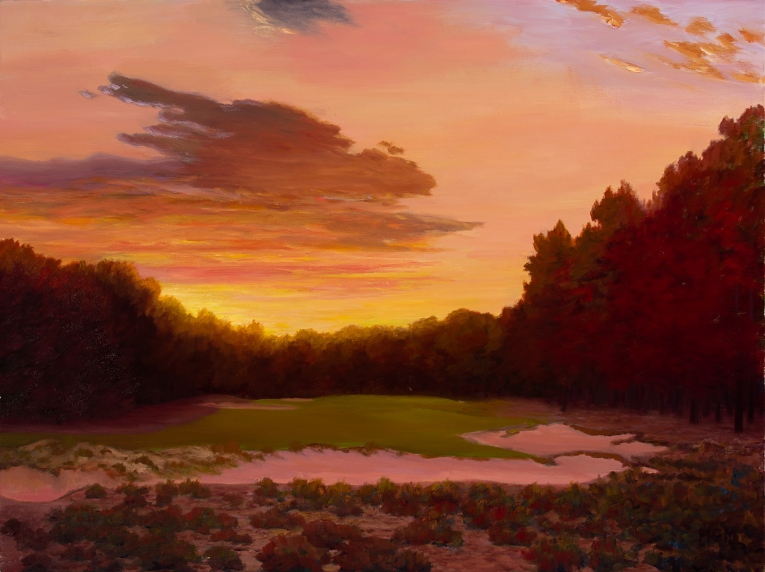
“Pinehurst #2, The Eighth at Sun Up”
The gathering light at sun up in this “luminist” style painting seems to create that morning “feeling” every golfer knows. Things are still quiet and undisturbed. There’s nobody ahead of you so the first footprints in the dew will be those of your group. There’s no wind blowing and the greens are holding. 30″ x 40″ oil/canvas $8,900
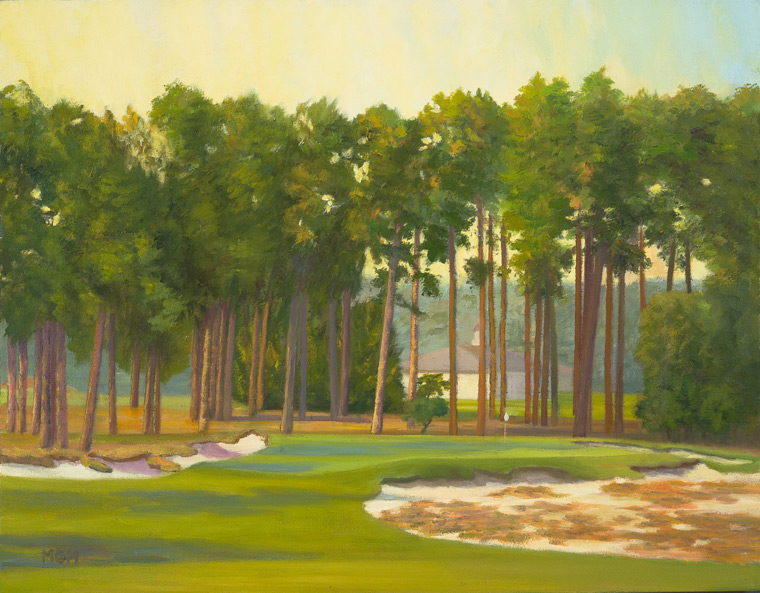
“Afternoon Sunlight, the 17th at Pinehurst #2”
Afternoon Sunlight, the 17th at Pinehurst #2 – The long shadows in the foreground and on the green emphasize the low angle of this particular afternoon. At the same time, the various colors and shading on the trees reveal the different angles of the broken light that comes through the tall pine branches. The front left to back right angle of the green makes depth perception tricky. 22″ x 28″ oil/canvas. $4,300
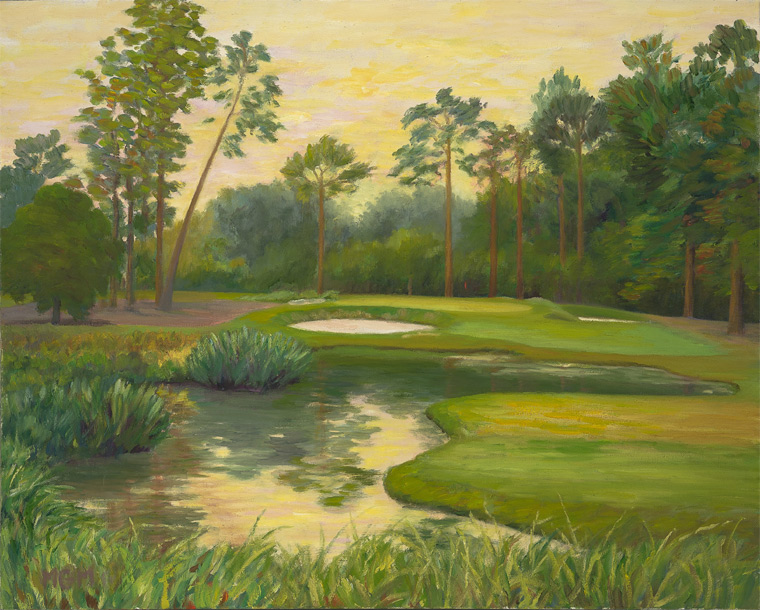
“The Serene Setting of Pine Needles #3”
The Serene Setting of Pine Needles #3 – Insofar that the third is visible from the road outside the course, it has become one of Pine Needles most well known holes. And while only a very poor tee shot will bring the pond into play, the natural pond brings a picturesqueness to the setting. The painting is an attempt to capture this naturalness and serenity while at the same time, depicting the “classic” Donald Ross features found in the green surrounds. 22″ x 28″ oil/canvas. $4,300
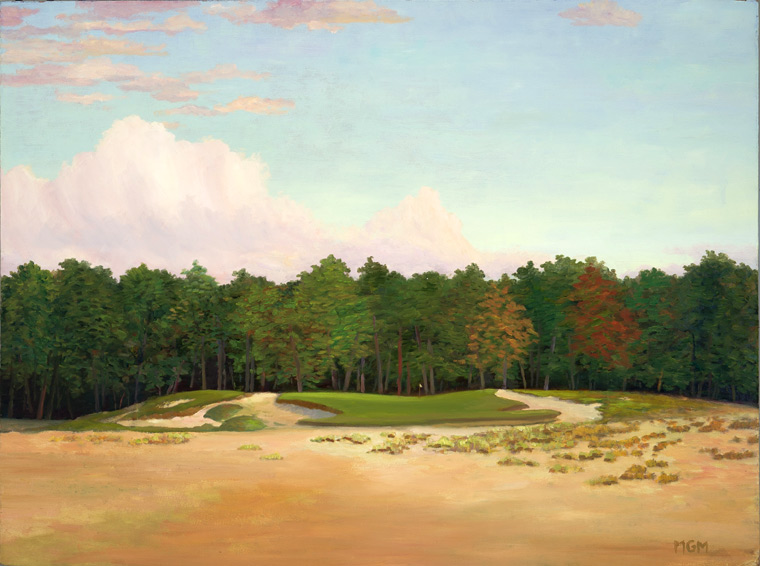
“The Sandy Carry on Pine Valley’s #3, c. 1937”
The Sandy Carry on Pine Valley #3 – The starkness of this “forced carry” par three certainly speaks for itself. Add to that the enormous, sharply sloped, saddle shaped green and you have one of George Crump’s most masterful holes. Should the putting surface be conditioned to modern speeds, 3 putts become common and 4 putts become easily possible. 36″ x 48″ o/p price $12,500
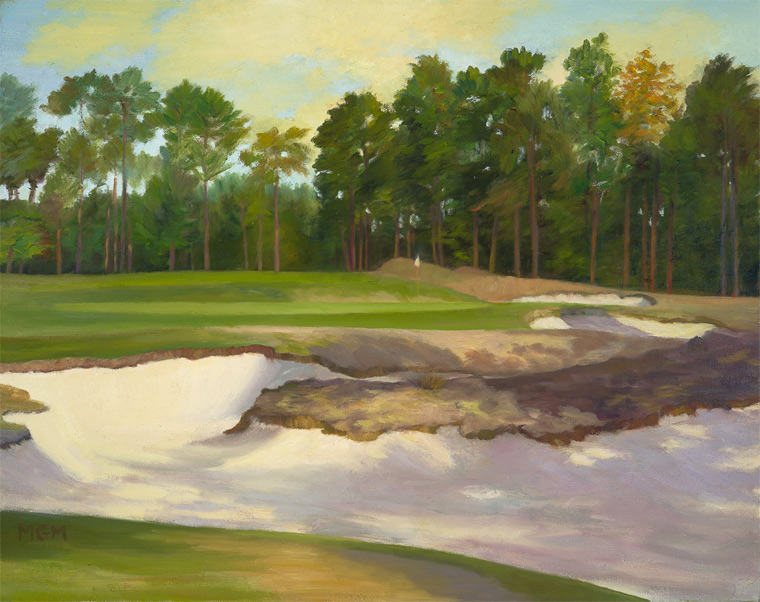
“The Imposing and Very Penal Bunker of #16, Pinehurst No. 2”
“The Imposing and Very Penal Bunker at #16, Pinehurst #2” It is bunkers like this that add drama to a golf hole. And while many at Pinehurst #2 do just that, maybe none so much as this monster at #16. I hoped to portray not only the “imposing” nature of its size and configuration, but highlight the random appearing contours and edges which make the bunker seem quite natural. The shadows in the bunker suggest the surrounding trees while the brightly lit bunker face on the left side makes for a rather dramatic focal point. 22″ x 28″ oil/canvas. $4,300
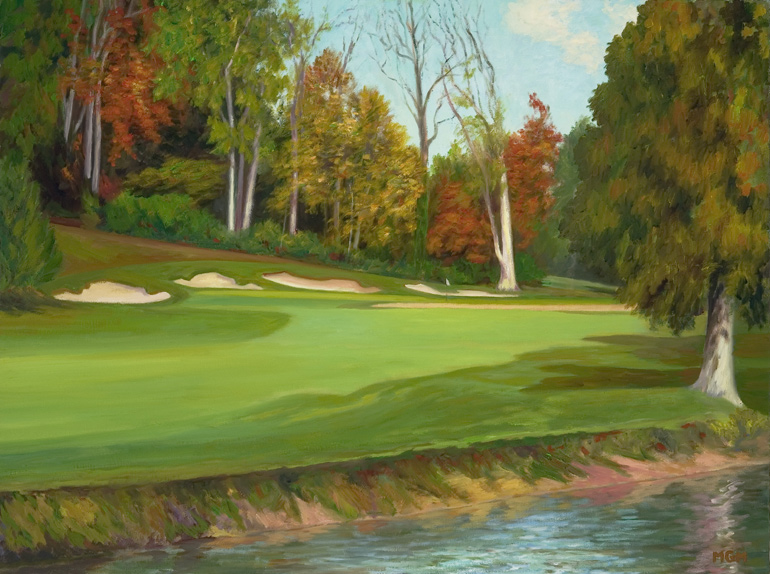
“Early Autumn at Lancaster Country Club, The Old Course, #7”
“Lancaster Country Club” – Aside from the beauty and elegance of this masterful William Flynn design, I selected this particular view of the 7th hole at Lancaster CC because of the variety of compositional elements which are highlighted by the fall colors. The diagonal of the creek, the variety of shapes in the four bunkers, the white tree trunks, the colors of the foliage and the lush fairway grasses all contribute (if the colors are well represented) to a feeling of compositional completeness. If the viewer feels like this scene is authentic, then mission accomplished. 30″ x 40″ oil/canvas. $9,400
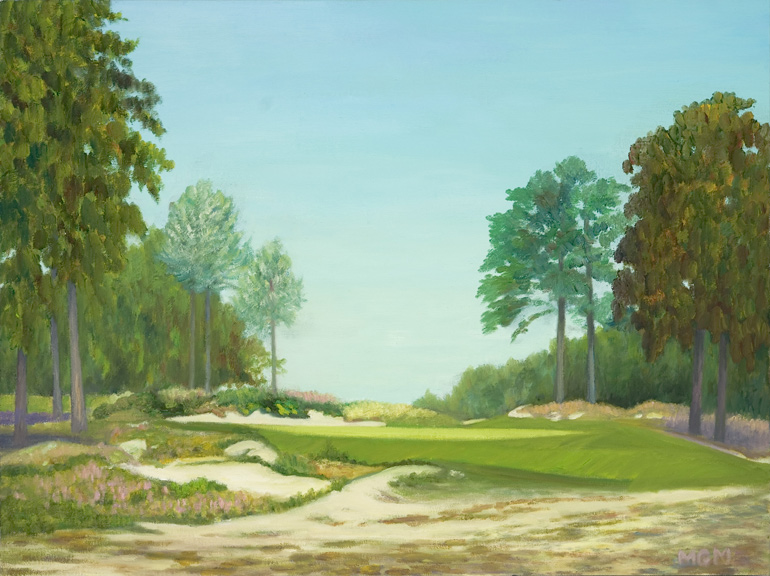
“The Pristine Grounds of Friars Head, #8”
“Pristine Grounds at Friars Head” – Whereas there are more dramatic holes at Friars Club, I selected this one as it incorporates what is so appealing about Coore/Crenshaw designs: the use of existing ground and unmaintained areas. I find myself gravitating to Coore/Crenshaw architecture for the apparent naturalness and ruggedness that they seem to “leave” in their best design work. Here, I found the pristine nature of the location and the way it is seemimgly undisturbed by the golf hole to be very appealing to the eye. 18″ x 24″ oil/canvas. $3,500
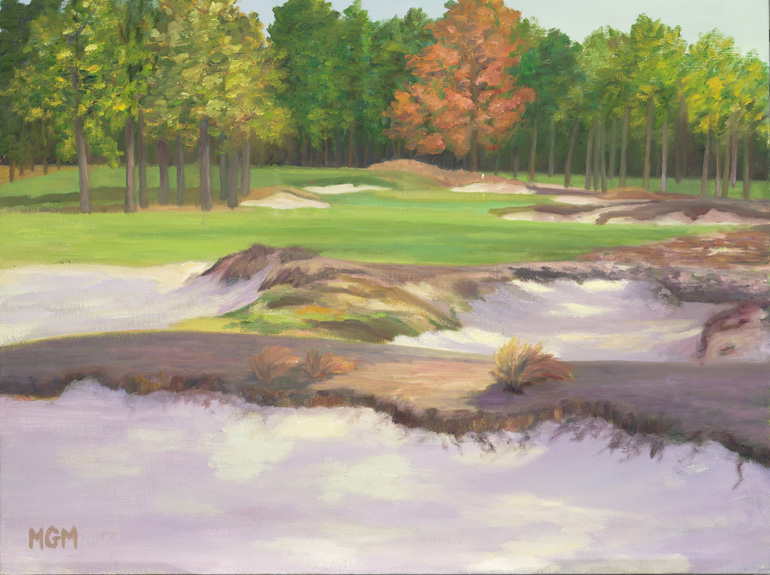
“Sun Dappled Bunkers at Pinehurst #2, 16th Hole”
“Sun Dappled Bunkers at Pinehurst #2” – As mentioned earlier, I greatly enjoy painting Coore/Crenshaw designs. And while this is a Coore/Crenshaw restoration of Donald Ross’s masterpiece, the feeling is the same. These architects are able to use the non maintained areas and natural ground to tremendous effect. What a pleasure to paint naturalness instead of manicured green grass and carefully edged, white sand bunkers. Plus, since the “sun dappled” bunkers indicate that there are pine trees next to the fairway, there is no need to incorporate them into the painting. 21″ x 28″ oil/canvas. $4,700
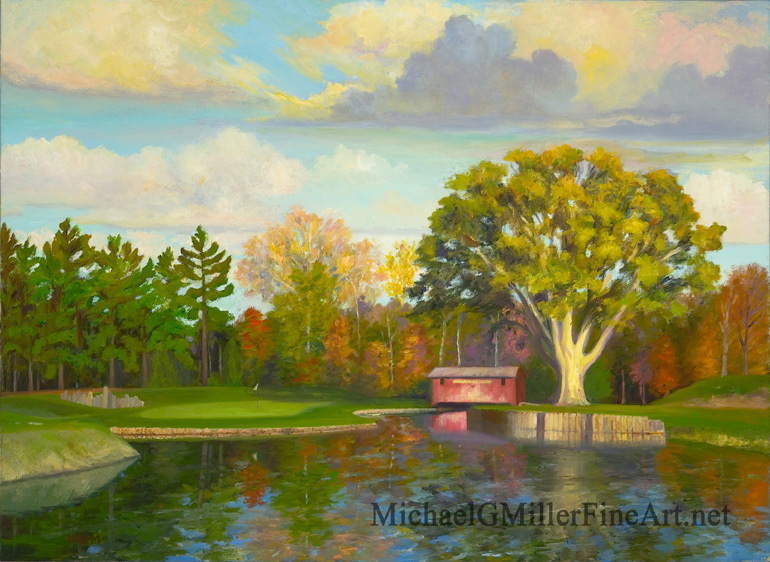
Dangerous Tranquility at Crooked Stick #6 – As the title suggests, this par 3 (can play up to 220 yards) entices the player with a very serene setting, but one that can jump up and destroy any round that may be intact to this point. Even if one avoids the water, left of the green is almost dead, front pin positions require exacting precision and any ball landing middle or deeper will roll off the back. That leaves the dangerous back right pin position as the most accessible. Nonetheless, the prudent player will just try to hit the green and move on. 32″x44″ oil/canvas. $10,800
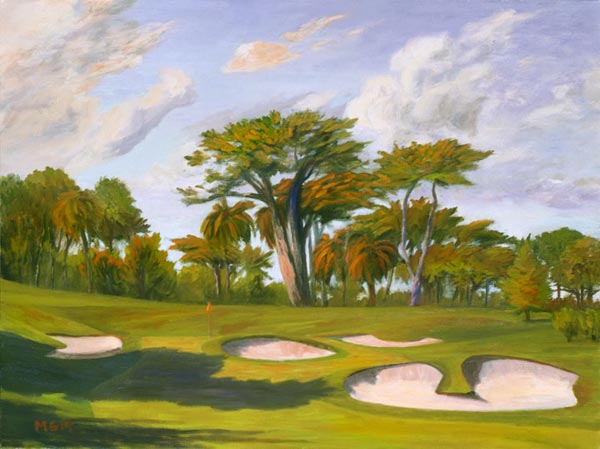
Approach to a Small Target, the eighteenth at The Olympic Club (Lake Course), c. 2000
The very short but very demanding 18th requires pin point accuracy, both off the tee and with the approach. This view from the left side offers the best angle and view to reach the putting surface, although even if reached in regulation, the green offers many problems for a less than well judged and struck putt. It is not a bad idea to stay below the hole with your shot to the green, even if one is left with a chip shot. 24″ x 32″ oil/canvas $4,750
For information on commissioning Mike Miller to paint a specific hole for you or your club, please contact him directly on 765.621.5695. Limited edition prints are also available for the paintings featured below. Final edition prints are signed, numbered and titled, on Somerset Velvet paper, either cut or torn (deckled) edges, sprayed with UV protective coating, packed in clear sleeve with foamcore backing. Mike Miller can reached at mgmfineart@gmail.com or through his web site millerfineart.com.