

California Golf Club of San Francisco
CA, USA
Green Keeper: Thomas Bastis
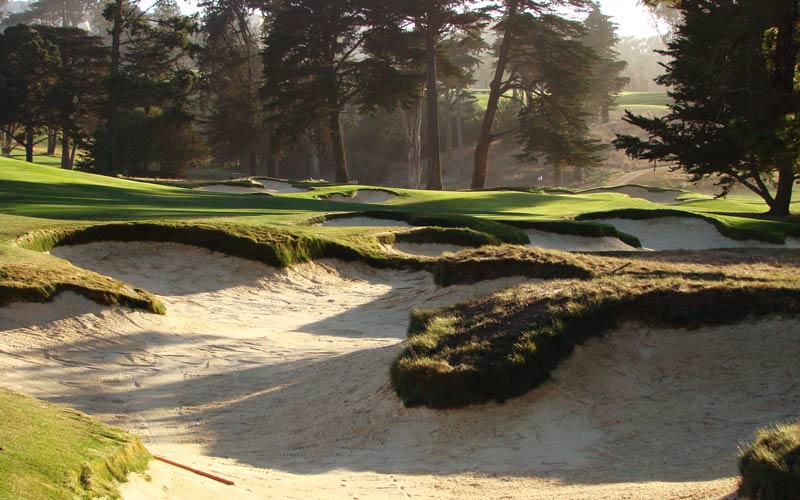
The newly created third hole, which doglegs right past this impressive nest of bunkers, is but one reason why the California Golf Club is the now the best that it has ever been.
When is the best a course has ever been?
In the case of many California courses built during the Golden Age, the answer is frequently within its first decade. Some of the greatest designs ever seen in the United States- Lakeside, Bel-Air, and Los Angeles – were radically changed for the worse prior to World War II. Other designs like Pasatiempo were compromised by the subsequent residential component that was built too close to the playing corridors. Only a few clubs like the Valley Club of Montecito have retained and/or returned the best playing attributes of the course’s original design.
Yet, there is one club that has returned the best Golden Age design features to its course and taken full advantage of the finest aspects of modern golf architecture and agronomy. The result is a startling transformation that makes the California Golf Club of San Francisco arguably one of the golf-rich state’s five finest courses for the first time in its history.
Originally incorporated in 1918, the California Golf Club moved from its Ingleside location to its present site in 1924.Referred to as the Baden property after Baden Farms, the new site was well removed from what then constituted the city of San Francisco. The California Golf Club hired the Scot Willie Locke to do the original routing and the opportunity presented to him was excellent as the Baden property measured over 550 acres. The final site that Locke chose was full of interesting land forms and possessed views of Mount Diablo (the tee shots and/or approaches at the sixth, eleventh, fourteenth, and seventeenth line up on it), Mount Tamalpais, San Bruno Mountain, and the San Francisco Bay to the east.
Though Locke is not a familiar name today, he is credited with designing nearby Lake Merced as well as Rosedale Golf Club in one of Toronto, Canada’s poshest suburbs. Sean Tully, the well respected historian and devoted chronicler of Alister MacKenzie’s work, believes that Locke’s visit to Pine Valley was directly responsible for the 200 plus bunkers with which Lake Merced originally opened. Tully also hypothesizes that Locke’s fallout with the California Golf Club stemmed from his unflinching desire to build small greens.
Whatever the reason, the California Golf Club elected to replace Locke with A. (Arthur) Vernon Macan, an Irishman who lost part of his leg in World War I, when construction started in 1924. Macan eventually made quite a name for himself throughout the pacific northwest but his disdain for travel meant he never achieved the same standing of his more famous Golden Age contemporaries. Though it is unclear if Macan made any routing changes here, he deserves full credit for the original greens, tees, and bunkering and was thus credited as the architect of the course when it opened. Uniformly favorable reviews followed, in part because it was fully mature when play commenced as grow-in occurred in both 1925 and 1926 as the California Golf Club mandated zero play until the clubhouse was completed in 1926.
Macan’s greenside bunkering and green contours were appealingly bold. However, his fairway bunkering lacked the same inspiration and popular conjecture is that Macan planned to add fairway bunkers after play had commenced. Indeed, this concept of studying play and then adding bunkers based on where divots were was not uncommon back in the 1920s. It truly makes sense, which is to say why not put bunkers directly where they influence play (i.e. where divots are) as opposed to on the sides of holes where they frequently only snare already bad shots. However, in 1927 when it came time to address the fairway bunkers, the California Golf Club elected to go with a different architect, again for reasons unknown.
Happily though,it was Alister MacKenzie, from the design firm of MacKenzie & Hunter. We all know the fame that MacKenzie later achieved by virtue of such world class designs as the West Course at Royal Melbourne, Augusta National, Crystal Downs, and Cypress Point. Timing-wise though, this was only his second project in North America (the Meadow Club one hour’s drive to the north was his first), so he was yet to become the name in golf course architecture. As an aside,it is worth noting that the American Golf Course Construction Company that MacKenzie formed and used here was the same group that worked on Cypress Point the following year.
His assignment at the California Golf Club was to redesign all the bunkering and rebuild at least two of the greens (the tenth and eighteenth). However, to be perfectly clear, he did not change any of the playing corridors and the photographs prior to his arrival show the course was already a very good one.
Having said that, MacKenzie’s flair for building bunkers was immense and after his work was complete, the California Golf Club‘s reputation was cemented as one ofthe best in the state and it began to host important events like the California State Open. Unfortunately, world events can always push sports to the side and such of course was the case with the Great Depression and World War II.
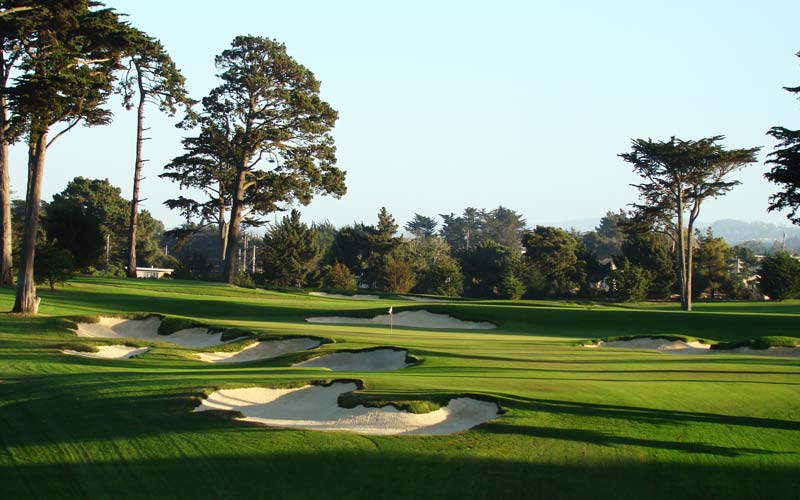
California Golf Club’s quartet of one shotters help make the course a stand-out with MacKenzie’s bunkers providing the strong appeal to the 200 yard twelfth.
Eventually, better times returned and by the mid-1960s, the California Golf Club once again wanted to make sure that they offered the best course possible and the day’s biggest name in golf architecture, Robert Trent Jones Sr., was brought in. His work is discussed below though little of it remains today, and the California Golf Club proudly hosted the United States Senior Amateur in 1970.
In 2005, the California Golf Club board decided to address the nematode problem that was afflicting the greens just as it was at other leading clubs in northern California. Given that the greens needed to be rebuilt and thus the course would be closed, the California Golf Club board mulled over what else needed attention. Certainly, the course didn’t drain particularly well in the winter. Also, the bunkers in general had become tired and there were several competing styles as no one would ever confuse a Jones bunker for a MacKenzie one.
Sensing this was a one-time unique opportunity to make major improvements to the course, the California Golf Club solicited proposals and fourteen different architects responded. One of the fourteen, Phillips Design, didn’t even submit a plan but rather gave them a sense of the opportunity that it saw by looking at the land where the new seventh hole now sits. This bold vision of Kyle Phillips impressed the board and ultimately it led to his being hired.
As we will see below, his proposal differed in substantial ways from the other proposals/architects that the California Golf Club considered. In particular, the front nine had seen several events conspire against it since the days of MacKenzie and Macan. To bring the front nine up to a similar quality as the back, Kyle Phillips‘s plan needed to be dramatic and indeed it was. Its two key elements were for the practice area to be relocated as well as for five (!) entirely new holes to be created. To Kyle Phillips‘s everlasting credit, three of the new holes (the third, seventh and eighth) are among the best on the course and as a result, the members now have an active debate as to which of the nines is better.
Just as important, Kyle Phillips knew when to leave well enough alone. No outside events had materially impaired the back nine as they had the front. Thus, there was a sense that the California Golf Club possessed a relatively untouched nine that featured MacKenzie’s own indelible stamp. Armed with a 1938 aerial, Kyle Phillips focused on realizing as much of MacKenzie’s playing spirit as possible on the back. In doing so, two small man-made ponds that had been added by the California Golf Club in the early 1990s were mercifully removed and the fifteenth green was slid to the right by thirty-five yards.
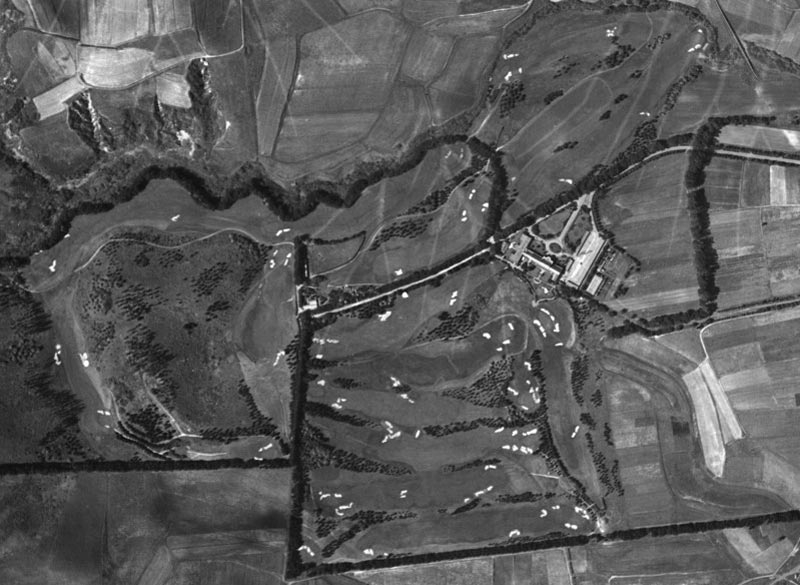
This 1938 aerial served as a guideline for recapturing numerous bunkering schemes. For instance, the central bunkers in the fifteenth fairway (i.e. second fairway from the bottom of the photograph) were brought back into play.
When Kyle Phillips was done, the two nines seamlessly melded together under one design style consistent with the Golden Age. However, just as crucial to the project’s overwhelming visual success was what went on underground. Without doubt, the foundation of this project commenced six feet under whenall the drainage was replaced. In addition, there was an amendment of sand brought in with four to six inches spread across all the playing surfaces. The poa anna grasses were replaced by bent with a fescue mix in the fairways and native fescues were allowed to grow in the rough.
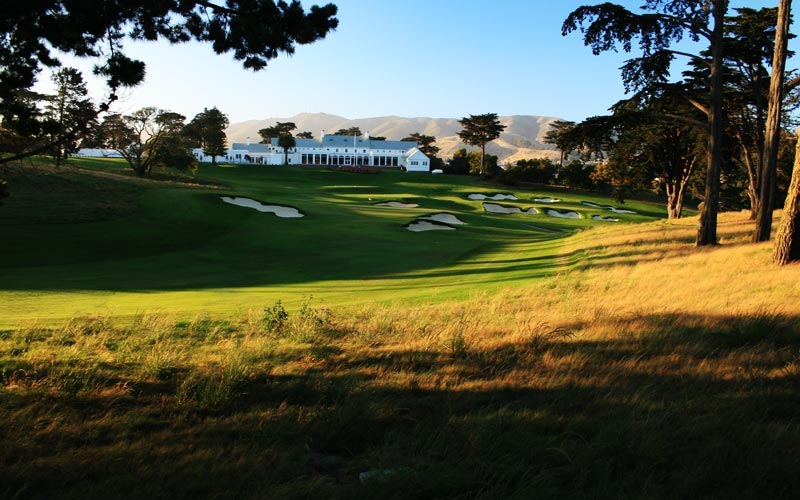
Thanks to new drainage, the sand amendment and the new fescue and bent grass selections, California Golf Club now plays as well as it looks.
The result of the above and below ground work is a sequence of holes that now play better than at any point in their history, as we see below.
Holes to Note
Please note: The hole yardages below are from markers that measure slightly over 6,800 yards. There is another set farther back that stretch the course to over 7,200 yards, from where a professional tournament could be played. The name of the back tees is Venturi, in homage to the United States Open champion who joined the California Golf Club in 1949 through the help of his patron Eddie Lowery. Lowery was the California Golf Club president in 1947, and despite a very rich life, he will always best be known for being Francis Ouimet’s ‘little caddie’ in the famous play off with Harry Vardon and Ted Ray for the 1913 United States Open Championship at The Country Club. In 2006, Venturi kindly assisted the board by speaking in favor of Kyle Phillips‘s plan and he told the members at a dinner meeting with Kyle Phillips, ‘You get one chance in a lifetime to do this and you don’t get a mulligan.’
First hole, 510 yards; Though there was plenty of gnashing of the teeth in regard to moving the practice are aaway from the clubhouse/first tee, the playing characteristics of this hole help to soften the blow. Namely, this is a reachable par five, which allows the California Golf Club golfer to ease into the round without immediate severe shotmaking requirements. Consistent with a Golden Age design, there is a feeling of spaciousness off the tee with the challenge stiffening at the green.
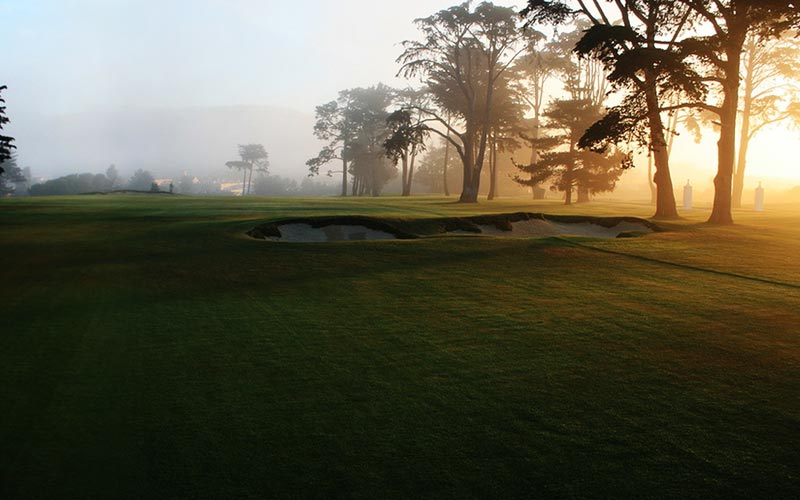
As seen in early morning light, the view from the first tee is one of uncluttered pleasure.
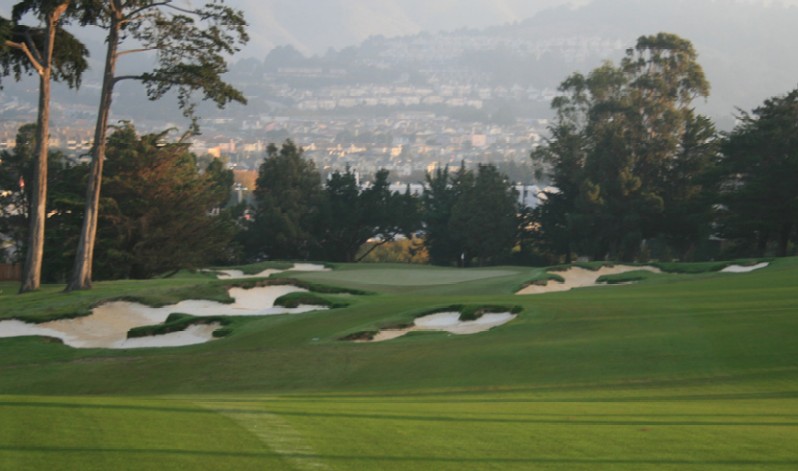
One of the neatest green complexes on the course is here at the first, with its steeply pitched back right to front left green and pit of despair bunker over back right.
Second hole & third holes, 410 & 415 yards, respectively; The surest way to improve a course through either a restoration or renovation is by improvingits worst hole(s). Good to great holes have a way of taking care of themselves but outright poor holes lower how a course/club is perceived in a more drastic manner than good holes do in elevating it. Here, time had been cruel to these two holes with the now busy Westborough Avenue having replaced the San Bruno Creek as the north boundary to the California Golf Club‘s property. Trent Jones did the course no favors when he crammed the second hole between a hillside and this busy road in 1963 for the sake of keeping the existing practice area in tact. Phillips displayed his big picture prowess when he envisaged moving the range further into the interior of the California Golf Club‘s property and creating a new second and third holes. Asking for the range to be moved away from the clubhouse was a divisive request and it could have cost him the project. To his credit, Kyle Phillips stuck to his belief and was unwavering that the range be moved as it was truly in the course’s best interest. To the California Golf Club board’s credit, they weathered the criticism from some members and eventually agreed to relocate the range six hundred yards away. This created the room for the new second with its excellent green and the striking new downhill third. Previously, the third hole was a Trent Jones par three that played over a man-made lake that reeked of something out of the 1960s. Kyle Phillips‘s third with its Golden Age overtones is a remarkable improvement.
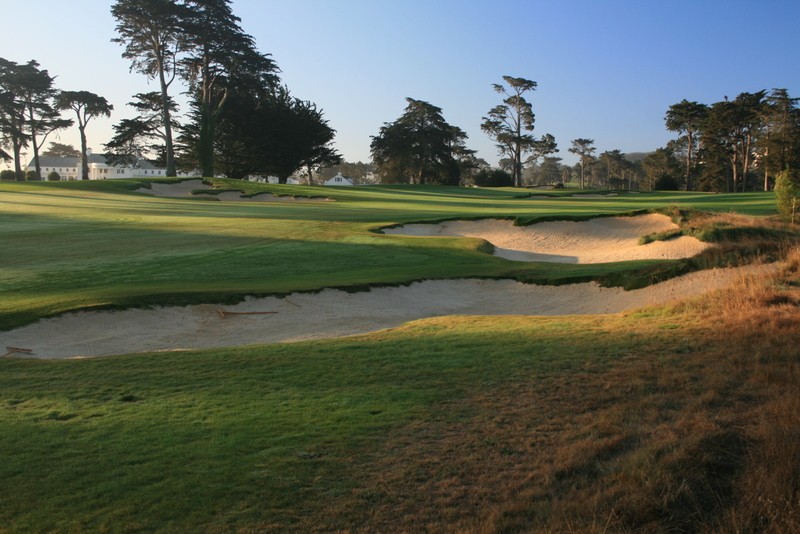
This area was once the practice area and by moving the second up here and away from the road, the hole now in keeping with the expansive nature of the other holes.
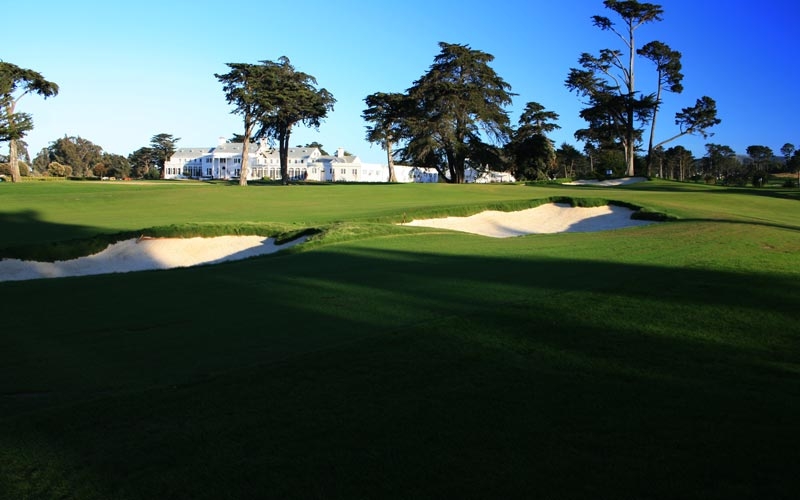
Taken forty yards short and right of the second green, the eye can’t discern where the fairway stops and the green begins. As we will see later at the seventh hole as well, when given the opportunity to build a new hole, Phillips looked to add playing virtues that were otherwise missing. In this case, he built a low profile green glued to the ground, which acts as a nice compliment to the pushed up and/or elevated greens found on the next four holes.
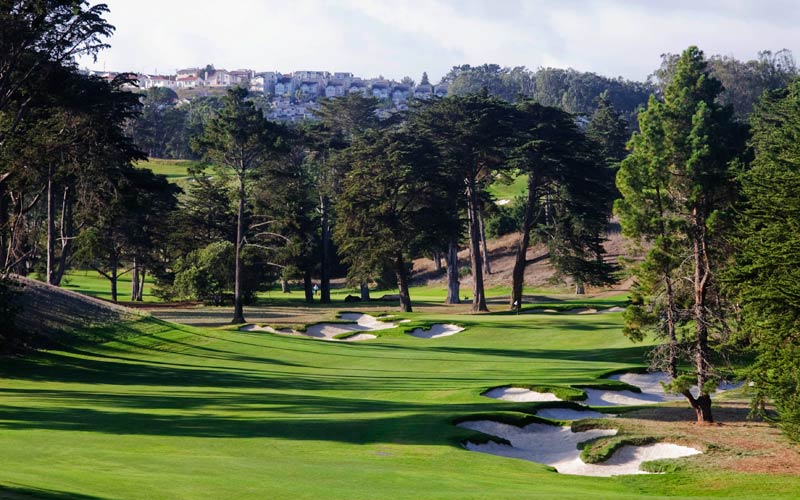
As opposed to a par three of no great merit that played to a green with an artificial water hazard, Phillips created this downhill two shotter that doglegs right past a striking nest of bunkers that look right out of the Sandbelt of Melbourne.
Fifth hole, 325 yards; Short par fours have always been used by skilled architects as a means of transporting a golfer uphill without allowing him to become bored or discouraged. Examples include Macdonald’s second hole at Sleepy Hollow as well as his fourth at Mid-Ocean, Donald Ross’s seventeenth at Essex County, and Coore & Crenshaw’s eighth at Colorado Golf Club. Modern equipment leaves the golfer with many options on how to play this hole. A driver can leave a mere flip but as can be expected to an uphill green on a Golden Age course, the green features a ferocious amount of back to front slope. The wise golfer may opt for a shorter club off the tee for the sake of being able to control a full wedge in.
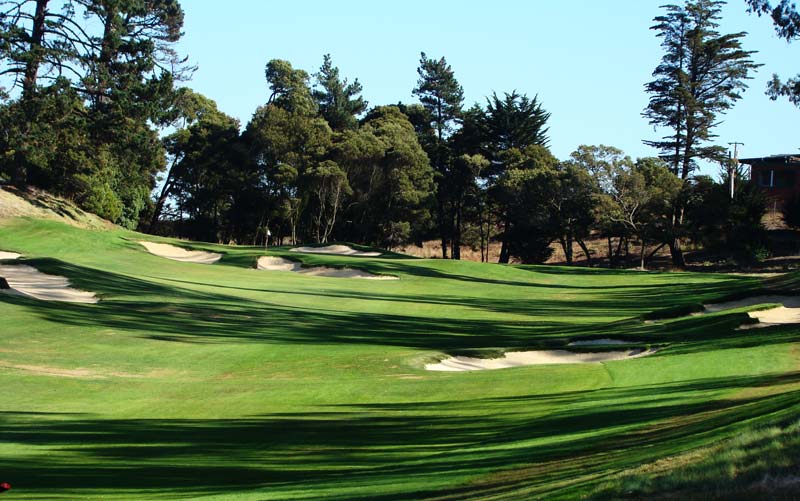
Phillips did a commendable job of extending the left bunker further into the fairway, guarding a plateau some eighty yards short of the green from where it is ideal to play one’s pitch.
Sixth hole, 180 yards; The first of a superlative set of one-shot holes, the pushed up sixth green complex takes maximum advantage of its stellar location. Undoubtedly, C.B. Macdonald and Seth Raynor would have taken this opportunity to build an Eden, given the long views in the background. However, as the last hole just featured a steep back to front fall in the putting surface, Macan went in the other direction, which is to say that a green was built that falls slightly away toward the back left. Especially as this hole plays with the prevailing wind, the challenge is to have one’s tee ball avoid the deep front greenside bunkers while not rolling over and down its tightly mown back slope.
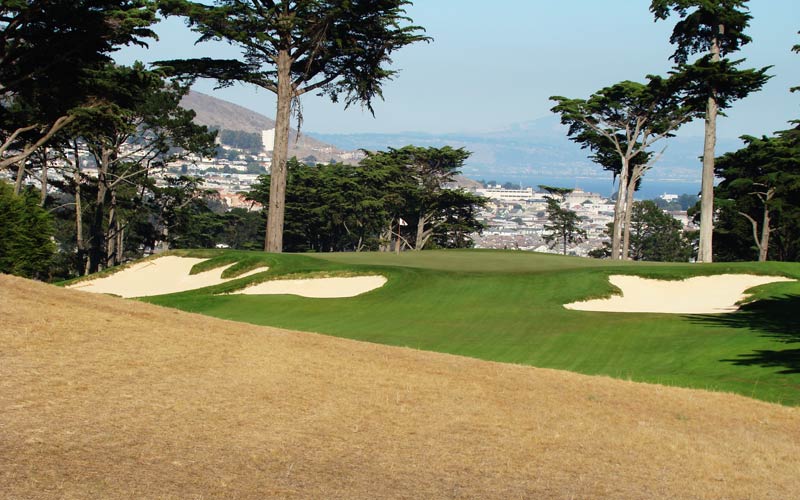
On a course full of long views, this is one of the best with the San Francisco Bay seen in the distance beyond the hard to find sixth green complex.
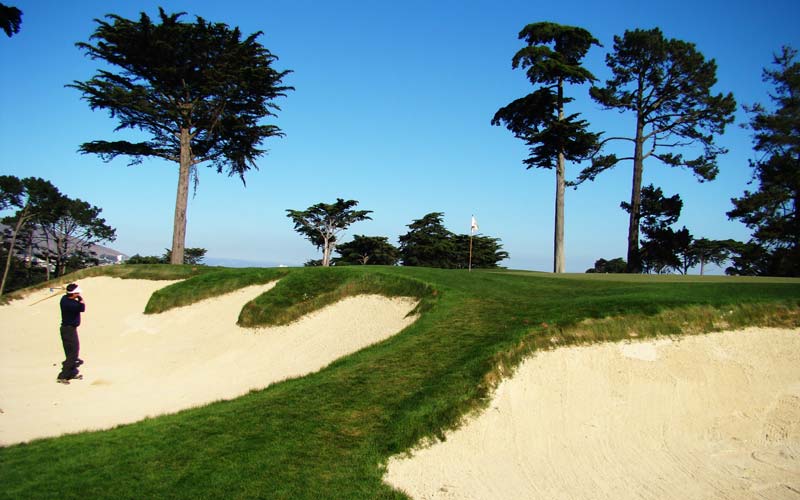
The deep bunkers promote the notion of not being short off the tee but a recovery shot from them may…
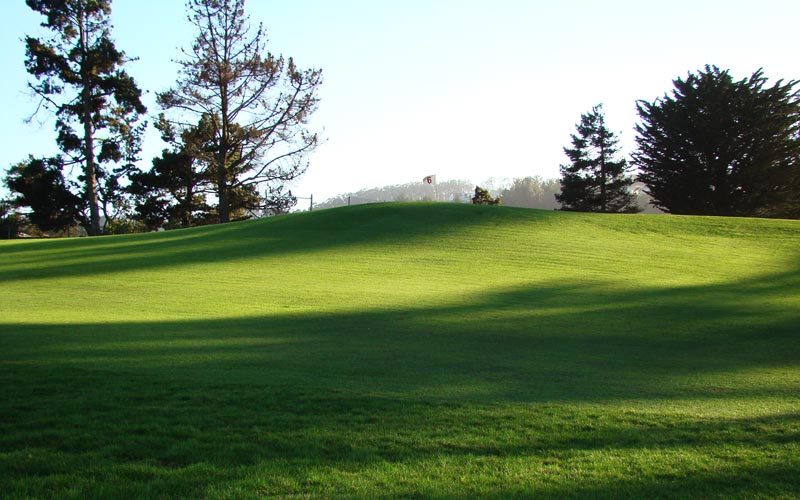
…be easier than playing a ticklish little pitch from the tight grass beyond the green.
Seventh hole, 405 yards; In trying to find criticism of the course as it is now played, there is little to grasp onto. Perhaps the simplest one is that four of the playing corridors on the back nine roughly parallel each other, which hints at a lack of playing angles (in fact the bunkering schemes and how holes thirteen, fourteen, fifteen and seventeen fall across the land snuff out such concern). Still, it is a welcome addition to the overall variety of the course to find this newly created Cape hole by Kyle Phillips. In fact, the hole seems such a natural today, one wonders why none of the previous architects pursued it. The reason is actually simple: a fair amount of earth moving had to occur to make the fairway suitable for golf and that was beyond what the Golden Age architects could have undertaken given the equipment/budget at their disposal. Though none of the other architects that the California Golf Club interviewed had the vision of creating a hole here,the new seventh and the timeless strategic questions that it poses make it feel like it absolutely belongs on this Golden Age course. Though only Kyle Phillips possessed the mental image required to create it, hindsight shows that not incorporating the deep hollow which the fairway bends aroundwould have been a great pity.
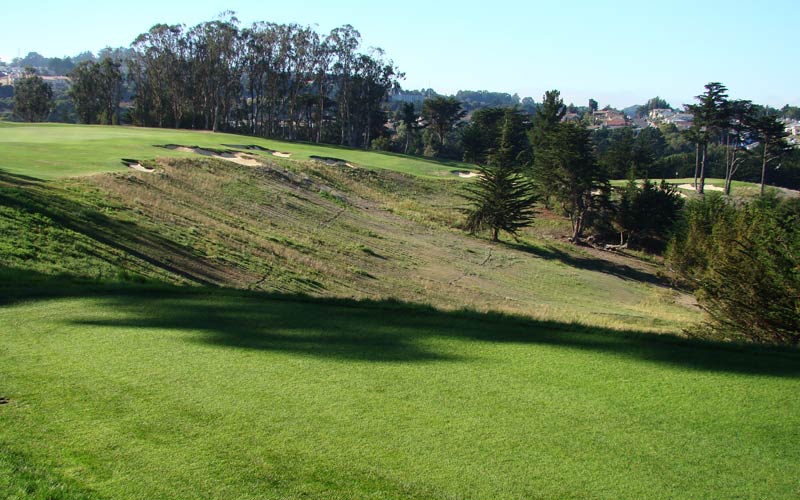
There is almost ninety degrees of playing angles for the golfer to consider off the new seventh tee. Shorter hitters go left of the bunkers that were cut into the ridge whereas the tiger golfer who can carry it 280 yards may well aim forty yards to the right (!) of the same cluster of bunkers.
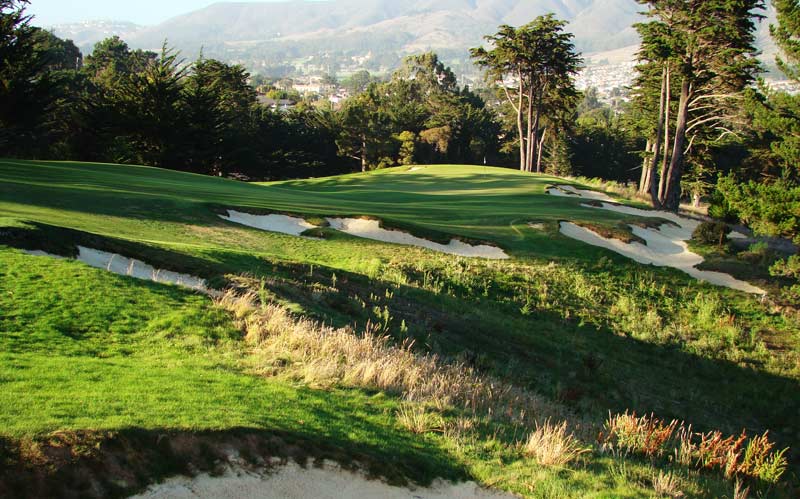
The green juts out into the same hazard that the tee ball carries, making it the proper definition of a Cape hole. The hole’s risk/reward angles enhance the course’s overall challenge.
Eighth hole, 215 yards; While the big picture thinking on this project was outstanding, so too was the detail work. With the advent of the seventh hole, the possibility was created for a long one shotter to play from the shoulder of the hillside to a green well below. Everything about the hole is big including the long views out to San Bruno Mountain. The fun though is had in a three foot mound that Kyle Phillips and his talented shapers built ten yards shy of the green that can be used to help propel balls well onto the deep putting surface. His shapers went to painstaking efforts to ensure that the mound plays just right and this is but one example whereby without their in-the-dirt efforts, Kyle Phillips‘s vision for the California Golf Club would not have been fully realized.
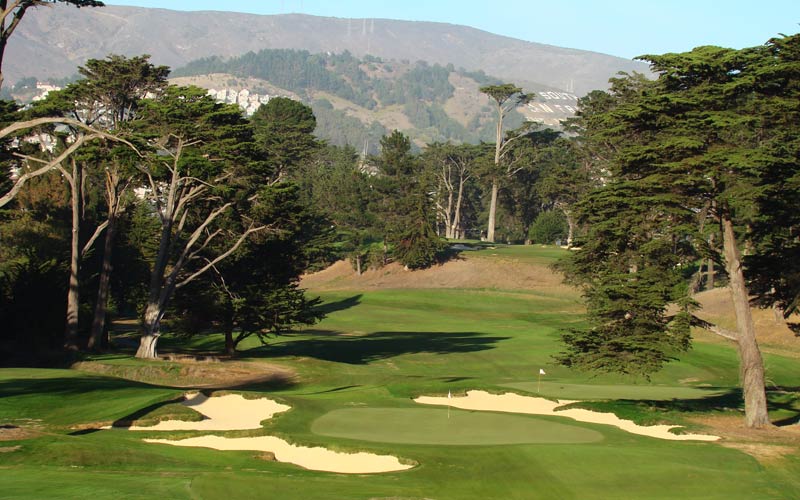
The golfer could stand on the eighth tee all day trying to get the tee ball just right. The mound that is front right of the green is barely discernible but adds great variety to how one should consider playing the hole. The third green is beyond.
Ninth hole, 400 yards; This classic dogleg was made possible only by Locke’s willingness to have the golfer climb a steep hill with his tee ball. Arguably the best two shotter on the course, it is therefore hard to believe that few modern architects would share his same conviction in routing a hole up and over such a steep embankment. Too many modern architects would either not route the hole in such a manner or even if they did, they would make some sort of saddle cut into the hillside to lessen its stern appearance. Either way, course and hole would suffer.
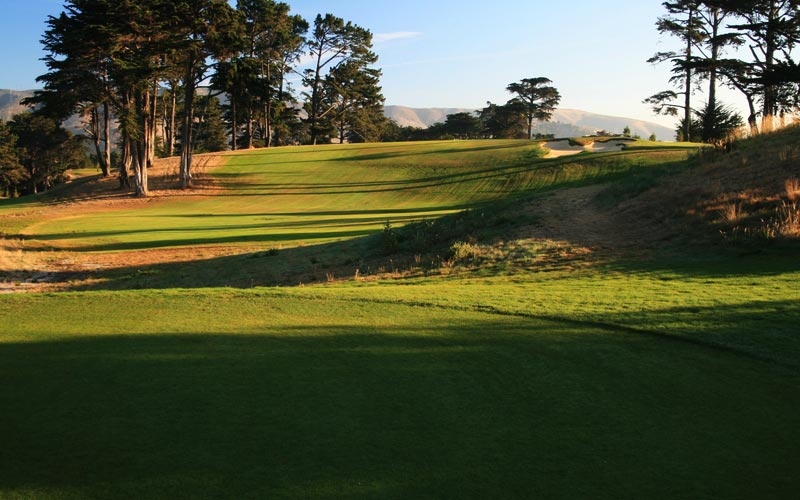
A great routing captures the most unique landforms of a property and Locke should be lauded for routing the ninth up and over this embankment. Originally built in the days of hickory golf clubs, this tee ball would have been particularly fearsome.
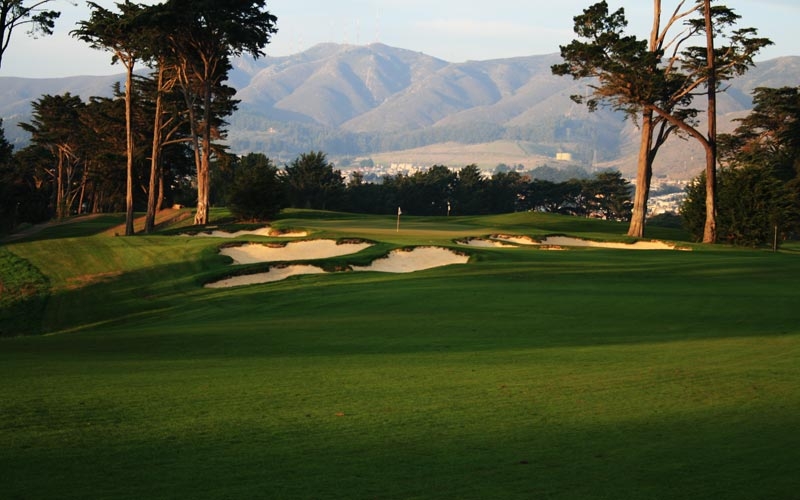
Having gained the higher ground with one’s tee ball, the San Bruno Mountain makes for a handsome backdrop on one’s approach. At thirty-eight yards, the green is one of the deepest on the course and MacKenzie’s bunkers only serve to create depth perception issues.
Tenth hole, 390 yards; When one thinks of the (new) California Golf Club, the lasting image is likely to be of short grass and sprawling bunkers. Thus, Locke is unlikely to ever get proper credit for how well he laid the holes across the land in all sorts of different manners. The tenth is a sterling example of Locke’s keen sense of the land as this switchback hole features a fairway that slopes from right to left and a green complex that was built into the hillside at a left to right angle. Yes, MacKenzie’s bunkers dress it up and make it the striking hole that it is today but it is the underlying use of the land that gives the hole its lasting playing qualities.
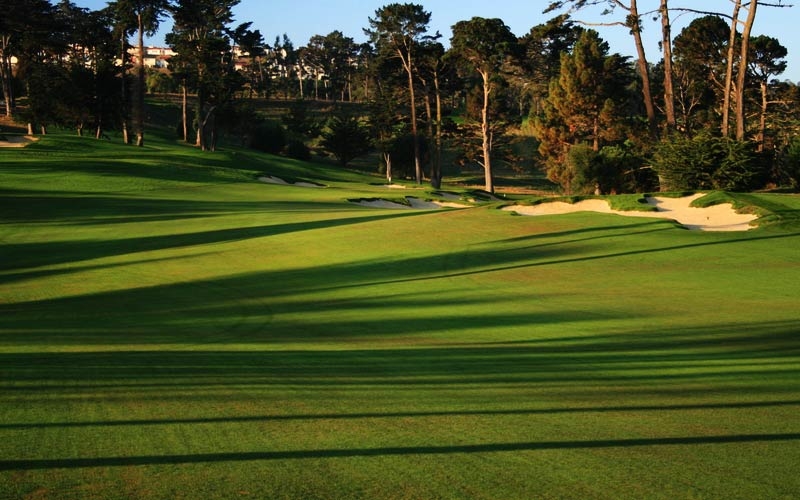
The ideal tee ball flirts with the high bunker on the right in order to gain the optimal spot in the fairway (i.e. left center) from which to play one’s approach.
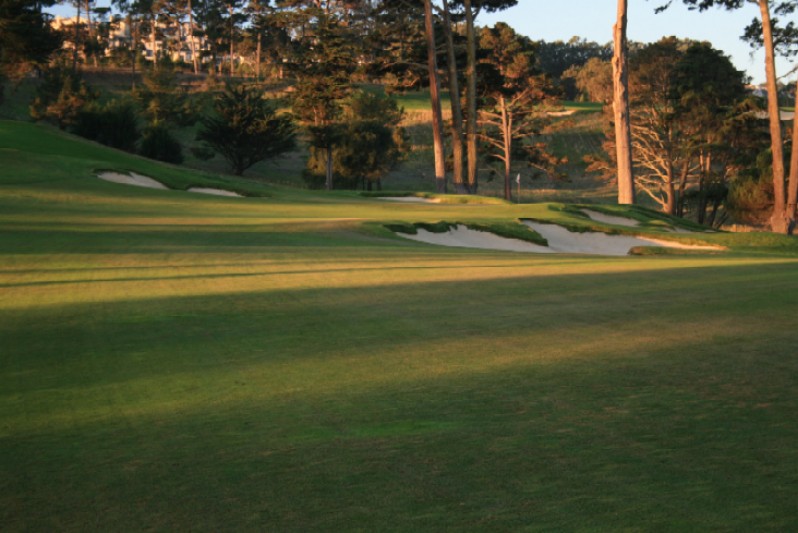
As opposed to the high right to low left landforms off the tee, the green surrounds are from high left to low right.
Eleventh hole, 400 yards; Another great use of the land occurs here, namely up at the green. Both downhill and downwind, the first time golfer might scratch his head when he sees a bunker thirty yards removed from the green, high up a hillside to the left. In fact, this bunker hides the slope ofa hill that can easily beused as a friend to the golfer in feeding his approach shots close. This clever touch comes in the midst of a stretch of big holes from the eighth through the fourteenth.
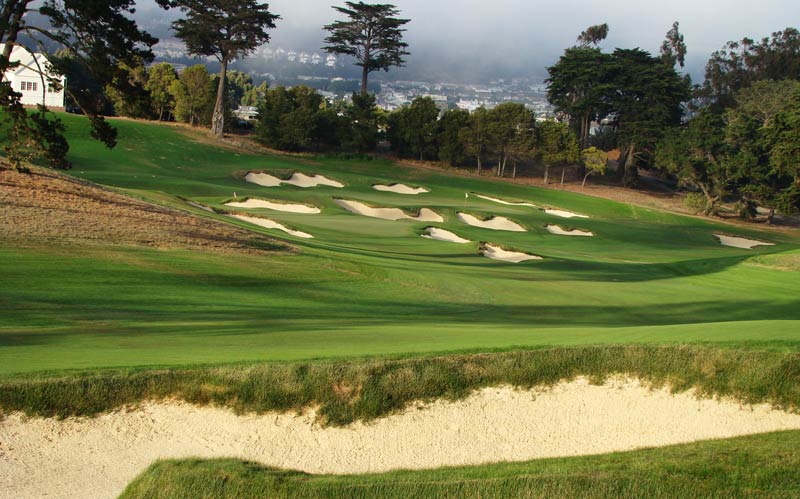
The eleventh fairway bends left around the base of a hill. The eighteenth green complex which MacKenzie rebuilt is in the background.
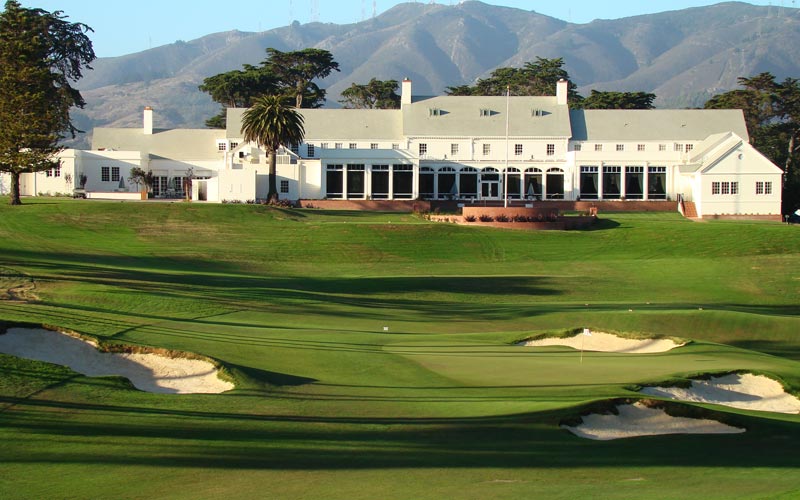
Approach shots that just clear the bunker on the left take the downslope and are fed onto the putting surface. On the day this photograph was taken, one player did just that and saw his ball finish within ten feet of this day’s hole location. His playing opponent took the conventional, direct route and his wedge landed just by the hole. Unfortunately – or fortunately as the case may be! – the ball took a big first bounce into the back bunker, from where an up and down proved elusive.
Twelfth hole, 200 yards; Some members note with a wry smile that MacKenzie did his most lavish bunkering on the holes most visible from the clubhouse, namely the tenth, eleventh, twelfth and eighteenth holes. Indeed, these four holes have twenty-seven bunkers which is nearly the same amount that Augusta National had on its entire course when it opened in 1933. In effect, the members wanted more bunkers and MacKenzie delivered, especially where they were in plain sight! Perhaps the biggest beneficiary is found here with this par three that plays away from the clubhouse to a green located across a gully. MacKenzie’s artistry is such that even if not playing, one is content to soak up the view.
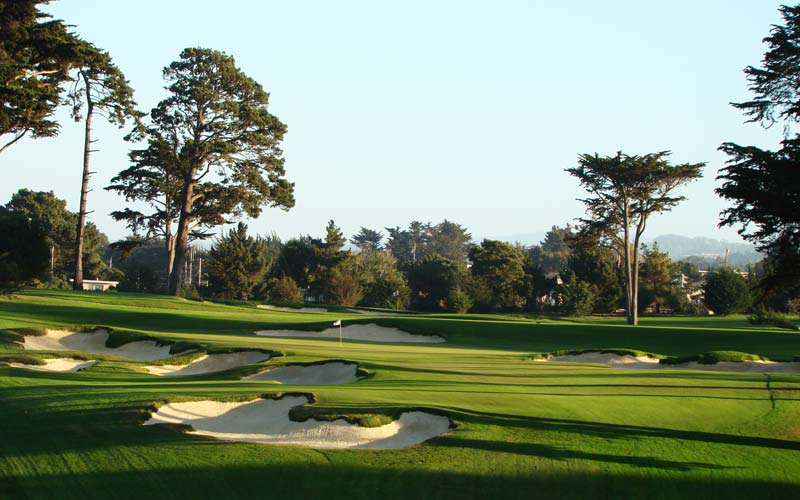
As the wind typically comes off the ocean, this hole is generally played in a right to left wind. Thus, the sight above of the flag blowing to the left is a commonplace one. MacKenzie clearly embraced this fact in creating the above bunkering scheme.
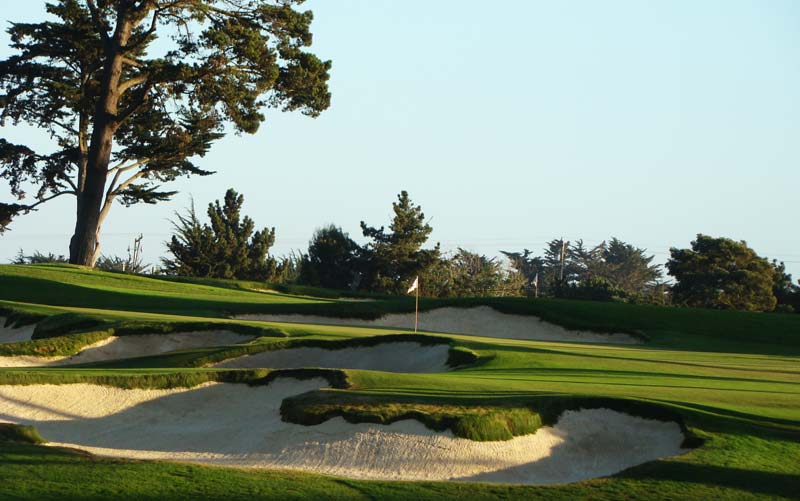
Tee balls can ride the right to left wind and bounce onto the green from its open right side. As part of MacKenzie’s visual trickery, the bunker in line with the hole location above is actually ten paces shy of the green’s front edge, meaning there is more room to run a ball on than first appears.
Thirteenth hole, 395 yards; When golf architect Mike DeVries (a MacKenzie devotee, member of Crystal Downs and who is presently restoring the aforementioned Meadow Club) stood on this tee for the first time, he took in the view and remarked as to what a genius MacKenzie was with the spacing of his bunkers. Like the eleventh hole one hour south at Pasatiempo Golf Club, MacKenzie had the rare ability to make hard, uphill holes a pleasure to play. The fact that this hole plays directly into the westerly wind exacerbates its challenge.
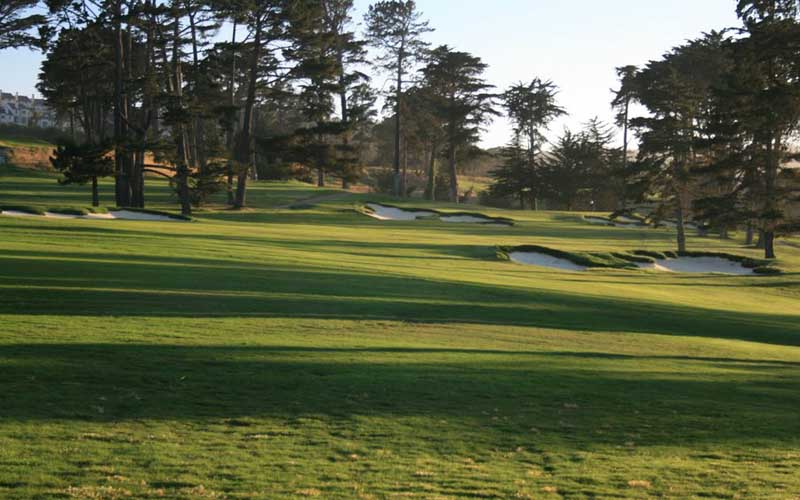
The spacing of the bunkers adds such visual appeal that the golfer in no way minds playing this uphill hole. Indeed, for some, it is one of the most attractive holes on the course.
Fourteenth hole, 445 yards; With the last of the big holes, Locke turned the fairway to the left enough to where a draw is clearly called for. As the golfer plays cautiously to the right, the dramatic greenside bunkers come more into play on one’s approach. Though the four gigantic bunkers right of the green claim the eye on the approach, architecture students will perhaps be even more impressed by the green itself, which is the high point of its surrounds.
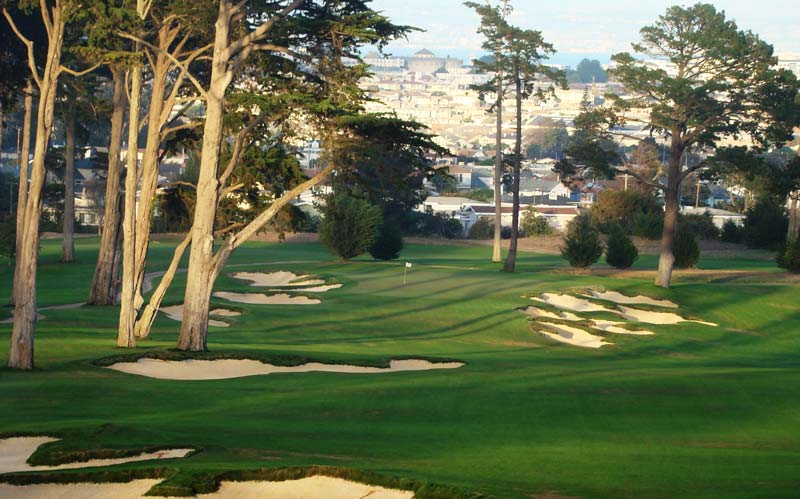
This elevated view down the long fourteenth captures much of the course’s appeal with its short grass galore, lack of rough, huge bunkers, and cypress trees.
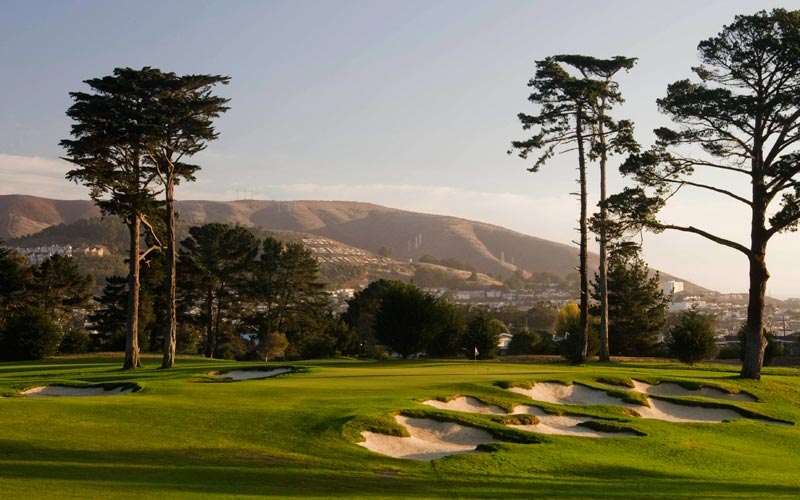
Though the fairway is wide, this view from the right center shows why an approach played from the left portion is preferable as otherwise, this nest of bunkers must be carried. Given their scale and how far the greenside bunkers protrude into the fairway, judging one’s approach shot is difficult.
Fifteenth hole, 495 yards; Working off the 1938 aerial, two central bunkers were recaptured by Phillips 150 yards short of the green. Depending on where the day’s hole location is, the golfer goes either right or left of them, which can be problematic given that the hole plays both uphill and into the prevailing wind. Nonetheless, the central bunkers pose a fine dilemma, one that the golfer hasn’t faced to date.
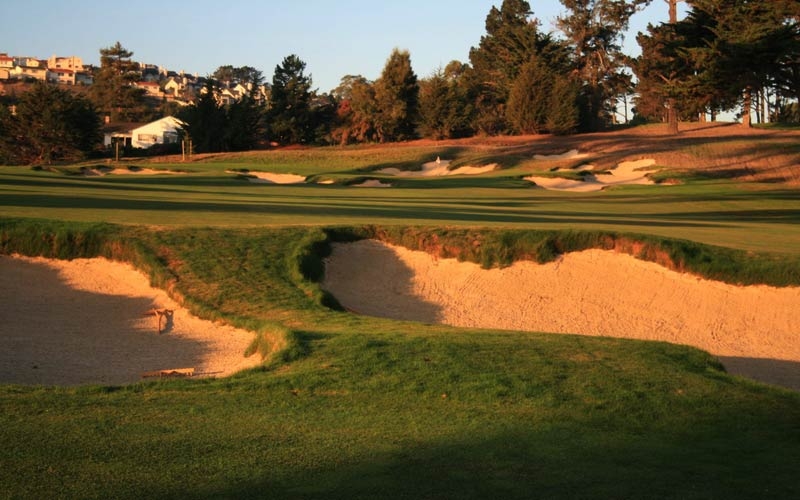
After restoring the central hazards in the foreground, Phillips moved the fifteenth green thirty-five yards to the right to its location above. It now sits nicely tucked in against the hillside whereas before it was more in the open with the white house serving as an unfortunate backdrop.
Sixteenth hole, 125 yards; Though the shortest one shotter byover fifty yards, it may also be the one thatelicits the most double-bogeys as the long narrow angled greenis a difficult target. Similar to the Postage Stamp at Royal Troon, there is no safe play or ideal place to miss the green, which is fair enough given the hole’s short length. Though deeper, the front bunkers may actually leave an easier recovery than the back bunkers from where the green racesaway.
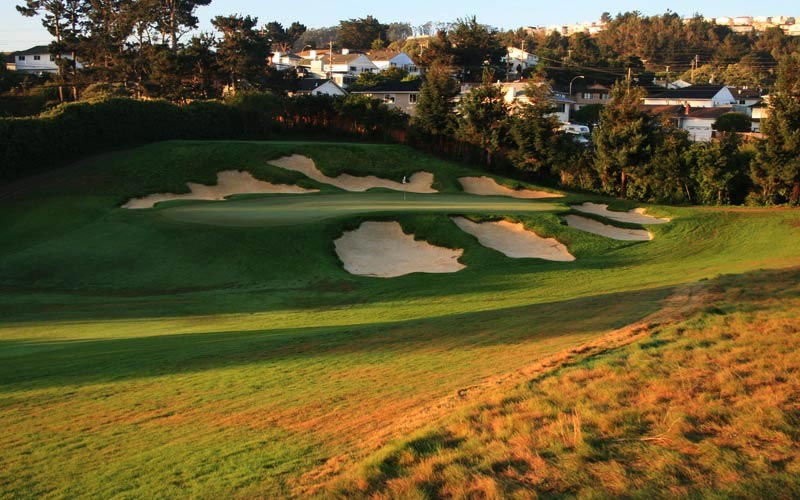
Don’t be fooled by its modest length – the heavily defended sixteenth green complex leaves numerous difficult/awkward recovery shots. A par should be gratefully accepted.
Seventeenth hole, 560 yards; Unlike many of the other course North American courses at which he worked, MacKenzie would be mighty pleased if he saw the California Golf Club today as it embodies so many of his favorite playing tenets: it is wide off the tee with the challenge coming at the green, short grass dominates throughout, thick rough that makes golfers bow with their heads as they beat through it in search of their golf balls is nearly absent, the placement of the bunkers lends strategic flair,and the greens are widely varied in shape and size. Nonetheless, all this goes for naught if the playing surfaces don’t function properly. Without fast and firm playing conditions, the ground game options that we have seen simply wouldn’t work. What a pity it would be if it was soft in front of the eighth green, thus rendering the mound there of little value or if one couldn’t land his approach twenty yards short of the eleventh and still have it nestle close. Another example of using the ground to gain an advantage occurs on the lay-up shot here, where the golfer hopes to rub past a high right MacKenzie bunker as described below.
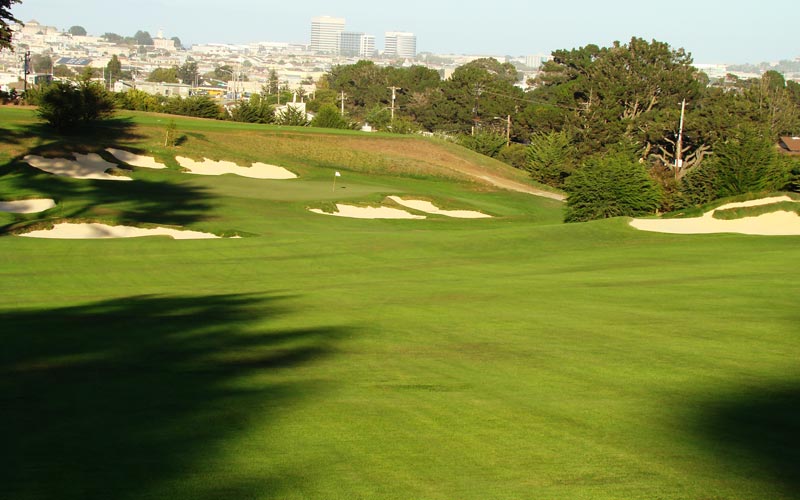
Given the angle of the green and its bunker pattern, the golfer wishes to approach it from the left. That much is clear. What isn’t as evident is that the best way to achieve the left center of the fairway is by feeding one’s second shot near the high right bunker and letting the topography carry the ball left to the proper position, which will certainly happen given the newfound firmness of the turf.
Eighteenth hole, 395 yards; The Home hole provides a fitting finish to a heavily bunkered green benched into the hillside beneath the sprawling white clubhouse. Appropriately, the hillside that leads up to the clubhouse is maintained as short grass, just one more reminder that one has just enjoyed a round of golf over a course where rough plays next to no role in the strategy of the course.
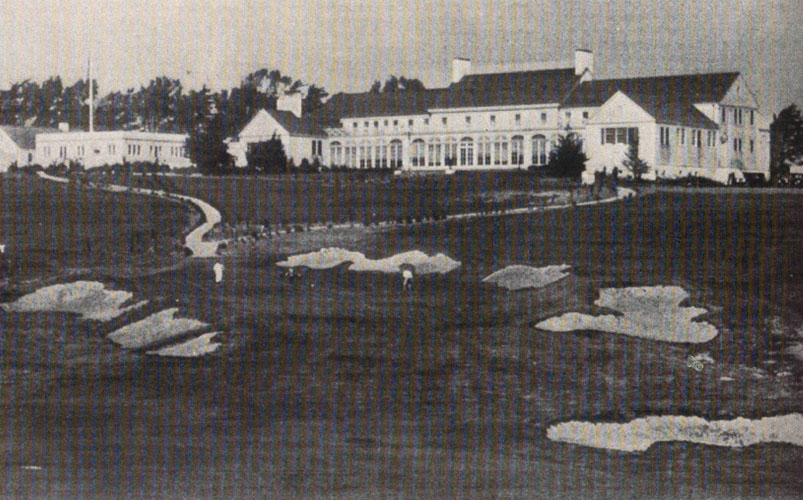
How successful was Phillips in returning MacKenzie’s sense of flair to the course? You be the judge. Above is a photograph taken in 1927 after MacKenzie had completed his work and below …
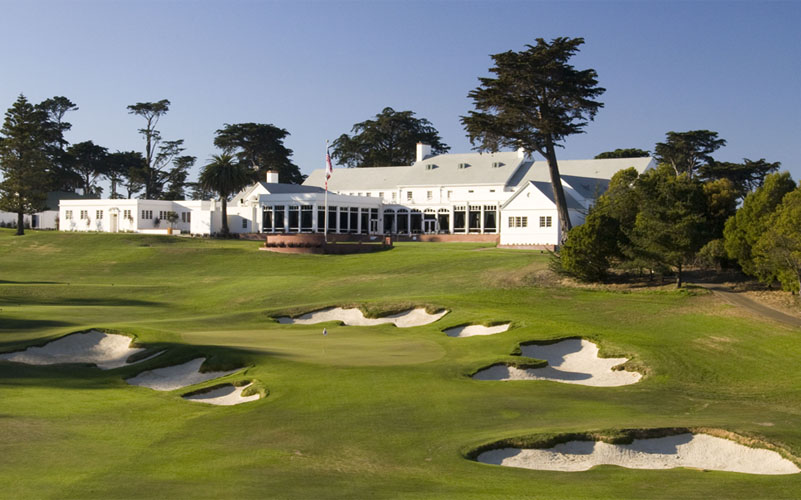
… is the same hole in 2008. As is evident, the attention to detail and the in-the-dirt work by Phillips and his gifted shapers was of exception.
One other fascinating element to this project is that California Golf Club’s owngreen keepingcrew assumed almost 50% of the construction work. Following the meticulous standard set by Phillips’s own shapers, Green Keeper Thomas Bastis did a marvelous job in making sure that Olliphant Construction (non-union) and his staff (union) worked in conjunction with one another and that the club’s interests – both from a timing and financial perspective – were met. Many of core group of employees at California Golf Club havetwenty years tenure with the club. As they were employed throughout the project, not only did they have uninterrupted job security, but they now enjoy ownership and immense pride in ‘their’ golf course, a true winning situation for all parties concerned.
Credit abounds to be shared. The boldness of Phillips’s plan and the courage of the club board to proceed with it provided the underpinning for the employees of the club and Olliphant Construction to create something truly special. A course that has been blessed with the hand of MacKenzie is rarely, if ever, improved upon but that is exactly what transpired here. The members of the California Golf Club are left to enjoy the benefits for decades to come.
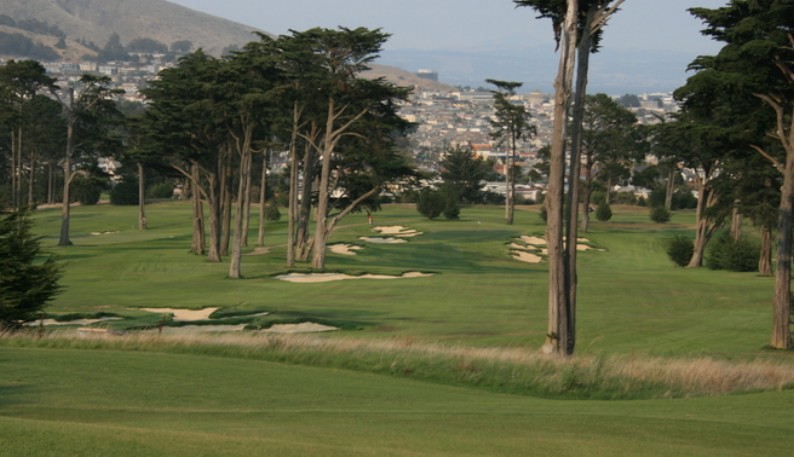
As seen from behind the sixth green, this view down the long fourteenth of short grass and interestingly placed hazards highlights why The California Golf Club is such a delight to play.
The End