The Tryall Club
Tryall, Jamaica
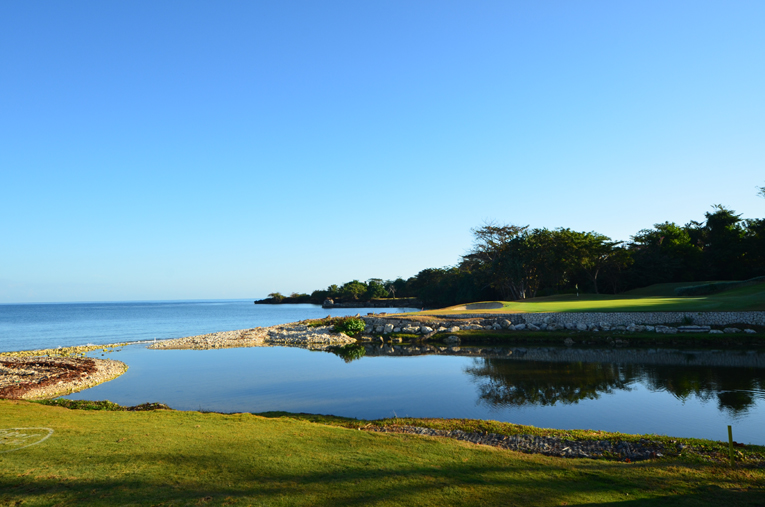
Caribbean trade winds, rolling topography, sloping greens, and tropical vegetation make Tryall one of the game’s most distinct playing experiences.
Of courses built between 1950 and 1970, only Pete Dye’s The Golf Club , Red Lawrence’s Desert Forest, and Ellis Maples’s Grandfather Mountain are profiled on this web site. In a broad generalization, courses built during this dark age in golf architecture were long in length and short in both character and charm. The bunkering was unimaginative, repeatedly forcing the same kind of aerial approach shots. Monotonously long holes resulted in the birth of the dreaded ‘7,000 yard championship course’ phrase.
As with any generalization, there are exceptions with one of the most important being Ralph Plummer’s design of Tryall Golf Club. Opened in 1958, the course measured 6,324 yards. Still golfers of the highest calibre have failed for more five decades to tear it apart, thanks to its sloping greens and the ever present trade winds. Recognized early on as the Caribbean’s first course of genuine character, Shell’s Wonderful World of Golf staged a match here in 1962 between Dow Finsterwald and Peter Alliss. Finsterwald won with a score of 72 to Alliss’s 75.
Twenty years later, a desire by the Club to host important events manifested itself and the Mazda Champions LPGA – Senior PGA were held at Tryall from 1985-87. This event was supplanted from 1988-1990 by the LPGA Jamaican Classic, which in turn set the stage for the Johnnie Walker World Championships from 1991 through 1995.
Just prior to the 1991 Johnnie Walker World Championship, a sports columnist not so shrewdly predicted that one of the professionals would break 60 as this par 71 course still measured less than 6,800 yards. That year’s winner was Fred Couples and not only did no one break 60 but Couples was the sole person in the field to break par for the four day event!
The subsequent winners of the Johnnie Walker (Faldo, Mize, Els, and Couples again) were all major championship winners, suggesting emphatically a quality venue. What then are Tryall’s attributes that promote the best to flourish?
Certainly, the island setting adds much toTryall’s allure and inspires one to play his best. However, that speaks little to the enduring merits of repeated games here. The trade winds which average 20 miles per hour pose the same challenge as the winds in the United Kingdom: can the golfer control the trajectory of his shots? A golfer with the talent to do so shines here. Those who followed Nick Faldo during his 1992 win of the Johnnie Walker marvel to this day at his complete ball flight control with every club in the bag.
The first six holes at Tryall are routed near the coastline, and apart from the romance of such a location, Mother Nature didn’t imbue this flat portion of the property with many natural features. Thus, Ralph Plummer did what every good architect should: he created character and did it in a manner that is peaceful to the eye. The land in no way appears tortured and the holes rest naturally on the property. In their cornerstone book The Golf Course by Ron Whitten and Geoffrey Cornish, Whitten notes that ‘Plummer was known for the attractiveness of his layouts and for his remarkable ability to estimate cuts and fills and shape greens and bunkers by eye.’
The only man-made water hazards on the course are the three ponds encountered early on, namely at the one shot second and in the landing areas for the second shots on the par five third and sixth. (Forty-three years later, the Club acquired the property to build a true coastal hole – today’s fourth – which is also a water hole, albeit a natural one). Plummer used the fill from the ponds to raise the tee and green pads several feet, thus providing the necessary drainage for these flat first six holes. Without any extraneous land movement from tee to green, Plummer’s low profile design at Tryall presents a timeless appeal.
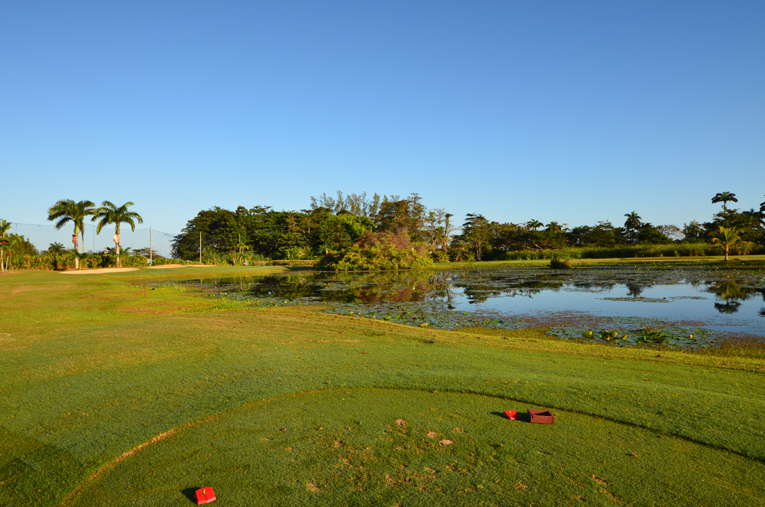
Though manufactured, the pond that fronts the second green looks a part of nature. No harsh bulkheads that scar so many modern courses are found here. Plummer modestly built up the second green and gave it enough pitch to properly drain.
This complete absence of clutter is most appreciated, especially relative to other courses built after World War II. Plummer didn’t build three bunkers where one would suffice. Plummer didn’t follow Robert Trent Jones horrific example at Oakland Hills six years prior in 1952 by pinching in fairways with bunkers on either side. Instead of reducing width and ruining playing angles by overbunkering holes, nine of the fourteen non-par three holes at Tryall originally were free of bunkers off the tee (e.g. the third, eighth, ninth, eleventh, thirteenth, fourteenth, fifteenth, seventeenth, and eighteenth).
Plummer also eschewed containment mounds and the framing of green sites. The challenge at Tryall intensifies as one gets closer to its greens – a tenet of classic architecture that allows the greatest range of golfers to enjoy a course. So fierce were Plummer’s orginial green slopes that the greens on holes 7, 8, 11, 12, 13 and 16 were softened when the Club switched from the old bermuda grass greens to today’s swift tifton dwarf greens.
Starting at the seventh, Mother Nature’s natural attributes are more profuse and Plummer took full advantage as he perfectly draped the holes onto the rolling foothills of the property. As with his other best west works like Preston Trail Golf Club, Great Southwest Golf Club, and the Cypress Creek Course at Champions Golf Club, Plummer’s routing makes intuitive sense to the golfer as one good hole follows another with the green to tee walks always short.
The golfer’s judgement is continually taxed at Tryall by the variety of approach shots required: the uphill approach at the ninth, the sharply downhill one shot tenth where one doesn’t want to be long, the uphill approach at the eleventh, the downhill one shot twelfth where one wants to be long, the uphill approach at the thirteenth, the downhill approach to the fourteenth. The continually shifting demands keep the golfer off-balance, a great architectural achievement as it means the golfer never tires of playing there.
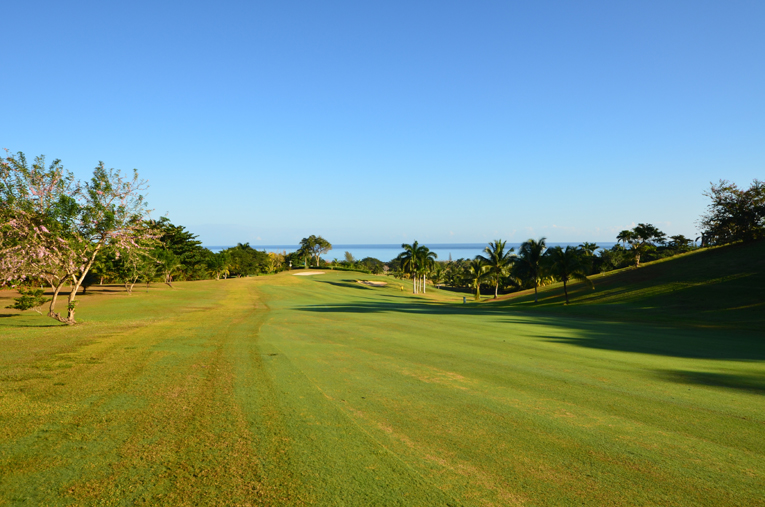
The fourteenth tumbles downhill toward the Caribbean Sea.
In addition to the rolling topography, a creek bed falls from the hill top and Plummer used it masterfully: the eighth green lies just across it, the bed parallels the ninth fairway on the left, the tenth green is placed on its far side, and a great risk-reward diagonal carry is created off the eleventh tee.
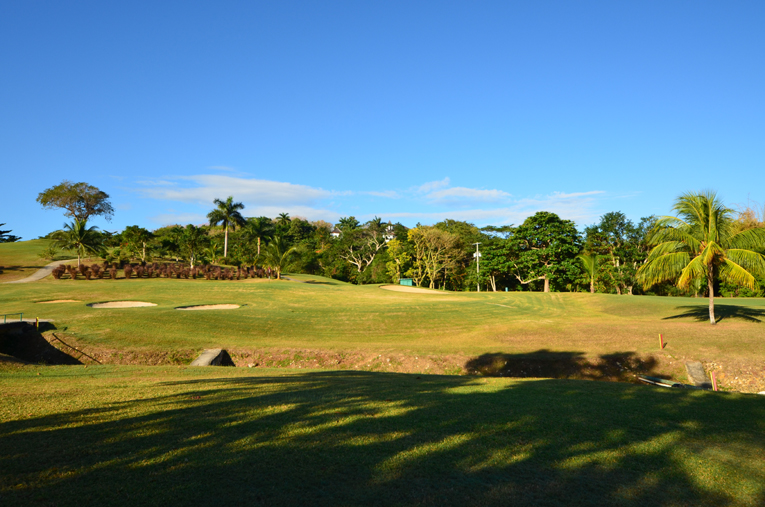
Plummer gracefully created a plateau atop a bed of coral for the eighth green, just over a creek bed. Note the perfect color of the fairway: overwatered, soft fairways are not seen at Tryall.
When the flatter but more exposed first six holes are combined with the rolling nature of the subsequent twelve, the result is an irresistible full spectrum of challenges as we see below.
Holes to Note
Third hole, 520 yards; A dogleg left full of neat playing angles, the tiger golfer hoping to get close to the green in two needs to be mindful of three palm trees approximately 100 yards shy of the putting surface. For most the green is always out of reach as the hole plays into the prevailing tradewinds. Like the sixth, Plummer incorporated a large pond 90-120 yards shy of the green into the hole’s strategy, making the second shot much more than a simple layup.
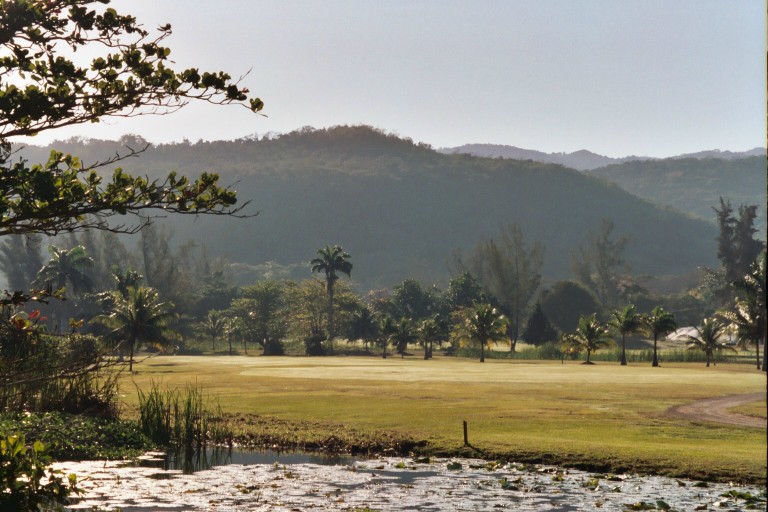
The view from the third tee – note how peacefully the fairway lays upon the land. No insipid mounding spoils the view and man’s hand is very soft upon the landscape.
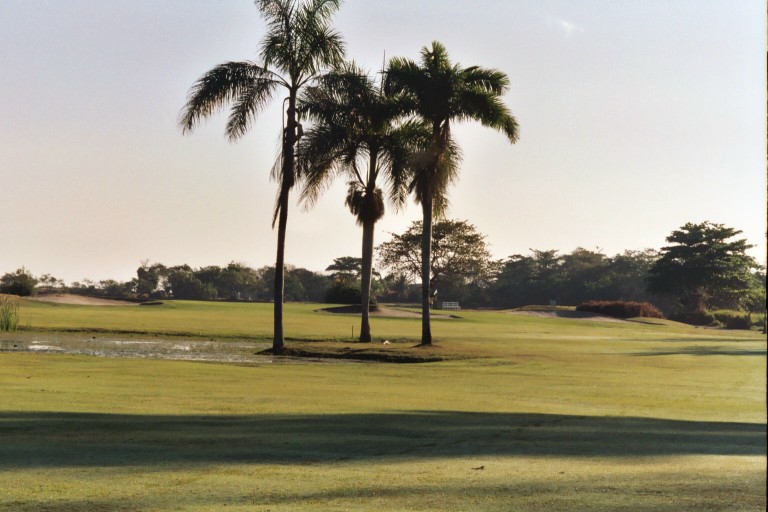
After a long drive down the middle, the tiger golfer might have to shape the ball to reach the 3rd green in two.
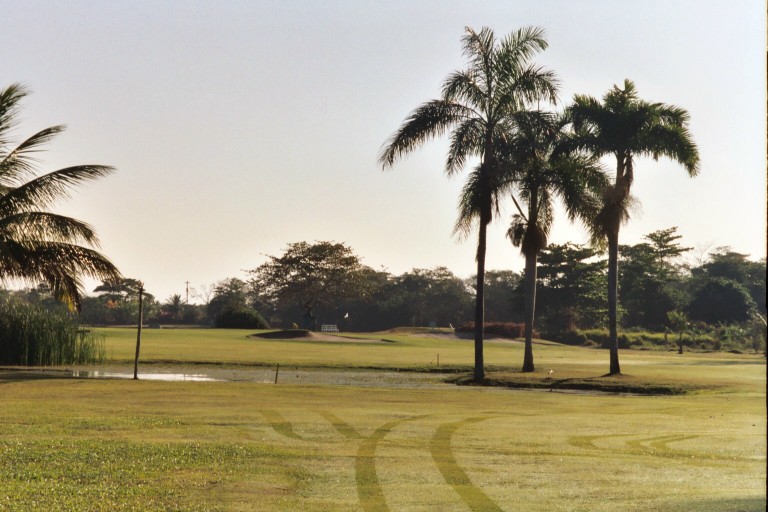
Better yet, the golfer can place his tee ball down the left of the fairway to gain a better angle into the green.
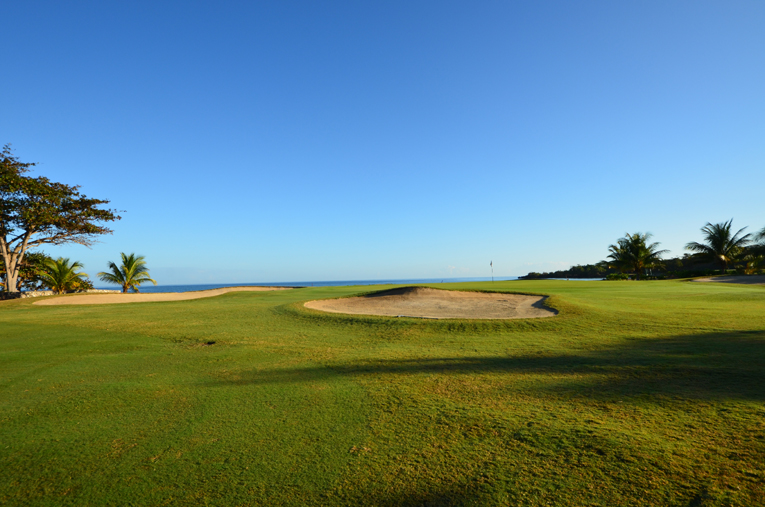
The third green, flush against the Caribbean Sea and much wider than it is deep, can be hard to hold with a long approach shot.
Fourth hole, 175 yards; This hole is not original to Plummer’s 1958 design as the Club at that time did not own the property where today’s fourth green and fifth tee now reside. The fourth was added in 1992 by IMG for that year’s Johnnie Walker Championship. Only eight holes later at the twelfth tee, the golfer is 180 feet higher and can’t help but reflect upon the great variety found within the holes at Tryall. Though Plummer’s fourth hole (which essentially played from near today’s fourth tee to today’s fifth green) was a clever hole in its own right, the course is better today for embracing the shoreline.
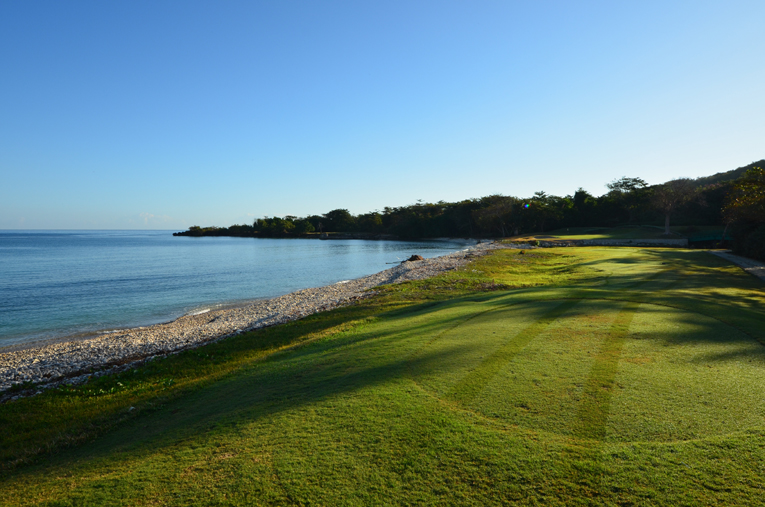
This early morning picture makes the fourth appear deceptively calm. The trade winds generally kick up later in the day and blow hard left to right across the hole.
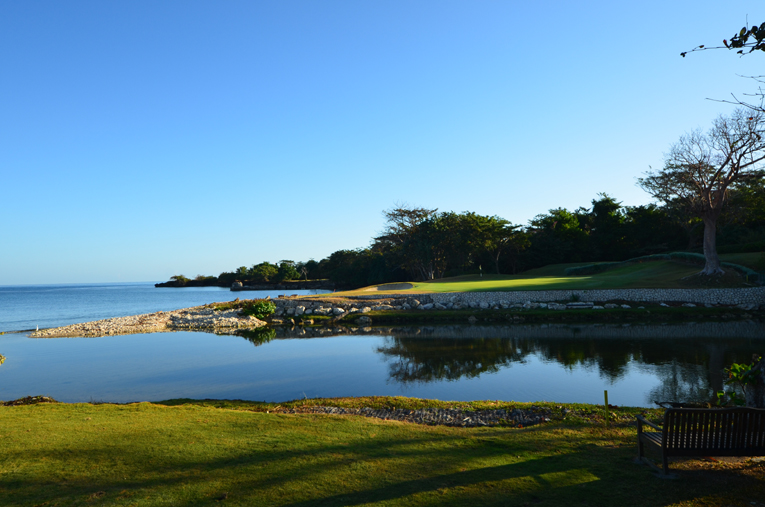
The fourth green complex is located across from the point where the Flint River feeds into the Caribbean Sea.
Seventh hole, 435 yards; Texas based Ralph Plummer was no stranger to wind and fast and firm playing conditions. On several green sites (here, the twelfth and fourteenth holes), the high ground beside the green can easily be used to bounce the ball onto the putting surface. Though made somewhat obsolete by how far the ball now travels, the ‘kick plate’ can still be used by the average club member to his advantage. Seeing a ball bound sharply to the right and feed toward the hole is one of the most satisfying moments on the course.
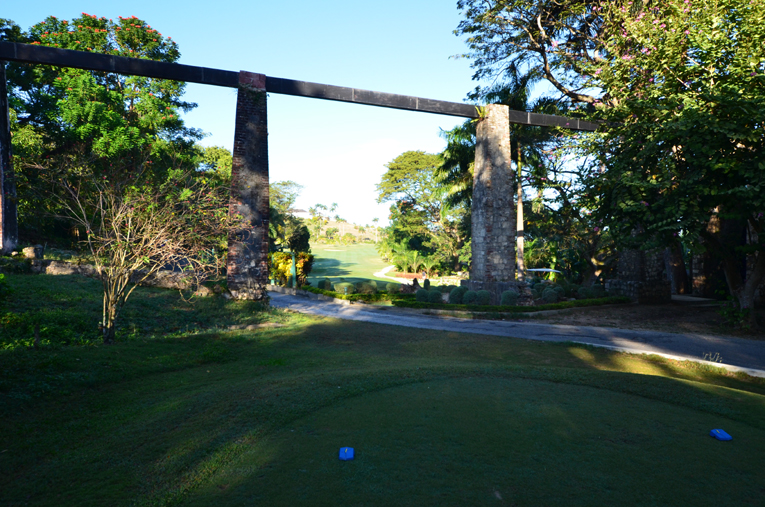
The tee ball from the back markers is played through the stone pillars of an aqueduct ….
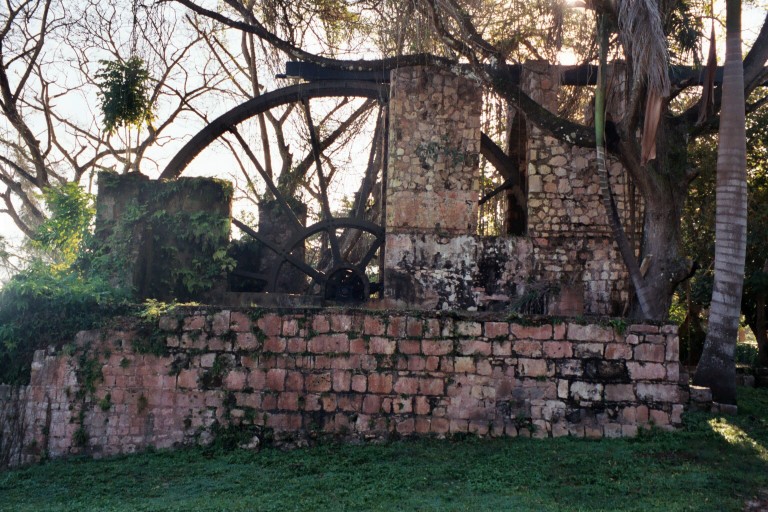
… that feeds a waterwheel that was constructed 180 years ago when the property was an active sugar plantation.
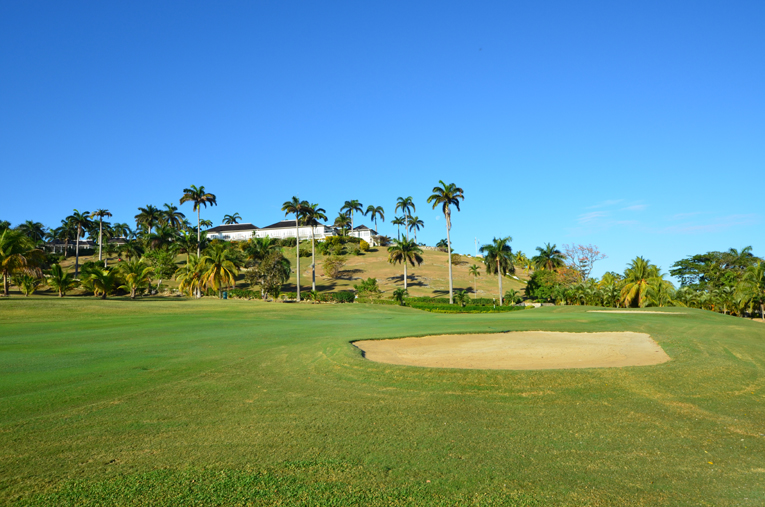
The left to right slope of the terrain on the high left side of the green is evident in this photograph. The stunning 18th century Georgian style Great House presides over the course.
The Tryall Club
Tryall, Jamaica
Ninth hole, 405 yards; The property that Tryall occupies was originally an English coastal fort, built to defend the Crown’s interests from pirates, the French and the Spanish. It later became a sugar plantation and throughout its history, The Great House has presided over the property from atop a dominant hill. The Great House is just that and Plummer’s routing took full advantage of this one-of-a-kind historic structure with holes playing around the hill’s base.
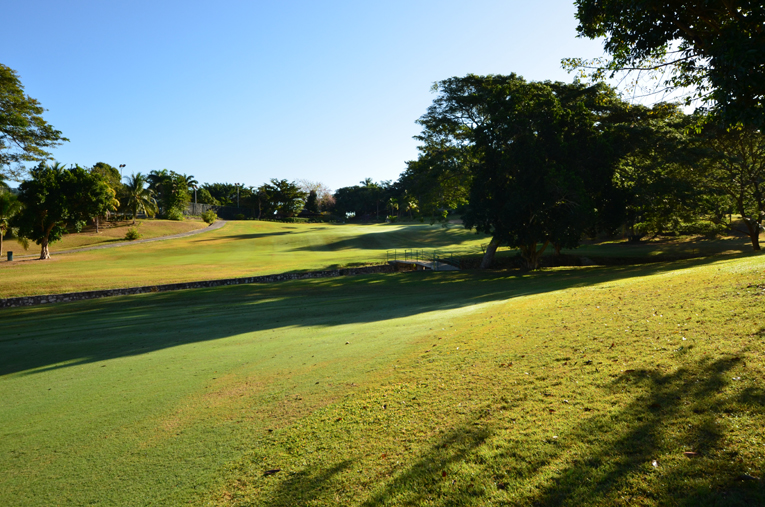
Plummer beautifully routed the ninth down in its own secluded valley with The Great House high above.
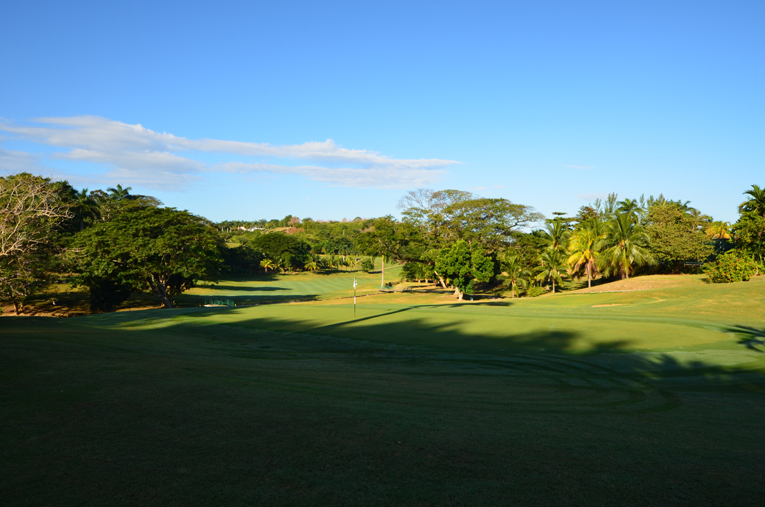
As seen from behind, the low profile features around the ninth green do little to aid the golfer in determining how best to get his approach shot close.
Tenth hole, 170 yards; Several of the steepest pitched greens are located just the other side of hazards. Form follows function as rain water is quickly shed off the green and toward the hazard. From a playing perspective, the challenge is both simple and enduring: the closer one flirts with the hazard, the easier (i.e. uphill) the putt. Take the tenth for example. To fly the ball deep into the green and well away from the creek bed is to court a three putt. For decades now, golfers have come to Tryall for a one week stay. At the start of the week, they hit the ball long, avoiding the obvious trouble fronting the green. The ensuing three putt prompts them to get more and more aggressive with their tee ball as the week wears on until they finally land in the creek bed. They are back the next day hitting the ball deep into the green and the cycle repeats.
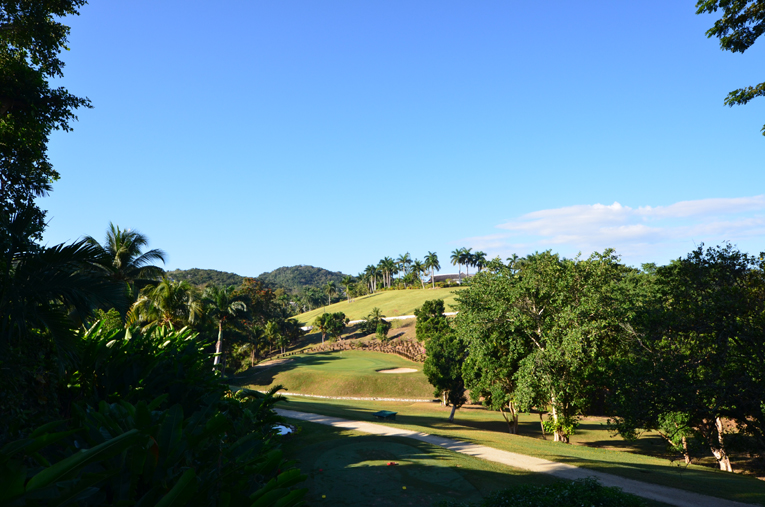
After the uphill approach to the ninth, the golfer faces the downhill tenth …
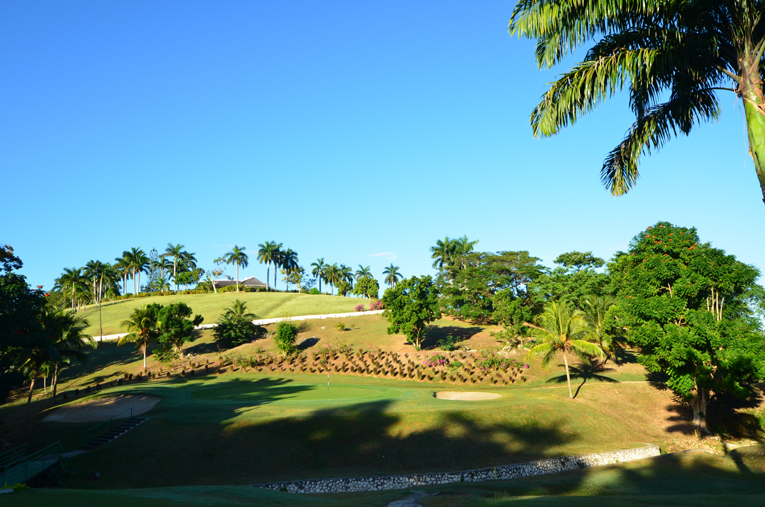
… where the creek bed and back to front pitch of the green provide the hole’s enduring strategy.
Eleventh hole, 500 yards; This three shotter sweeps left up the hill to the highest green on the course. Plummer’s routing of the hole incorporates a ditch in a similar fashion to the thirteenth at MacKenzie’s Augusta National: the golfer eager to get home in two must draw the ball and flirt with the left hand portion of the fairway. Anything in the ditch or left guarantees a high score.
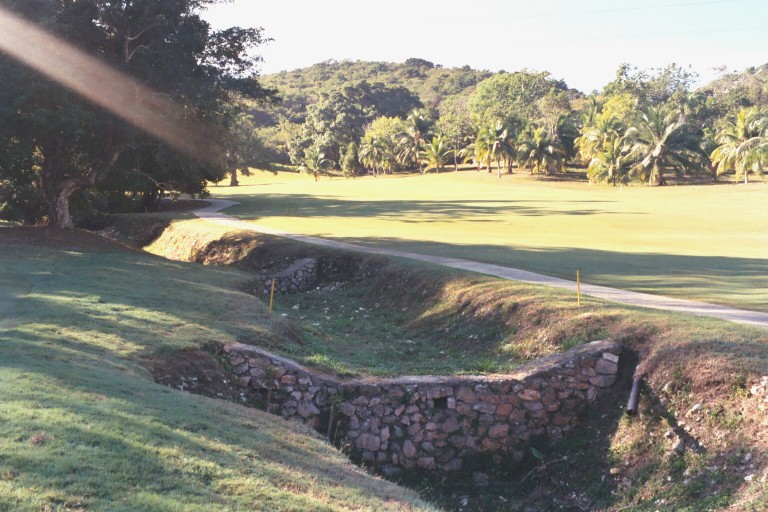
The bold line on the dogleg left eleventh requires an uphill carry of 240 yards over this creek bed to bring the green within reach on one’s second.
Twelfth hole, 215 yards; IMG and Peter McElvoy added blue tees to the course in 1991 in preparation for the Club hosting its first Johnnie Walker World Championship that December. The task was relatively straightforward and they stretched the course 300 yards to its present length of 6,775 yards. However, the new tee at the twelfth required quite a bit of imagination. Plummer’s original hole was 180 yards and played downhill a good 50 feet. Forgoing the glamour of the hole’s drop shot qualities (the white tees remain on the elevated tee), McElvoy built a lower tee 35 yards back. The resulting long iron shot across the left to right slope of the hillside is a genuine thriller. According to Head Golf Professional Nelson Long, the play is to miss the green long so as to guarantee a chip back up the green, the back half of which slopes away from the golfer on the tee.
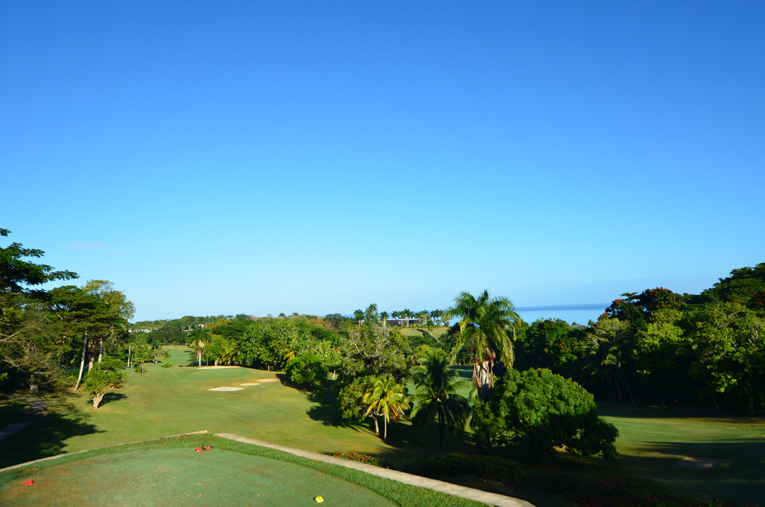
The twelfth plays sharply downhill from the white markers. The sea is in view despite this tee being the most inland point on the course.
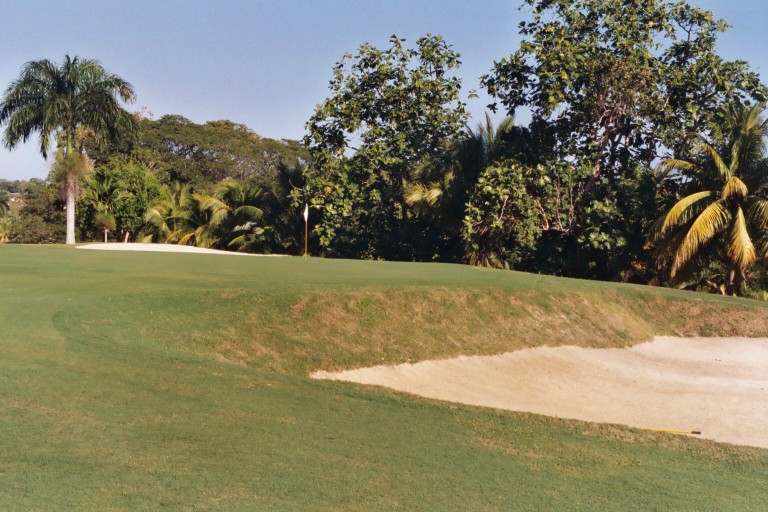
The Club’s bunker project successfully restored both depth and character to Tryall’s bunkers, as seen here at the twelfth.
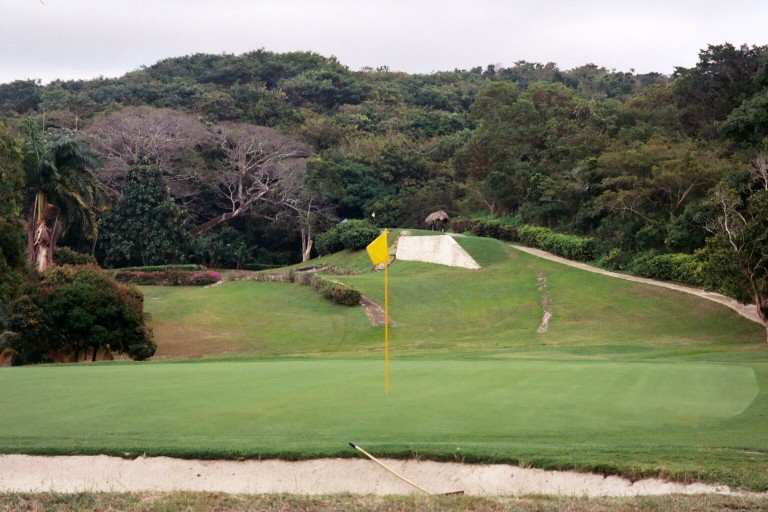
As seen from behind, the back half of the twelfth green falls away from the tee.
Fourteenth hole, 450 yards; One of the game’s most noble two shotters, Plummer left well enough alone and didn’t create a single bunker from tee to green as his routing over the twisting topography didn’t require such clutter to give the hole excellent golfing qualities. Plummer benched the green into a hill and any approach hit left will bound onto the green from the high side. Complicating matters is that more times than not the wind comes from the golfer’s right.
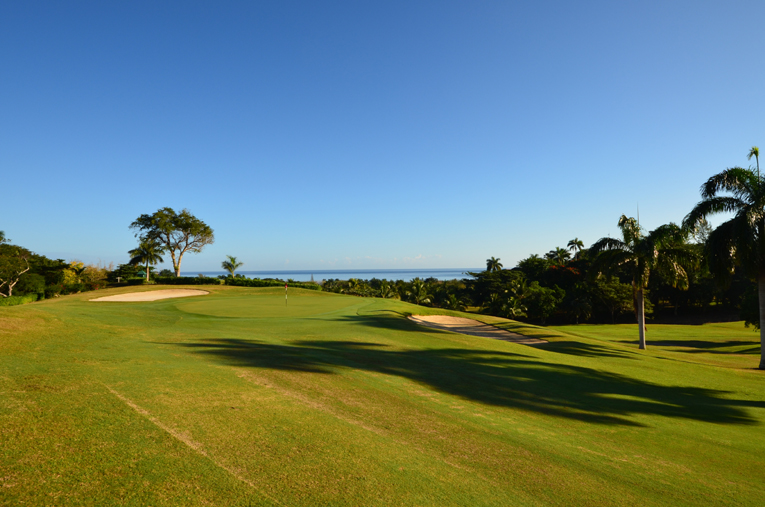
Many architects in the 1950’s and 1960’s would have mistakenly bunkered this green front left and right, thus limiting the type of approach shot that the green would accept. Not Plummer – he created a high left bank, kept the green open from that angle and ever since, many a member has delighted in bouncing the ball onto the green.
Fifteenth hole, 445 yards; Along with the eleventh and twelfth holes, the fifteenth is the other hole where IMG’s 1991 blue tee additions paid off most handsomely. Originally a straight hole, McElvoy benched the new blue tee into the hillside and a dogleg left was created (this helped to offset the loss of Plummer’s slight dogleg left fourth hole).
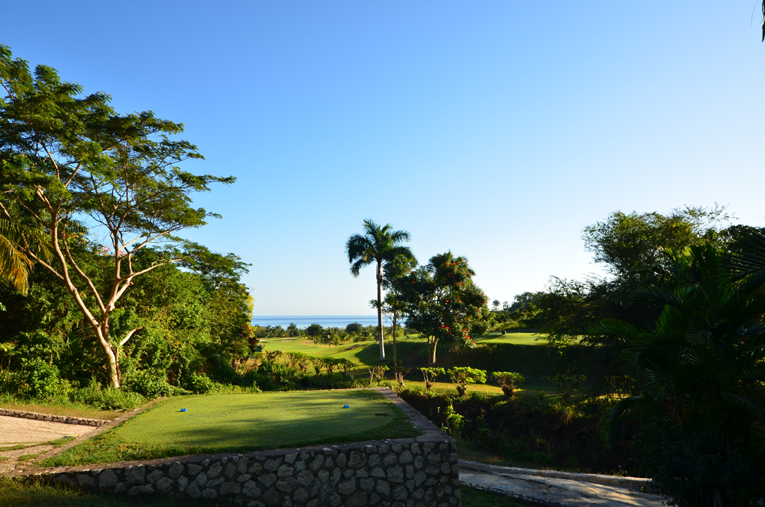
The addition of the back markers in 1991 made the fifteenth a dogleg left and a very powerful two shotter as it generally plays into the wind.
Seventeenth hole, 390 yards; A dangerous hole in all respects with out of bounds hard down the right and the green literally walled off. Head Golf Professional Nelson Long likes to hit a low chasing fade off the tee and let the ball run out down the fairway. The wind wants to push the ball right toward the out of bounds, so the golfer who has a low tee ball at his ready command has the advantage. Due to the influence of The Old Course at St. Andrews and England’s first great club Royal Liverpool, out of bounds was once viewed by many architects as a key feature for any great course to possess. And so it is at Tryall where the defining feature of the last three holes is that out of bounds is most prominent just when the pressure within one’s match is at its peak.
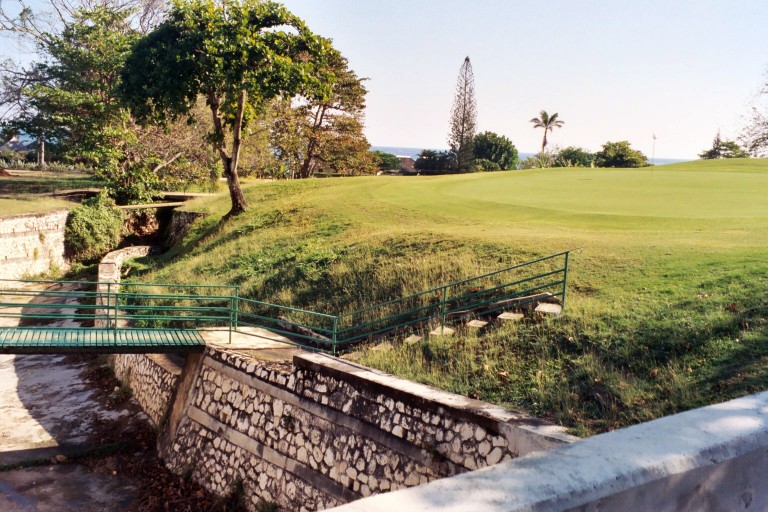
To say the seventeenth green is well fortified is not an exaggeration!
Another attribute of a round at Tryall is the wide variety of indigenous tropical vegetation that the golfer gets to appreciate as he walks the course. Though the Club has always been careful to preserve wide playing corridors, the holes are most handsomely adorned with vegetation. Along with the pine tree, the palm tree is one of the few trees well suited for a golf course as its branches are well off the ground and the golfer is generally given some opportunity of a recovery shot. Looking for lost balls amongst palm trees is unheard of and of course, the palm tree does little to shield the wind – a very good thing.
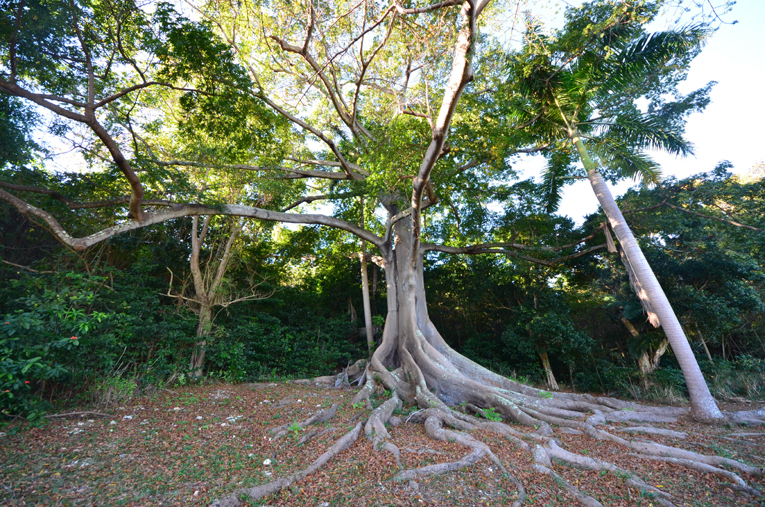
A one of a kind tree. The Club is to be congratulated for having preserved the distinctive tropical trees and vegetation without allowing them to crowd the golf.
New courses open all the time, accompanied by big media pushes. Such courses stream into the public’s conscience but seemingly fade away just a few years later. With Tryall being a private club open to limited resort play, it doesn’t promote itself to any degree. Yet as its history shows, this course is the real deal and has been so for over forty-five years.
Rather than chase the latest and greatest course openings, more golfers should come to Tryall. Montego Bay is a two or three hour direct flight from many points within the United States, not much farther than Florida. What true golfer ever tires of flighting his shots in the wind or of managing his game properly to stay below the hole? Such challenges were at the heart of the game when ittook hold in the United Kingdom over 150 years ago. Throw in the tropical climate and beautiful spirit of the Jamaican people, and the golfer is guaranteed to return home more invigorated than when he left.
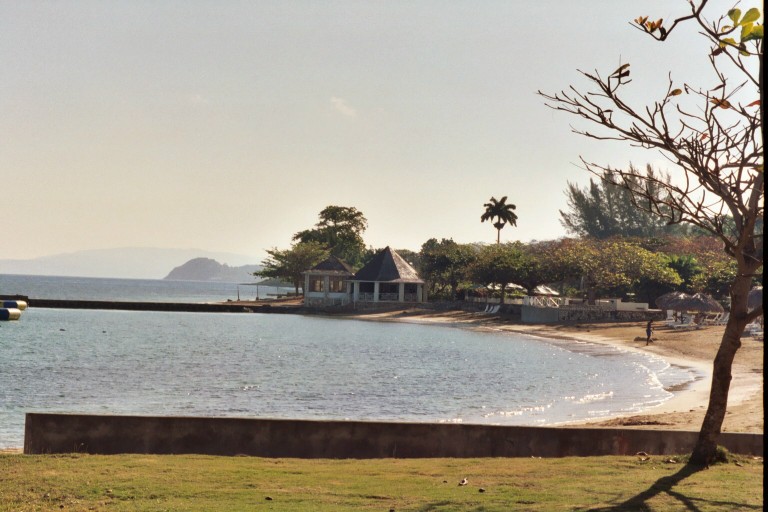
After the round, the Beach Club directly across from the golf professional shop provides soothing native rum drinks that sometimes provide clarity as to where the strokes went.
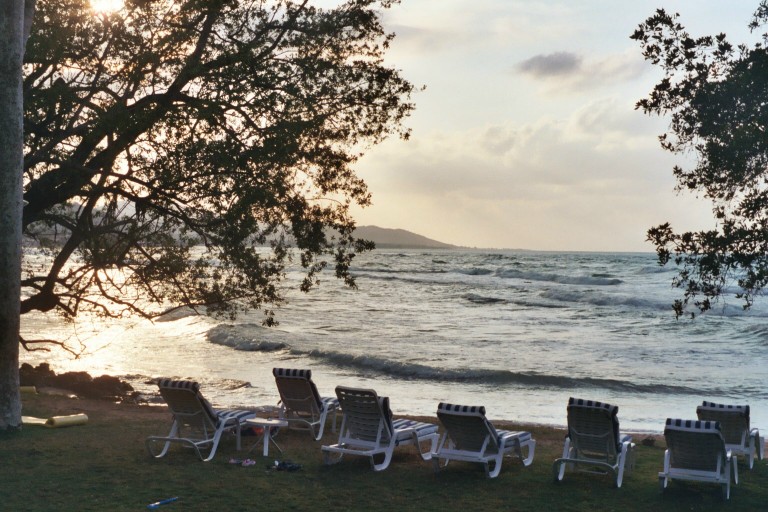
Private residences at Tryall like the one at Randolins (www.randolinsvilla.com) can be rented on a weekly basis.
The End