Royal Worlington & Newmarket
Suffolk, England
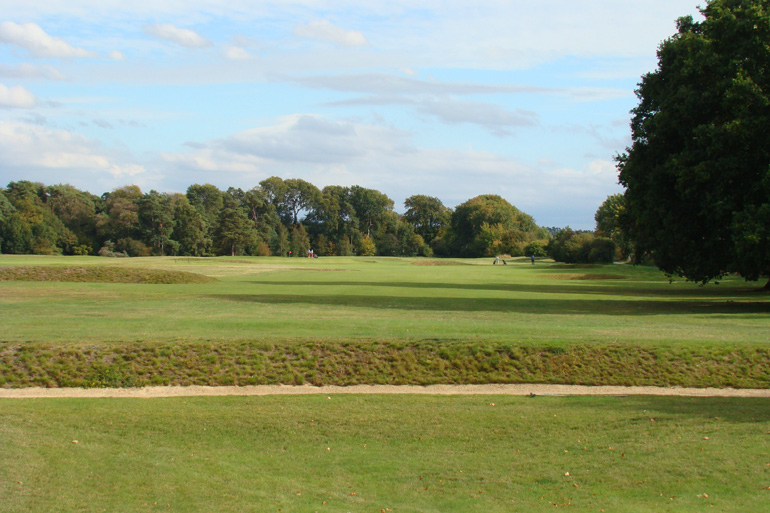
So it begins! Though not dramatic, Mildenhall is as intellectually rewarding as any one hour and fifteen minutes that a gentleman can spend on a course.
“The best nine-hole course in the world” hardly does Royal Worlington & Newmarket justice. While accurate, it is as misleading as calling Saville Row “a fine place for English tailored clothing.” For Royal Worlington stands on its own among the world’s finest, needing no qualifiers.
If it weren’t for its small property allowing for only nine holes, Royal Worlington would be better known as the possessor of the finest green complexes in England. In addition to the first-rate firm and fast conditioning enabled by its sandy soil, the greens feature bold contouring, the likes of which are not seen south of Hadrian’s Wall. They are well varied, from the rolls of the first to the crowned second to the horrors of the fifth to the side-sloping ninth. One could place a top amateur on a closely-mown area five yards off each green in regulation and he would be content to save par five out of nine times. Mildenhall (as the course is sometimes referred to given its proximity to the Mildenhall train station) does not rely on bunkers or rough for its defenses but rather the cunning use of the land and its subtle contours.
Royal Worlington gets the most that it can out of the property it occupies, which is the ultimate compliment to any architect. Holes 1-3 and 7-9 are set, basically, in a field while holes 4-6 are stretched out on a wide wooded avenue. The second hole perhaps best illustrates how easy it can in fact be to create a fine hole. The green at the end of its 223 yards was simply pushed up, creating a most difficult but still interesting short hole. Patric Dickinson likened finding the green to “pitching on a policeman’s helmet.” Indeed, one can’t help but think how fun the hole would be at any length. A 270 yard version would be intriguing.
The most enduring aspect of Royal Worlington & Newmarket that encourages the player to go round and round (apart from the club’s devastating pink pitcher!) is that it keeps the player on edge. With just nine holes, Royal Worlington has the best collection of half-par holes with which the authors are familiar. The par on the card for holes 1, 2, 4, 5, 6 and 8 is 5, 3, 5, 3, 4 and 4 respectively, yet a score of 4, 4, 4, 4, 5, and 5 is just as likely. Patric Dickinson, not surprisingly, perfectly describes them when he writes that the nine holes have as “many facets, highlights and angles as any diamond, and they are quite as hard.”
Nine hole courses are generally perceived as being just a notch above the dreaded ‘executive course’, of which no one has ever written a single kind word. Nine holers often occupy land that is ill-suited for golf, feature non-descript holes, and play heavy underfoot. The typical nine holer conjures the pervasive spirit of being a poor substitute for the full monty. Any such misconception goes out the door here, especially after the over-confident golfer suffers a 6 at the first as we see below.
Holes to Note
First hole, 480 yards; With no practice area, Tom Dunn kindly permits the golfer a gentle start. Or does he? Tom Hood, the club’s first general manager and construction foreman for Dunn, saw fit to imbue the green with some of the finest random contours one will ever putt over. The expectant score of 4 is less likely to materialize than does an untidy three putt 6.
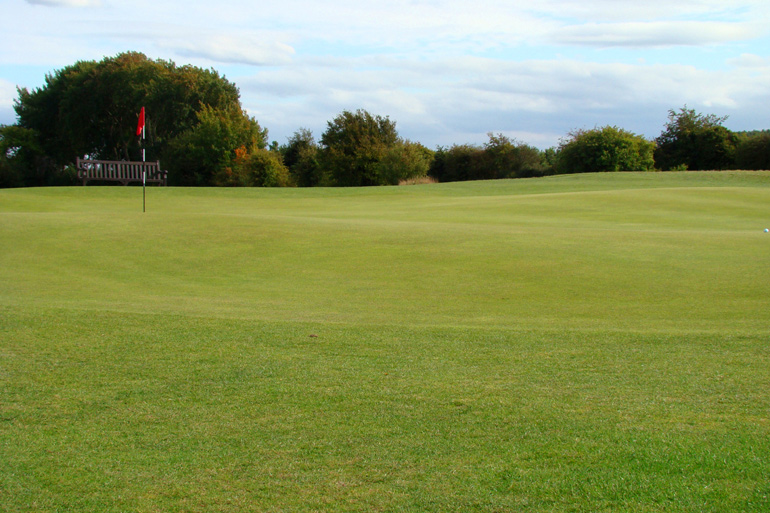
The random contours in the first green have turned two shots into three for well over 100 years.
Second hole, 225 yards; Standing on the tee, the second doesn’t generate as much affection or appreciation as do many of the other holes. In fact, it looks a bit dullish as it is played into the corner of the property. Only when within fifty or sixty yards of the green does it begin to reveal its true playing qualities.
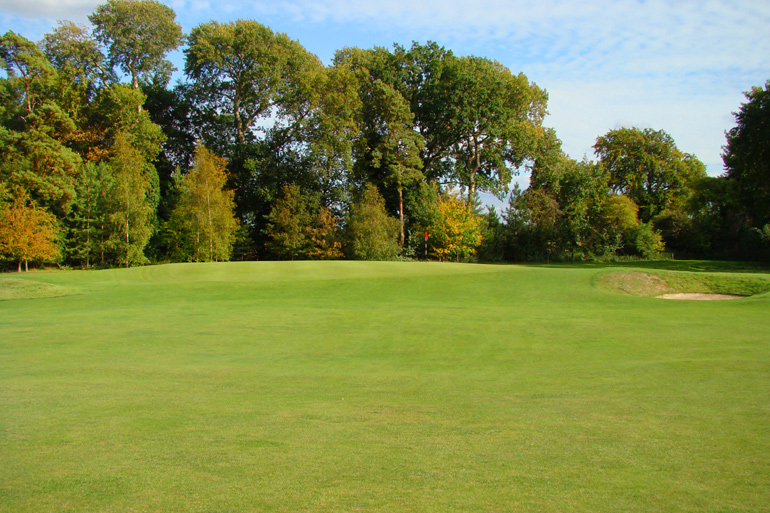
The pushed up second green is hard enough to hit from thirty yards, let alone 225 yards!
Third hole, 380 yards; A gem of a hole that seems to become more difficult with each attempt. The hog’s back fairway is the very devil to find from the tee, with the slightest pull or draw finding a nasty hook stance in a trough full of healthy rough. Slightly more room than one imagines is afforded to the right off the tee as there is a hint of a valley in that side of the fairway, but a long drive that just veers right will find a small bog. After a good drive, the approach should be simple enough, yet it rarely is. The green provides an ample target with subtle rolls, and the front left bunker is far enough away (although in a most frustrating spot to a player who strays left off the tee). As befitting a hole of this length, finding the fairway is paramount as a swale must be carried and a hot running shot out of the rough won’t do. This hole is the scene of a rare bit of controversy at Royal Worlington since the days of Darwin. At the bottom of the dip fronting the green used to be a stream (or, at least, some sort of water course). Somehow, it became abandoned and treated as just a moggy area through the green. Appreciating the strategic appeal of the water hazard, several members proposed that the area be returned to its former character. This work was carried out, and a cry went up from the membership, largely due to the aesthetics of the sleepers used. Instead of giving the construction a second chance, the majority of the membership insisted that the work be undone. Sadly, the area now looks peculiar. The remnants of the ditch is choked with tall grass and looks as if it should be surrounded by yellow stakes.
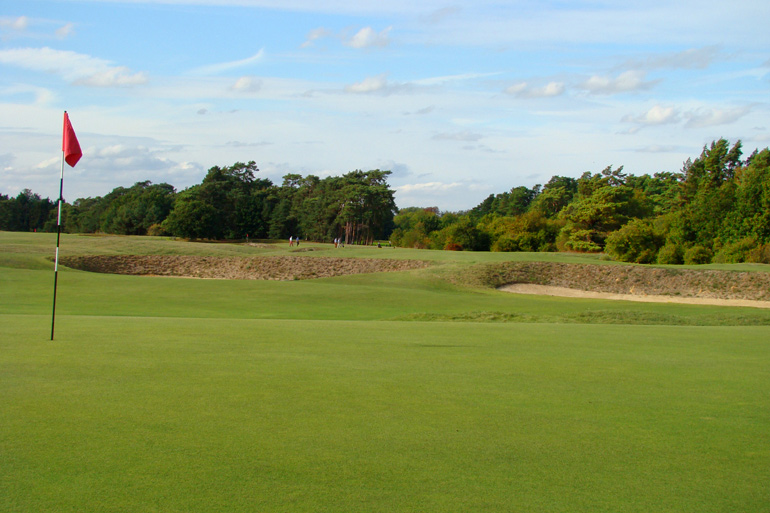
Played across the second green as well as a pair of cross bunkers, the third tee shot is both old world and charming.
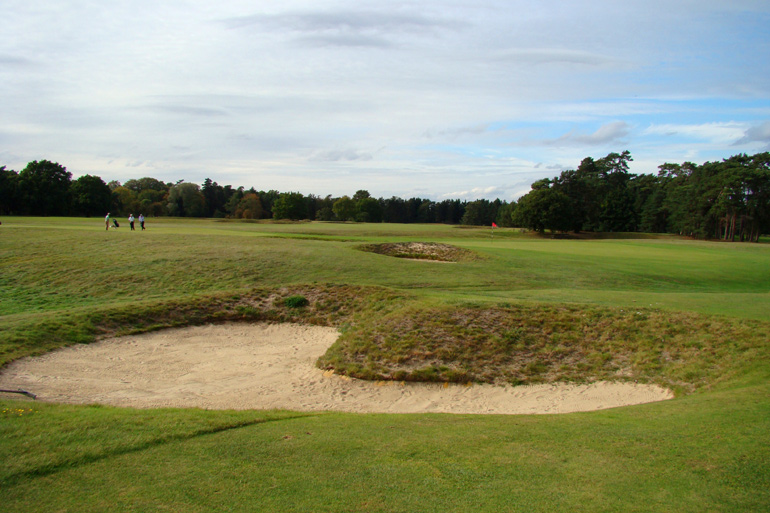
The approach to the third. The close proximity of the seventh green and the big sky are are two of many reasons that a golfer might find himself thinking of The Old Course at St. Andrews.
Fourth hole, 490 yards; Lengthened by 50 yards in 1920 with the acquisition of three acres where the tees are now found, the fourth and sixth share a broad expanse of fairway between the darkest of woods on the right and a thin row of trees on the left. The fairway should be an easy target to find from the tee but the woods to the right are intimidating and dense and encourage the player (at least subconsciously) to steer away to the left, toward, alas, a string of bunkers shared with the sixth. (Sound familiar? See St. Andrews (Old).) What really makes this hole, though, is the green complex. It starts with the slight rise in front and then races away from the player to the back right. When the hole is located toward the front of the green, the player struggles from forty or fifty yards to contrive some sort of a shot that stays within fifteen feet of the hole. Such befuddlement is not what the tiger expects to encounter on a sub 500 yard hole.
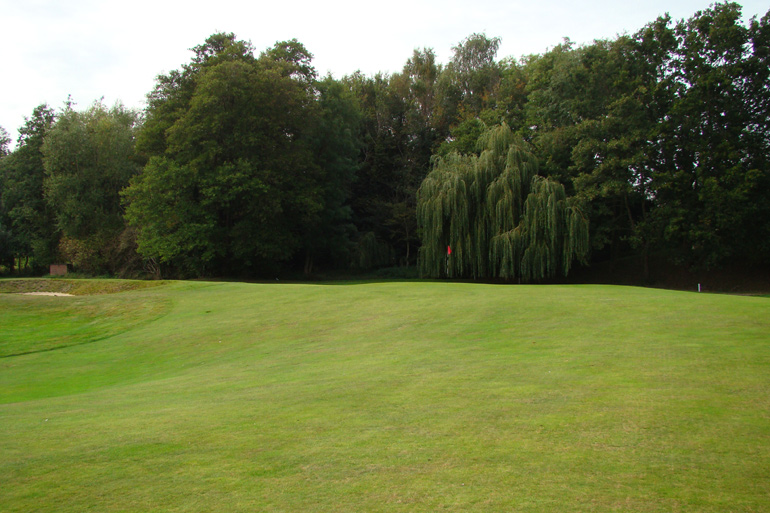
The architects have provided no design features to comfort the golfer on his approach shot to the fourth. All the golfer knows for sure is that ground runs away from him.
Fifth hole, 160 yards; Perhaps the greatest one shot hole outside the United States and certainly the most British of all holes: Take what shot you may, this unadorned hole invariably triumphs, standing proud century after century. From the tee shot which charmingly plays across the fourth green to the final putt, it commands every ounce of the player’s attention. Otherwise, even the very best players can look foolish as they wreck their card during a medal round (of which there are mercifully few at Royal Worlington). A former captain of the club once found the green with his tee shot, only to hole out in 8. The green is long and narrow with essentially three levels. Though 26 paces across, the left and right third of the green slope off to their sides, leaving a desperately narrow shelf on which a ball might stay.To the left is large hollow known as Mog’s Bog that once was a water hazard but is today just the start of many fives. To the right of the green is another rather steep slope leading to a stream that occasionally catches a ball. Level fours here during competition over the course of a year won’t harm your chances.
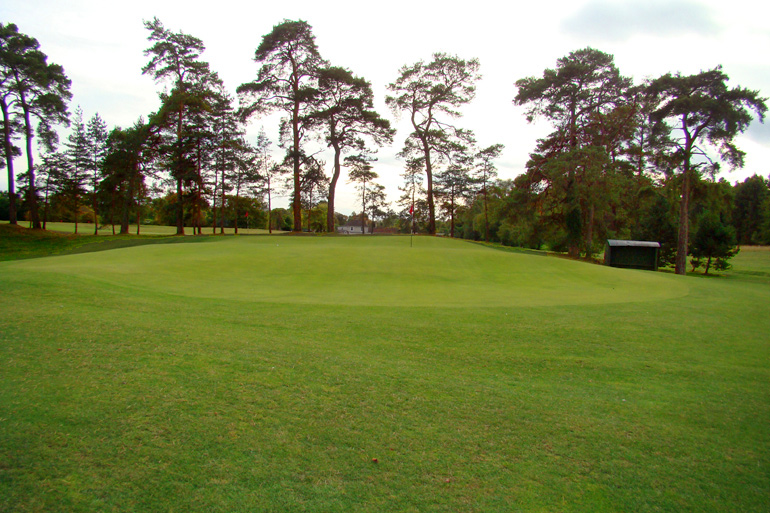
The all world fifth green may well be the most likely spot in golf to induce a golfer to pitch a wobbly!
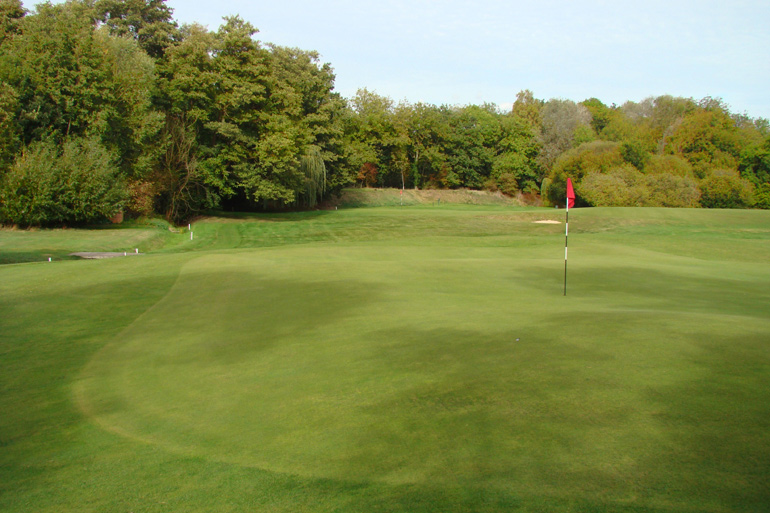
As seen from behind, the right third of the green does the golfer no favors.
Sixth hole, 460 yards; This tee shot is a fooler. From the tee, looking across the fifth green, the trees to the right are not as fearful as those to the right of the fourth. While a player senses them, he is more acutely aware of the large bunkers on the left between the two fairways, especially if he became ensnared in one while playing the fourth. He then favors the right side of the fairway, only to find that the green is partially hidden from that side, just ever so slightly tucked around the corner of the tree line. The player while not bunkered now must fade a long-iron or wood around the trees, whose branches seem to extend across the fairway. The bold tee shot that challenges the bunkers on the left leaves a straightforward, although long, second. The green is slightly raised, sloping off on all sides, ensuring that there are few fours earned with a chip and a putt.
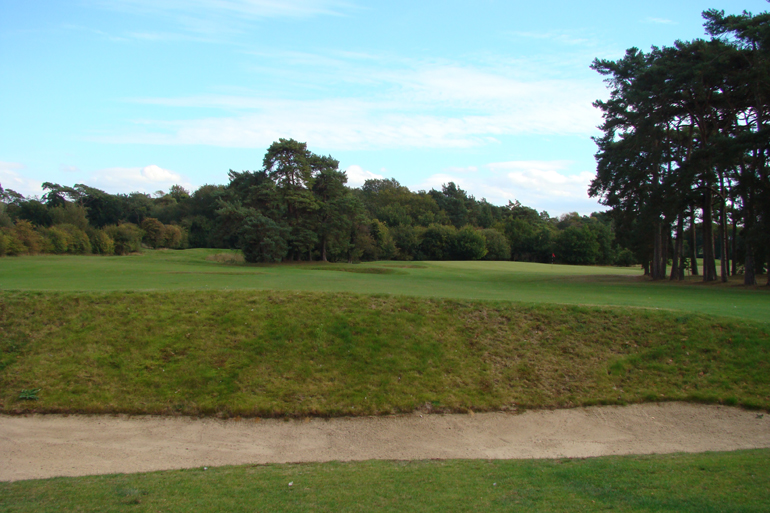
A Principal’s Nose central hazard in the foreground coupled with the trees by the green make the sixth another tough half par hole.
Seventh hole, 165 yards; Not as murderously conceived as the other two one shotters, the seventh remains a fine hole with much focus given to the area five yards short and five yards into the green. Just short is a slightly built up area upon which much hinges. Land on the slope facing the tee and the tee shot is deadened and front hole locations become accesssible. Land beyond and catch its downslope and the player is likely to wander to the eighth tee never quite sure how he managed another disheartening three putt bogey.
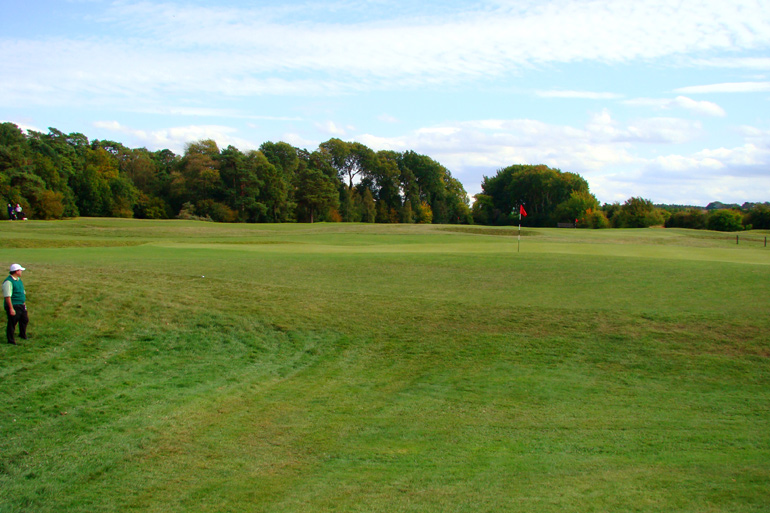
Part of the joy of Mildenhall is how one can – potentially, at least – recovery from its obstacles. As seen at the seventh, the trough before the green is such that people are willing to tempt being short. Alas, as the gentleman above will testify, a recovery close to the hole is far from certain.
Eighth hole, 460 yards; A brute of a hole. This is the most tightly bunkered tee shot, with pits on either side of the fairway at just the distance of a good drive. If the fairway is found, the second is a long one over cross bunkers some 80 yards short of the green. The flagstick is visible but not the putting green, which runs away from the player. A formidable bunker protects the left side, leaving the right the side to favor. Yet, for some inexplicable reason it is difficult to play all the way over to the right. Though lengthy, it is nonetheless a ‘feel’ hole as one has to sort out just how far short of the green to land his approach based on that day’s playing conditions. The fact that the area in which he must land his approach is blocked from view by the walls of the cross bunkers exacerbates the need for proper judgement.
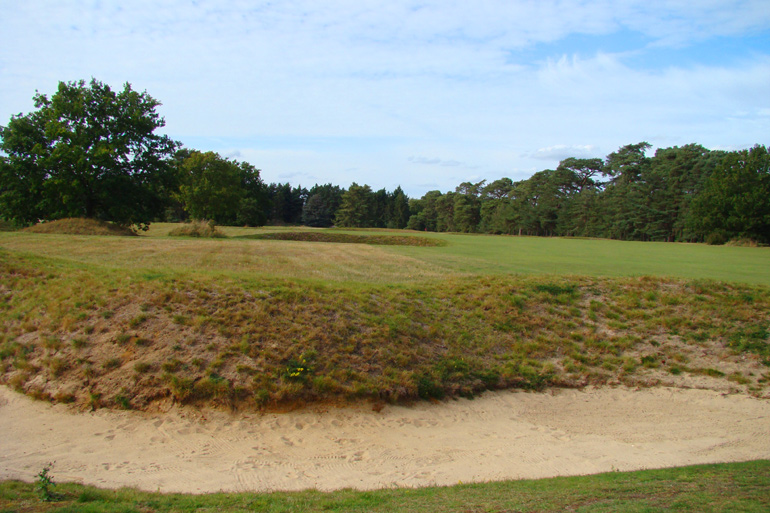
A nice, proper hazard, this fairway bunker precludes reaching the green which is 230 yards away.
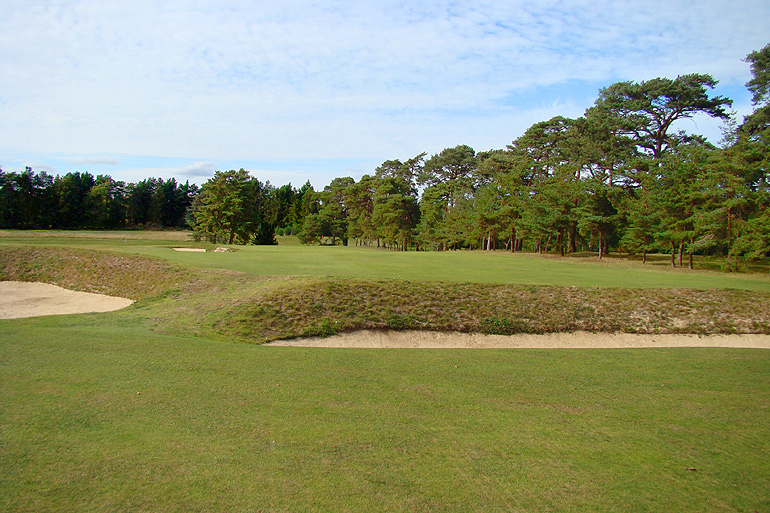
These cross bunkers create dead ground from back in the fairway.
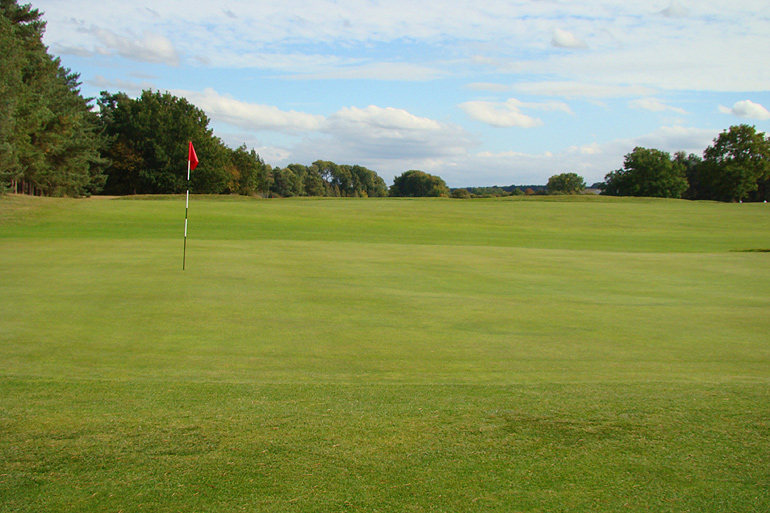
This view from behind the eighth green shows how the green is an extension of the fairway and that it too follows the natural tilt of the land.
Ninth hole, 290 yards; At first glance, some might think that the architects tried too hard to force another par four into the routing. How simple, they would think, it would have been to build a par three from behind the eighth green to a green just short of the public road. That way, they would argue, there would be no long hike back to the tee and players (as well as car drivers) would not have to worry about pitching across the road for the approach. Such a plan might be a practical approach, and in fact, that is what Tom Dunn did! However, Royal Worlington is also about frugality and squeezing whatever is possible out of the land. Harry Colt did just that when he consulted with the club in 1920. After all, the player has already played across three greens, so why not toss in a road in for good measure? The hole works wonderfully, thanks to Colt’s work. The tension created between the drive across the corner of the boundary and the pitch to a green featuring a pronounced left-to-right-slope is perfect. At times the club has entertained the idea of building one or two bunkers left of the fairway, but fortunately this has not occurred. As it is, the players naturally tend to miss the fairway to the left, away from the boundary on the right. This tendency is accentuated by the vacuum to the left. However, a player who does so soon appreciates his error, as the rough coupled with the green’s left to right pitch makes for a most testing pitch shot.
There you have it. Though the natural features of the property don’t make one wax on like the front at Royal County Down, the individual holes and the shots required are of the highest order. Much of that is due to the good fortune of being laid along a long, thin sandbelt in Suffolk and the resulting firmness underfoot leaves the golfer with many unique challenges. From its varied and undulating greens, several of which slope away, the golfer can’t help but think of The Old Course at St. Andrews. Similarly, time and the progression of equipment has in no way diminished the appeal of Royal Worlington & Newmarket. Truly a course for the ages.
In a dour mood, one wonders how modern golf design devolved into its frequent sad state of soft conditions through the green, hazards meaninglessly placed outside of the fairway, and greens propped up from back to front to comfort the golfer and collect the approach shot. Yuk! How did Tom Dunn get so much right in 1893 and current designers fail to understand the strategic values so well executed? Ah well, in a better mood, one shrugs off such concerns and heads for Mildenhall to enjoy the best that the game has to offer.



![Minchinhampton (Old) [2016]](https://golfclubatlas.com/wp-content/uploads/2018/09/Minchinhampton-500x383.jpg)
![St. Enodoc (Church) [2017]](https://golfclubatlas.com/wp-content/uploads/2017/11/St.-Enodoc-500x383.jpg)
![Sunningdale (Old) [2014]](https://golfclubatlas.com/wp-content/uploads/2017/11/Sunningdale-Old-Course-500x383.jpg)